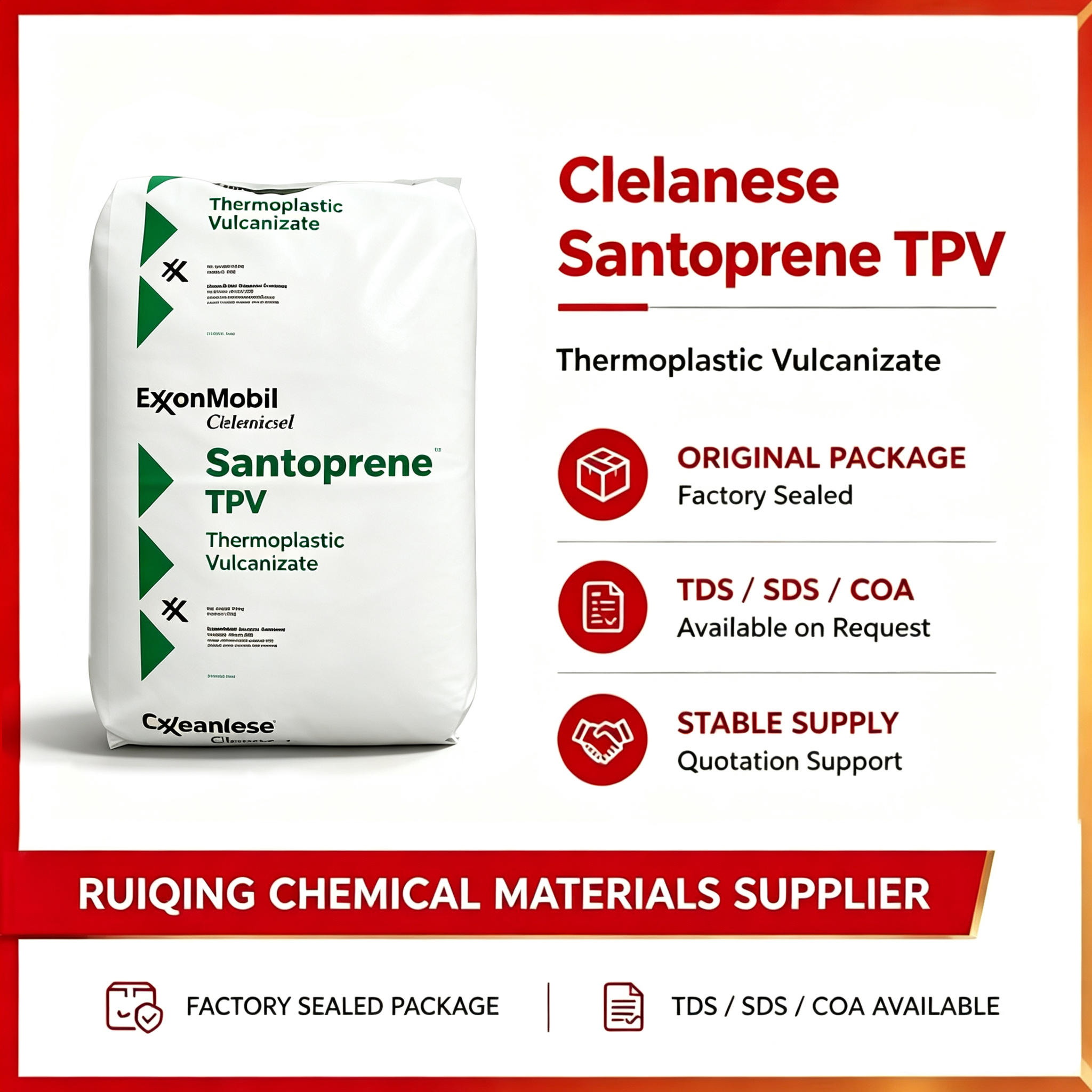
描述
Santoprene 8123-45S100 is a hard, black thermoplastic vulcanizate from Celanese specifically developed as a low-friction coextruded slip-coat layer for automotive weatherseal applications.
Unlike conventional Santoprene grades primarily selected for soft sealing or compression performance, Santoprene 8123-45S100 serves a specialized surface-function role.
Its main purpose is to provide a harder, smoother, more wear-resistant surface on flexible automotive sealing profiles.
Celanese currently identifies the grade as:
- 45 Shore D
- Black
- Low coefficient of friction
- Automotive exterior grade
- Slip-coat extrusion grade
- Good wear properties
This makes Santoprene 8123-45S100 particularly relevant for components where the surface of a weatherseal repeatedly slides against:
- Glass
- Painted metal
- Plastic trim
- Another sealing profile
- Moving automotive components
The low-friction surface helps reduce drag during movement while the wear-resistant formulation supports long-term sliding contact.
One of the most important applications is automotive weatherseal coextrusion, where Santoprene 8123-45S100 forms a thin functional surface layer over another flexible TPV or compatible olefinic elastomer.
This provides an integrated thermoplastic alternative to some post-applied spray-on slip-coating systems.
For more TPV products, visit our TPV Thermoplastic Vulcanizates Product Category →.
For current Santoprene portfolio information, see the Official Celanese Santoprene & Geolast Product Finder →.
Key Features of Santoprene 8123-45S100
| Feature | Engineering Benefit |
|---|---|
| 45 Shore D Hardness | Provides a hard surface layer while remaining part of the TPV system |
| Low Coefficient of Friction | Reduces sliding resistance against glass and adjacent components |
| Black Formulation | Suitable for conventional automotive weatherseal appearance |
| Slip-Coat Function | Provides a functional low-friction surface on sealing profiles |
| Excellent Wear Resistance | Helps maintain surface function during repeated sliding |
| Excellent Weather Resistance | Supports automotive exterior exposure |
| Smooth Surface | Improves sliding behavior and finished profile appearance |
| Coextrusion Capability | Allows the slip layer to be integrated directly into the weatherseal profile |
| Olefin-Compatible | Suitable for coextrusion with compatible olefinic thermoplastic elastomers |
| Shear-Dependent Flow | Supports thermoplastic extrusion through thin functional-layer tooling |
| Thermoplastic Processing | Eliminates a separate rubber-curing step for the coating layer |
| Manufacturing-Stream Recyclability | Compatible clean production scrap can be managed within appropriate production streams |
Typical Applications for Santoprene 8123-45S100
Santoprene 8123-45S100 is mainly intended for automotive sealing systems where sliding friction must be controlled.
| Application Area | Typical Use |
|---|---|
| Automotive Weatherseals | Low-friction surface layer |
| Glass-Run Channels | Sliding surface against moving automotive glass |
| Window Seals | Low-friction sealing contact |
| Door Weatherseals | Wear-resistant functional surface |
| Beltline Seals | Sliding-contact layer |
| Glass Guidance Profiles | Smooth interface around moving glass |
| Coextruded Sealing Profiles | Hard functional surface over flexible TPV |
| Automotive Exterior Profiles | Wear-resistant black surface |
| Sliding Seals | Components requiring reduced drag |
| Dynamic Sealing Interfaces | Repeated sliding or rubbing surfaces |
Celanese’s current Product Finder specifically places Santoprene 8123-45S100 in Automotive Exterior and identifies it as a slip-coat extrusion grade with low CoF and good wear properties.
Typical Properties of Santoprene 8123-45S100
Physical Properties
| Property | Typical Value |
|---|---|
| Material Type | TPV / TPE-V |
| Hardness | 45 Shore D |
| Appearance | Black |
| Polymer Base | Polyolefin-Based TPV |
| Product Form | Pellets |
| Special Function | Low-Friction Slip-Coat |
| Primary Market | Automotive Exterior |
The current Celanese Product Finder confirms 45 Shore D hardness and Black appearance.
Mechanical Property Positioning
Celanese does not publish conventional tensile strength, elongation and compression-set values for Santoprene 8123-45S100 in its current Product Finder.
That is not unusual for this grade because its primary function is not conventional elastomeric sealing.
Its key performance targets are instead:
- Surface hardness
- Low friction
- Wear resistance
- Surface smoothness
- Weather resistance
- Coextrusion behavior
For this reason, the webpage should not borrow tensile or elongation values from another Santoprene grade.
45 Shore D Hard Surface
The hardness of Santoprene 8123-45S100 is 45 Shore D.
This is important because most conventional Santoprene sealing grades are measured on the softer Shore A scale.
The higher Shore D hardness allows the material to create a relatively hard functional surface while retaining compatibility with a thermoplastic elastomer weatherseal system.
This is useful where the profile surface needs to resist:
- Sliding wear
- Repeated glass movement
- Surface abrasion
- Contact pressure
- Frictional drag
For SEO purposes, 45 Shore D TPV is therefore a much better description than generic phrases such as “hard rubber.”
Low Coefficient of Friction
The defining characteristic of Santoprene 8123-45S100 is its low coefficient of friction.
Celanese specifically lists low CoF as a requirement fulfilled by this grade.
Low friction is important in automotive sealing systems where glass or another moving component repeatedly contacts the seal.
A lower-friction surface can help:
- Reduce glass movement resistance
- Reduce stick-slip behavior
- Improve window movement
- Reduce surface drag
- Reduce wear
- Improve operating feel
This makes Santoprene 8123-45S100 especially relevant for glass-run and weatherseal systems.
Automotive Weatherseal Slip-Coat
Santoprene 8123-45S100 is specifically designed as a coextruded slip-coat layer.
In a typical profile, the weatherseal may include:
- A soft sealing body
- Structural portions
- Flexible lips
- A harder low-friction surface
Santoprene 8123-45S100 can be applied as the functional low-friction layer during profile extrusion.
This creates an integrated slip surface rather than applying a coating as a separate downstream manufacturing step.
Potential manufacturing benefits include:
- Integrated extrusion
- Reduced secondary coating operations
- Consistent layer placement
- Continuous profile production
- Better process integration
- Simplified handling
Alternative to Spray-On Slip-Coat Systems
One important technical positioning for Santoprene 8123-45S100 is its use as an alternative to some conventional spray-on slip-coat systems.
A coextruded slip layer can eliminate or reduce the need for:
- Post-extrusion spraying
- Additional coating equipment
- Coating drying
- Solvent handling
- Separate surface-treatment operations
Instead, the low-friction layer becomes part of the profile during the extrusion process.
For high-volume automotive weatherseal production, this can simplify the production route.
Wear Resistance
Celanese identifies good wear properties as one of the defining characteristics of Santoprene 8123-45S100.
Wear resistance is especially important for:
- Moving glass
- Window channels
- Sliding door interfaces
- Dynamic seals
- Repeated rubbing surfaces
A slip-coat layer must retain its surface function over repeated cycles.
If the surface wears too quickly, friction can increase and the weatherseal may no longer provide the intended sliding performance.
Weather Resistance
Automotive exterior weatherseals are routinely exposed to:
- Sunlight
- Heat
- Cold
- Moisture
- Rain
- Atmospheric ozone
- Repeated temperature cycling
Santoprene 8123-45S100 is designed for applications requiring excellent weather resistance.
This supports use in exterior sealing profiles where the slip layer must continue functioning after environmental exposure.
Surface Smoothness
Another important feature is excellent surface smoothness.
A smooth surface can help reduce mechanical interaction between:
- Glass and seal
- Plastic trim and seal
- Painted metal and seal
- Adjacent flexible components
Surface smoothness can also improve the visual consistency of the finished weatherseal.
For automotive applications, both functional friction and appearance may be important.
Coextrusion with Olefinic TPE Materials
Santoprene 8123-45S100 is designed for coextrusion with compatible olefin thermoplastic rubber / TPV systems.
A typical coextruded profile may combine:
Soft TPV sealing body + Santoprene 8123-45S100 low-friction surface layer
This allows the profile to combine different properties in one continuous component.
The soft material provides:
- Sealing
- Flexibility
- Compression
while Santoprene 8123-45S100 provides:
- Harder surface
- Reduced friction
- Wear resistance
- Smooth sliding behavior
Actual coextrusion compatibility should be validated using the exact substrate grade and extrusion line.
Why Choose Santoprene 8123-45S100?
The main reason to select Santoprene 8123-45S100 is its highly specialized low-friction surface functionality.
It provides:
- 45 Shore D hardness
- Black appearance
- Low coefficient of friction
- Good wear resistance
- Excellent weather resistance
- Smooth surface
- Flexible slip-coat behavior
- Coextrusion capability
- Automotive exterior positioning
- Thermoplastic processing
- Compatibility with selected olefinic TPE systems
For manufacturers producing automotive glass-run channels, window seals, beltline seals or weatherseal profiles, Santoprene 8123-45S100 is particularly relevant where an integrated low-friction surface is required.
Processing Guidelines for Santoprene 8123-45S100
The main processing route for Santoprene 8123-45S100 is:
Extrusion / Coextrusion
Because the material is intended as a thin functional slip-coat layer, profile extrusion conditions should be optimized around:
- Stable layer thickness
- Surface smoothness
- Coextrusion balance
- Melt pressure
- Die design
- Adhesion to the underlying TPV
- Line speed
Drying
Santoprene TPV is generally low in moisture sensitivity.
For Santoprene 8123-45S100, optional conditioning can be used when material has been exposed to unfavorable storage conditions.
A commonly published grade-specific condition is approximately:
65°C for 4 hours using desiccant drying, if desired.
Routine drying may not always be necessary when pellets have been correctly stored.
General Processing Temperature
A broad Santoprene TPV processing window is approximately:
175–230°C
Actual extrusion temperatures should be optimized according to:
- Extruder diameter
- Screw design
- Coextrusion ratio
- Slip-layer thickness
- Die geometry
- Profile speed
- Substrate TPV
- Surface-quality requirements
Coextrusion Processing
For coextrusion, the processor should control:
- Individual extruder output
- Melt temperatures
- Melt-pressure balance
- Layer thickness
- Die temperature
- Residence time
- Flow distribution
- Line speed
- Cooling
Because the slip layer may be relatively thin, small changes in output can significantly change final coating thickness.
Shear-Dependent Flow
Santoprene 8123-45S100 is shear dependent.
Its apparent viscosity decreases as shear increases.
This behavior can help process the material through:
- Thin flow channels
- Narrow coextrusion passages
- Fine slip-layer dies
- High-speed profile tooling
It also means that shear, die design and screw speed can strongly influence extrusion behavior.
Layer Thickness Control
For slip-coat applications, uniform layer thickness is essential.
Too little material may reduce:
- Wear resistance
- Low-friction performance
- Surface continuity
Too much material may:
- Increase material cost
- Affect profile flexibility
- Alter geometry
- Change surface appearance
The optimum thickness therefore depends on the weatherseal design and automotive validation requirements.
Die Design
The coextrusion die should provide:
- Stable melt distribution
- Uniform slip-layer coverage
- Limited stagnation
- Smooth joining of material streams
- Controlled pressure
A balanced die can help maintain consistent low-friction performance over long profile lengths.
Material Compatibility
Santoprene 8123-45S100 is designed to be coextruded with compatible olefinic thermoplastic elastomers.
When changing materials, proper purging is important.
Santoprene TPV processing generally requires special care around incompatible polymer contamination such as:
- POM / Acetal
- PVC
Thorough purging helps avoid processing instability.
Automotive Exterior Applications
Celanese currently identifies Automotive Exterior as the principal market for Santoprene 8123-45S100.
Typical areas include:
- Door sealing systems
- Window systems
- Glass-run channels
- Beltline seals
- Sliding seals
- Exterior weatherstrips
For automotive production, the final material should also be evaluated against the customer’s specific:
- OEM requirements
- Wear test
- Friction test
- UV aging test
- Weathering test
- Temperature cycling
- Glass interaction test
Related Products
We supply Santoprene TPV grades for different automotive weatherseal, extrusion, friction and surface requirements.
Typical product families include:
- Santoprene slip-coat grades
- Santoprene low-COF TPV grades
- Santoprene automotive exterior grades
- Santoprene weatherseal grades
- Santoprene profile extrusion grades
- Santoprene coextrusion grades
- Santoprene wear-resistant TPV grades
- Santoprene specialty surface grades
View More TPV Thermoplastic Vulcanizates →
Technical Documents for Santoprene 8123-45S100
| Document Type | Description |
|---|---|
| TDS | Physical and processing data |
| SDS | Safety Data Sheet |
| Coextrusion Guide | Slip-coat and profile extrusion guidance |
| Automotive Application Information | Weatherseal and low-friction application information |
| Processing Guide | Extrusion temperature and tooling recommendations |
| OEM Documentation | Application-specific documentation where applicable |
| COA | Batch-specific quality information where available |
Need technical documents for Santoprene 8123-45S100?
📧 Email: ruiqingchem@gmail.com
📝 Online form: Contact Us →
Please state Santoprene 8123-45S100 and specify whether you require TDS, SDS, coextrusion guidance or automotive application documentation.
FAQ About Santoprene 8123-45S100
Q1: What is Santoprene 8123-45S100?
Santoprene 8123-45S100 is a hard black TPV from Celanese specifically designed as a low-friction coextruded slip-coat layer for automotive weatherseal applications.
Q2: What is the hardness of Santoprene 8123-45S100?
The current Celanese Product Finder lists 45 Shore D.
Q3: Is Santoprene 8123-45S100 Shore A or Shore D?
It is Shore D, not Shore A.
Q4: What color is Santoprene 8123-45S100?
The standard grade is Black.
Q5: Is Santoprene 8123-45S100 a low-friction grade?
Yes. Celanese specifically identifies Low Coefficient of Friction as one of its defining properties.
Q6: What is Santoprene 8123-45S100 mainly used for?
Its main application is a slip-coat layer on automotive weatherseal profiles.
Q7: Can Santoprene 8123-45S100 be used on glass-run channels?
Yes. Low-friction weatherseal surfaces around moving automotive glass are one of the most relevant applications for this grade.
Q8: Is Santoprene 8123-45S100 an extrusion grade?
Yes. Celanese identifies it as a Slip-Coat Extrusion Grade.
Q9: Can Santoprene 8123-45S100 be coextruded?
Yes. Coextrusion is one of the grade’s main design purposes.
Q10: What materials can it be coextruded with?
It is designed for coextrusion with compatible olefinic thermoplastic rubber and TPV systems.
Q11: Does Santoprene 8123-45S100 have good wear resistance?
Yes. Celanese specifically lists good wear properties.
Q12: Does it have good weather resistance?
Yes. Weather resistance is an important requirement for this automotive exterior slip-coat material.
Q13: Can Santoprene 8123-45S100 replace spray-on slip coatings?
It was specifically developed as an integrated coextruded slip-coat solution and can be evaluated as an alternative to certain post-applied slip-coat systems.
Q14: Does Santoprene 8123-45S100 require drying?
Routine drying is generally limited, although optional desiccant drying may be used if needed because of storage or handling conditions.
Q15: What processing temperature can be used?
Santoprene TPV has a broad processing window around 175–230°C; final coextrusion settings should be optimized for the exact substrate, die and line conditions.
Q16: Is Santoprene 8123-45S100 suitable for automotive exterior applications?
Yes. Celanese’s current Product Finder specifically places the grade in Automotive Exterior.
Request Santoprene 8123-45S100 Price & Technical Support
For pricing, availability, technical documents or application support for Santoprene 8123-45S100, please provide:
- Required quantity
- Destination country or port
- Automotive weatherseal application
- Glass-run / window / beltline / door-seal application
- Substrate TPV grade
- Required slip-layer thickness
- Target coefficient of friction
- Wear-resistance requirement
- Weathering requirement
- Coextrusion line conditions
- Profile dimensions
- OEM specification, if applicable
- TDS / SDS requirement
- COA requirement
- Sample requirement, if applicable
📧 Email: ruiqingchem@gmail.com