
描述
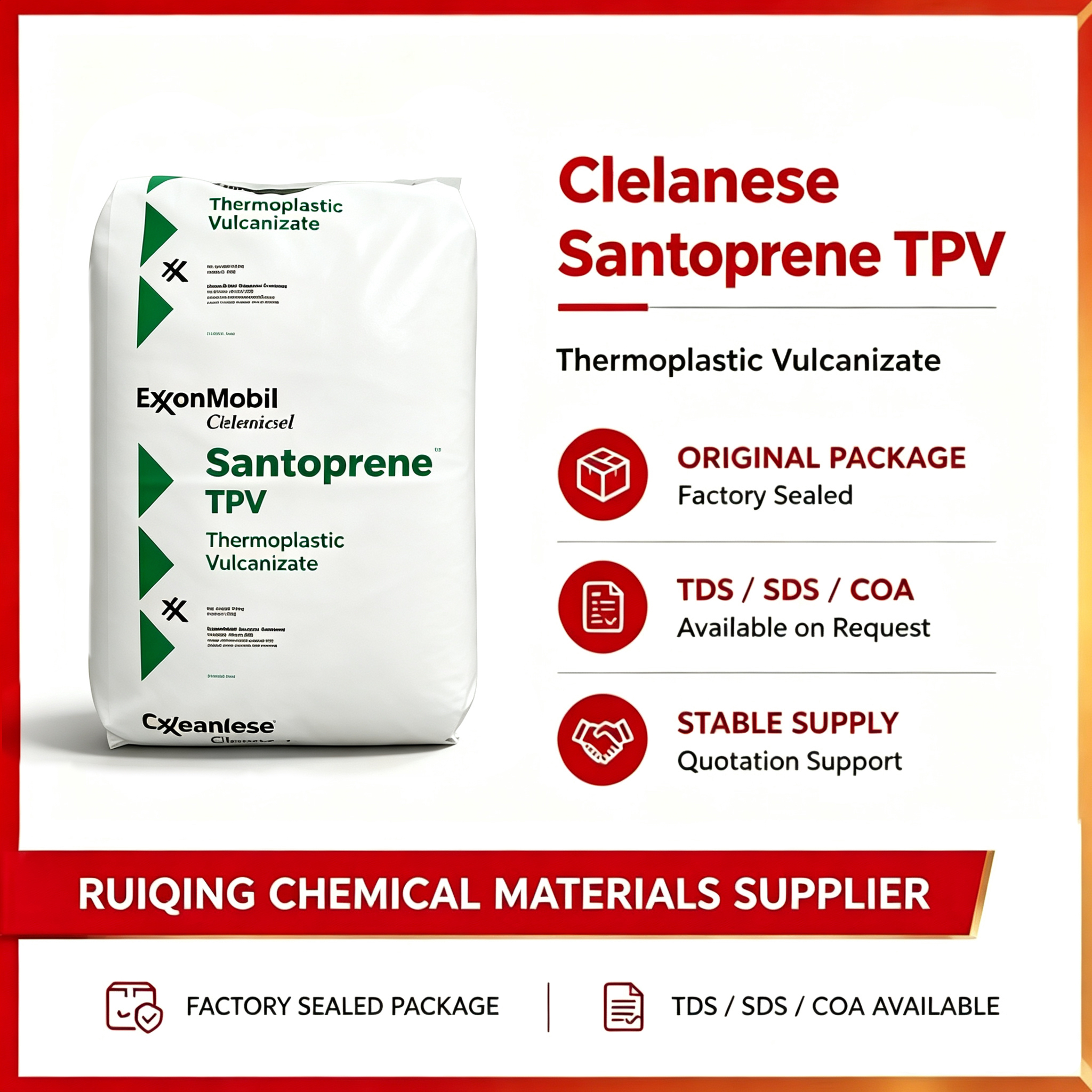
Santoprene 6SD002A87 NAT is a natural thermoplastic vulcanizate from Celanese designed for flexible and semi-rigid elastomeric components manufactured using conventional thermoplastic processing equipment.
The grade belongs to the TPV / TPE-V material family.
Santoprene TPV combines a dynamically vulcanized elastomeric phase with a thermoplastic matrix. This structure allows the finished material to provide many rubber-like characteristics while still being processed using conventional thermoplastic manufacturing methods.
For product designers and molders, this can provide several practical advantages:
- Rubber-like flexibility
- Thermoplastic injection molding
- Complex molded geometry
- Shorter processing cycles than many thermoset elastomers
- No secondary vulcanization step during normal molding
- Natural coloration
- Custom color capability
- Controlled reuse of clean manufacturing scrap
The NAT designation identifies Santoprene 6SD002A87 NAT as a natural-colored material rather than a standard black formulation.
This can be especially useful for parts requiring:
- White
- Gray
- Beige
- Custom colors
- Color coding
- Appearance matching
Santoprene TPV is widely used across sealing, automotive, consumer, building and industrial applications where manufacturers require both elastomeric behavior and thermoplastic processing. Celanese positions Santoprene broadly around sealing performance, durability, chemical resistance, design flexibility and manufacturing efficiency.
For more TPV products, visit our TPV Thermoplastic Vulcanizates Product Category →.
For the current Santoprene portfolio, see the Official Celanese Santoprene & Geolast Product Finder →.
Key Features of Santoprene 6SD002A87 NAT
| Feature | Engineering Benefit |
|---|---|
| Natural Appearance | Suitable for custom-color molded components |
| TPV / TPE-V Material | Combines thermoplastic processing with elastomeric performance |
| Injection Molding Grade | Suitable for efficient production of complex molded parts |
| Firm Elastomeric Response | Relevant where greater shape support is needed than very soft TPV grades |
| Rubber-Like Flexibility | Supports flexible and deformable technical components |
| Thermoplastic Processing | Can be processed on conventional thermoplastic machinery |
| Complex Geometry Capability | Suitable for detailed molded parts |
| Colorable Base | Supports white, gray and custom-colored finished components |
| Sealing Applications | Relevant to flexible seals and gaskets |
| Technical Components | Suitable for molded functional elastomer parts |
| Production Efficiency | No separate curing operation during normal injection molding |
| Manufacturing Scrap Recovery | Clean process scrap may be reusable under controlled conditions |
Typical Applications for Santoprene 6SD002A87 NAT
Santoprene 6SD002A87 NAT can be considered for injection-molded applications requiring a natural, flexible TPV.
| Application Area | Typical Use |
|---|---|
| Seals | Flexible molded sealing components |
| Gaskets | Elastomeric compression interfaces |
| Grommets | Protection around cables, tubes and openings |
| Flexible Housings | Protective and functional molded parts |
| Automotive Components | Flexible technical molded components |
| Building Components | Sealing and protective parts |
| Consumer Products | Flexible functional or decorative parts |
| Industrial Components | General-purpose elastomeric molded parts |
| Protective Bumpers | Contact and impact surfaces |
| Flexible Interfaces | Interfaces between rigid components |
| Colored Technical Parts | Custom-colored elastomeric parts |
| Injection-Molded TPV Components | Detailed flexible geometries |
The exact suitability for any application should be based on the customer’s required mechanical properties, temperature range, chemical exposure and part geometry.
Natural / Colorable TPV
One of the most commercially useful features of Santoprene 6SD002A87 NAT is its Natural base color.
Natural TPV can be useful when the finished part needs to be:
- White
- Light gray
- Beige
- Blue
- Red
- Green
- Color matched to another component
- Color coded by function
This is particularly useful in consumer, automotive, industrial and building applications where black is not acceptable.
For best results, use a color concentrate compatible with TPV.
The final formulation should be evaluated for:
- Color dispersion
- Surface quality
- Flow
- Mechanical properties
- Shrinkage
- Thermal stability
TPV Material Structure
Santoprene 6SD002A87 NAT belongs to the thermoplastic vulcanizate family.
TPV materials differ from ordinary thermoplastic elastomers because the elastomeric phase is dynamically vulcanized during manufacture.
The finished compound combines:
Vulcanized elastomeric domains + thermoplastic continuous phase
This structure gives Santoprene materials characteristics associated with both rubber and thermoplastics.
Potential benefits include:
- Elastic response
- Flexibility
- Recovery after deformation
- Chemical resistance
- Heat resistance
- Thermoplastic melt processability
This balance is one reason Santoprene TPV is widely used for seals, flexible housings and molded engineering components.
Injection Molding Applications
The main processing direction for Santoprene 6SD002A87 NAT should be presented as Injection Molding.
Injection molding is particularly useful for parts requiring:
- Complex geometry
- High production volumes
- Consistent dimensions
- Integrated sealing features
- Thin local sections
- Ribs
- Flexible lips
- Snap-over features
- Molded textures
Potential molded components include:
- Sealing rings
- Gaskets
- Grommets
- Protective covers
- Flexible clips
- Technical housings
- Bumpers
- Functional elastomer components
Seals & Gaskets
Santoprene 6SD002A87 NAT can be considered for molded sealing components where a relatively firm elastomeric response is required.
Common sealing designs include:
- Housing seals
- Connector seals
- Compression gaskets
- Mechanical interfaces
- Protective seals
- Flexible contact surfaces
When choosing a TPV for a seal, engineers should consider:
- Required hardness
- Compression set
- Operating temperature
- Compression ratio
- Chemical exposure
- Seal geometry
- Long-term loading
Because the latest public grade-specific compression-set data for this particular grade could not be independently confirmed, the value should be taken from the current Celanese TDS before final engineering selection.
Grommets & Protective Components
Natural TPV materials can also be useful for grommets and protective interfaces.
These components may need to:
- Flex during installation
- Protect cables
- Protect tubes
- Absorb vibration
- Prevent hard-to-hard contact
- Provide environmental sealing
Thermoplastic injection molding also allows integrated features such as:
- Ribs
- Retaining lips
- Snap-fit geometries
- Mounting features
- Thin flexible sections
Automotive Applications
Santoprene TPV is widely used in automotive engineering for seals, flexible components and protective parts.
Santoprene 6SD002A87 NAT can therefore be evaluated for selected applications such as:
- Molded seals
- Grommets
- Flexible interfaces
- Protective parts
- Interior functional parts
- Technical elastomer components
A specific OEM specification should only be claimed when confirmed by current grade-specific documentation.
Building & Construction Applications
Santoprene TPV also has broad use in building-material applications.
Potential applications for a natural molded TPV include:
- Flexible construction components
- Colored seals
- Molded gaskets
- Protective interfaces
- Building accessories
- Housing seals
The ability to use a custom color can be valuable where visible components must coordinate with surrounding materials.
Consumer Product Applications
The combination of flexibility, colorability and injection molding makes Santoprene 6SD002A87 NAT relevant to consumer-product applications.
Possible components include:
- Flexible housings
- Soft functional surfaces
- Protective bumpers
- Appliance parts
- Hand-contact components
- Colored technical parts
- Flexible interfaces
Mold texture can also be used to produce different surface appearances without secondary coating.
Why Choose Santoprene 6SD002A87 NAT?
Santoprene 6SD002A87 NAT is particularly useful when the application requires a natural, injection-moldable TPV rather than a standard black elastomer.
Its main advantages include:
- Natural / colorable formulation
- Thermoplastic vulcanizate construction
- Rubber-like behavior
- Injection-molding capability
- Complex part design
- Efficient high-volume processing
- Flexible sealing applications
- Technical molded-component capability
- Potential manufacturing scrap recovery
For manufacturers producing natural or colored seals, gaskets, grommets, flexible housings or technical elastomeric parts, Santoprene 6SD002A87 NAT is a relevant material to evaluate.
Processing Guidelines for Santoprene 6SD002A87 NAT
The primary conversion method for the grade is Injection Molding.
Because complete current grade-specific temperature settings were not available in the publicly accessible material information reviewed, the webpage should avoid presenting a neighboring grade’s processing temperatures as though they belonged to 6SD002A87 NAT.
For initial processing development, the current Celanese TDS should be requested and used as the primary reference.
Pre-Drying
Santoprene TPV processing commonly uses controlled drying when required.
Important variables include:
| Processing Parameter | Control Point |
|---|---|
| Drying | Follow current grade-specific Celanese recommendation |
| Dryer Type | Dehumidified/desiccant drying preferred when specified |
| Moisture | Maintain within the current TDS limit |
| Storage | Keep material sealed and dry before processing |
Injection Molding Optimization
Important process variables include:
- Melt temperature
- Mold temperature
- Injection speed
- Injection pressure
- Holding pressure
- Screw speed
- Back pressure
- Gate dimensions
- Runner geometry
- Venting
- Cooling time
These parameters should be optimized together rather than independently.
Shear-Dependent TPV Flow
Santoprene TPV typically exhibits shear-thinning behavior.
As shear rate increases, apparent melt viscosity decreases.
This means flow can often be improved through:
- Appropriate screw speed
- Correct gate dimensions
- Higher injection speed
- Efficient runner design
rather than simply increasing melt temperature.
This can be especially useful when filling:
- Thin sections
- Small ribs
- Flexible lips
- Narrow flow paths
- Detailed part geometries
Gate Design
Gate design has a significant effect on TPV filling.
A suitable gate can provide:
- Sufficient shear
- Stable filling
- Consistent pressure
- Good surface quality
The ideal gate size depends on:
- Part thickness
- Flow length
- Material hardness
- Mold layout
- Injection-machine capability
Mold Venting
Proper venting is particularly important for flexible thermoplastic materials.
Poor venting may contribute to:
- Burn marks
- Short shots
- Poor surface appearance
- Excessive injection pressure
Vents should be positioned near the end of flow paths and other potential air traps.
Part Ejection
Flexible materials can behave differently from rigid thermoplastics during ejection.
The mold should provide:
- Adequate draft
- Suitable ejector area
- Smooth cavity surfaces
- Controlled cooling
This reduces the risk of:
- Part deformation
- Ejector marks
- Stretching
- Tearing during removal
Coloring Santoprene 6SD002A87 NAT
Because this grade is Natural, color masterbatch can be introduced according to the required appearance.
Important considerations include:
- Carrier compatibility
- Pigment concentration
- Dispersion
- UV requirements
- Heat stability
- Surface appearance
For applications requiring long-term outdoor exposure, pigments and additives should also be selected for the relevant UV and weathering environment.
Material Compatibility
Proper purging should be used when changing materials.
Santoprene processing guidance commonly requires particular care when transitioning from incompatible polymer systems.
Equipment cleanliness is important to prevent:
- Contamination
- Surface defects
- Unstable processing
- Color contamination
This is especially important when processing a Natural grade, because dark contamination is much more visible than in black TPV.
Storage
Santoprene 6SD002A87 NAT should be stored:
- Indoors
- In original packaging
- In dry conditions
- Away from excessive heat
- Away from direct sunlight
- With opened bags protected from contamination
Natural material should also be protected from dust and dark-colored contamination because these can become visible in the molded component.
Legacy Forprene Grade Name
Older material databases and technical references may identify a corresponding grade as:
Forprene 6SD002A87 NEUTRO
while newer databases index:
Santoprene 6SD002A87 NAT.
Including the legacy name once on the webpage can be useful for customers searching old:
- Drawings
- Material lists
- BOMs
- Mold specifications
- TDS references
A good SEO sentence is:
Santoprene 6SD002A87 NAT, formerly referenced in some material databases as Forprene 6SD002A87 NEUTRO, is a natural TPV grade supplied within the Celanese elastomer portfolio.
Related Products
We supply Santoprene TPV grades for different hardness, color, molding and application requirements.
Typical product families include:
- Santoprene 6SD Series
- Santoprene Natural TPV
- Santoprene colorable TPV
- Santoprene injection-molding grades
- Santoprene sealing grades
- Santoprene gasket materials
- Santoprene automotive TPV
- Santoprene construction TPV
- Santoprene consumer-product TPV
View More TPV Thermoplastic Vulcanizates →
Technical Documents for Santoprene 6SD002A87 NAT
| Document Type | Description |
|---|---|
| TDS | Current grade-specific physical, mechanical and processing data |
| SDS | Safety Data Sheet |
| Injection Molding Guide | Processing and mold-design recommendations |
| Coloring Information | Guidance for Natural TPV pigmentation |
| Regulatory Information | Application-specific regulatory documentation |
| Santoprene Product Information | Celanese TPV technical information |
| COA | Batch-specific quality documentation where available |
Need technical documents for Santoprene 6SD002A87 NAT?
📧 Email: ruiqingchem@gmail.com
📝 Online form: Contact Us →
Please state Santoprene 6SD002A87 NAT and specify whether you require TDS, SDS, processing information or COA.
FAQ About Santoprene 6SD002A87 NAT
Q1: What is Santoprene 6SD002A87 NAT?
Santoprene 6SD002A87 NAT is a natural thermoplastic vulcanizate from Celanese intended for flexible molded technical components.
Q2: What does NAT mean?
NAT indicates Natural coloration rather than a standard black formulation.
Q3: Is Santoprene 6SD002A87 NAT a TPV?
Yes. It is indexed as a thermoplastic rubber / dynamically vulcanized TPV grade.
Q4: Is Santoprene 6SD002A87 NAT still listed under Celanese?
Yes. Current material databases index SANTOPRENE 6SD002A87 NAT under Celanese Corporation.
Q5: Is A87 definitely 87 Shore A?
The grade designation contains A87, but I would not write 87 Shore A as the current measured value until the current grade-specific Celanese TDS confirms it.
Q6: Can Santoprene 6SD002A87 NAT be colored?
Yes. Its Natural appearance makes it suitable for custom coloring with a compatible color concentrate.
Q7: Can Santoprene 6SD002A87 NAT be injection molded?
Yes. The 6SD series is used for thermoplastic molding applications, and this grade is indexed as a Santoprene TPV compound.
Q8: Can it be used for seals?
It can be evaluated for molded sealing components where the current grade-specific mechanical and compression-set properties meet the application requirements.
Q9: Can Santoprene 6SD002A87 NAT be used for gaskets?
Yes, gasket and flexible-interface applications are appropriate candidates for evaluation.
Q10: What is the density?
I recommend using the density from the current grade-specific Celanese TDS rather than copying the value from 6SD001A65 NAT, 6SD001A30 NAT or legacy neighboring grades.
Q11: What is the tensile strength?
The exact current grade-specific tensile value should be taken from the latest Celanese TDS.
Q12: What is the elongation at break?
The current grade-specific TDS should be used for the exact elongation figure; it should not be inferred from the grade name.
Q13: Is it the same as Forprene 6SD002A87 NEUTRO?
Current databases list Santoprene 6SD002A87 NAT, while legacy Celanese/Forprene databases also contain Forprene 6SD002A87 NEUTRO, making the older name useful as a cross-reference.
Q14: Does it need drying?
Follow the current Celanese grade-specific TDS for drying temperature, drying time and moisture limits.
Q15: What injection temperature should be used?
Use the current 6SD002A87 NAT processing sheet. Do not automatically use the injection temperatures published for 6SD001A30 NAT or another 6SD grade.
Q16: What applications are suitable?
Potential applications include seals, gaskets, grommets, flexible housings, protective components, consumer parts and other injection-molded TPV components.
Request Santoprene 6SD002A87 NAT Price & Technical Support
For pricing, availability, technical documents or application support for Santoprene 6SD002A87 NAT, please provide:
- Required quantity
- Destination country or port
- Application
- Required hardness
- Required color
- Seal / gasket / flexible-part requirement
- Operating temperature
- Chemical-contact conditions
- Injection-molding process
- Part dimensions
- Required mechanical properties
- TDS / SDS requirement
- COA requirement
- Sample requirement, if applicable
📧 Email: ruiqingchem@gmail.com