描述
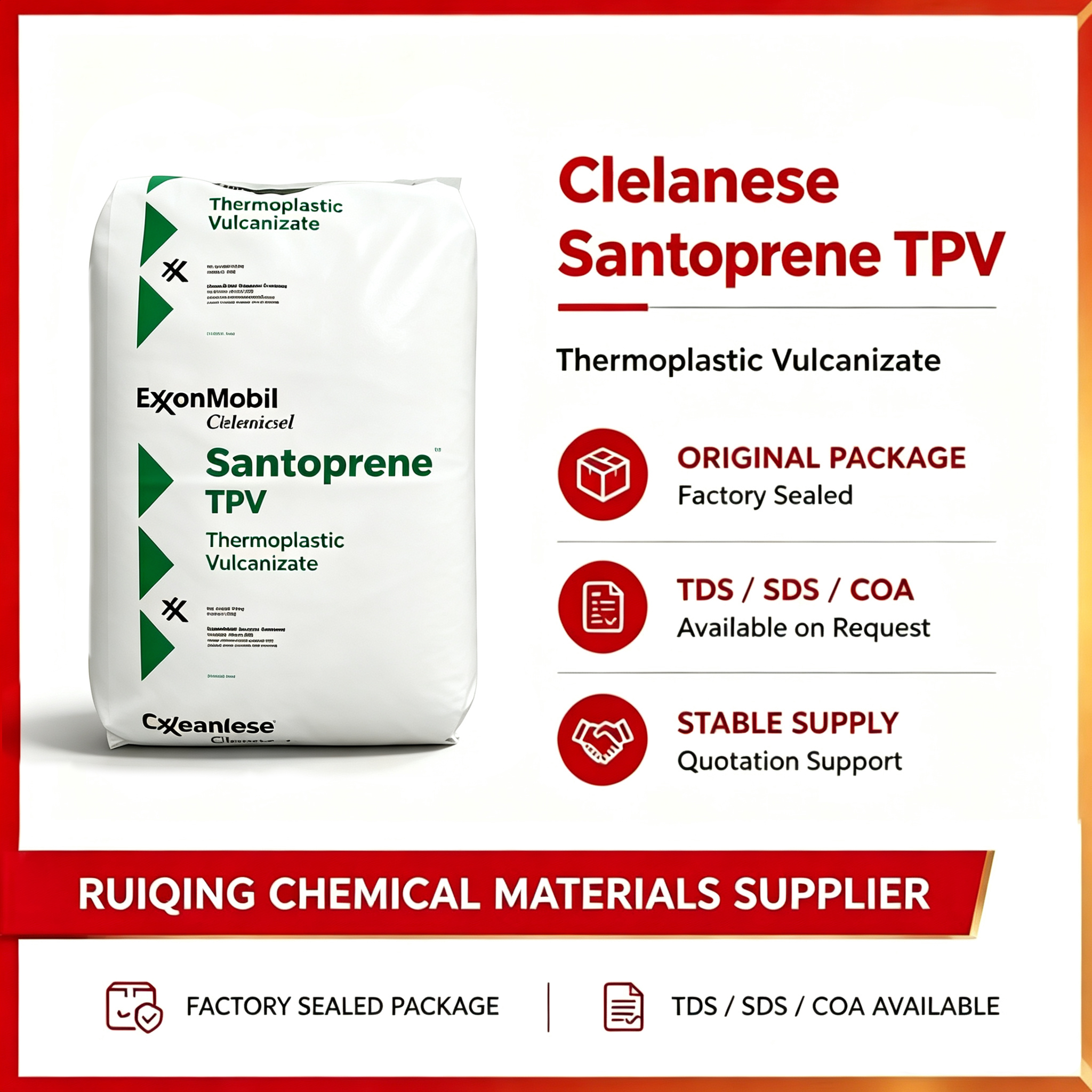
Santoprene 691-65W175 is a natural, colorable thermoplastic vulcanizate from Celanese developed for thin-wall, architectural glazing and sealing applications.
The material combines rubber-like flexibility with conventional thermoplastic processing, allowing manufacturers to produce continuous sealing profiles without the curing process associated with traditional thermoset rubber.
Celanese’s current Product Finder lists the following typical values for Santoprene 691-65W175:
- 70 Shore A hardness
- Natural appearance
- 490% elongation at break
- 6.2 MPa tensile stress at break
- 2.7 MPa tensile stress at 100% elongation
- Extrusion processing
- Injection molding
- Thin-wall glazing and sealing positioning
The natural formulation is especially useful where manufacturers need custom-colored glazing, sealing or profile components rather than a standard black exterior seal.
Santoprene 691-65W175 is also a shear-dependent TPV, so apparent melt viscosity decreases as processing shear increases. This helps the material flow through narrow profile sections and detailed extrusion tooling.
Its combination of approximately 70A hardness and 490% elongation provides a useful balance of firmness and flexibility for sealing profiles that must deform during installation or service.
For more TPV products, visit our TPV Thermoplastic Vulcanizates Product Category →.
For the current Santoprene portfolio, see the Official Celanese Santoprene & Geolast Product Finder →.
Key Features of Santoprene 691-65W175
| Feature | Engineering Benefit |
|---|---|
| 70 Shore A Hardness | Provides a medium-firm elastomeric response |
| Natural / Colorable | Suitable for customized colors and visible profiles |
| 490% Elongation at Break | Provides high flexibility and deformation capability |
| 6.2 MPa Tensile Stress at Break | Provides useful mechanical durability |
| 2.7 MPa Stress at 100% Elongation | Supports flexible sealing performance |
| Thin-Wall Extrusion | Suitable for detailed sealing lips and profile sections |
| Architectural Glazing Grade | Designed for glazing and sealing applications |
| Excellent Profile Definition | Supports precise continuous extrusions |
| Excellent Ozone Resistance | Useful for exposed sealing components |
| Excellent Flex-Fatigue Resistance | Suitable for repeatedly flexed profiles |
| Shear-Dependent Flow | Improves flow as processing shear increases |
| Extrusion Processability | Suitable for profiles and continuous seals |
| Injection Moldable | Supports molded sealing and technical components |
| Thermoformable | Broadens manufacturing options |
| Polyolefin Based | Provides thermoplastic processing with elastomeric behavior |
| Manufacturing-Stream Recyclability | Suitable production scrap can be reprocessed |
The strongest technical positioning for Santoprene 691-65W175 is its combination of natural colorability, thin-wall profile capability and glazing/sealing performance.
Typical Applications for Santoprene 691-65W175
Santoprene 691-65W175 is especially useful in applications requiring a natural or custom-colored flexible profile.
| Application Area | Typical Use |
|---|---|
| Architectural Glazing | Flexible glazing seals and profiles |
| Window Seals | Flexible window sealing components |
| Door Seals | Continuous sealing profiles |
| Building Gaskets | Flexible compression seals |
| Glass Sealing Profiles | Flexible interfaces around glazing systems |
| Thin-Wall Profiles | Detailed sealing lips and ribs |
| Colored Sealing Profiles | Custom-colored architectural components |
| Construction Profiles | Continuous flexible building elements |
| Industrial Seals | Flexible extrusion components |
| Flexible Gaskets | Molded or extruded sealing parts |
| Consumer Products | Natural/colorable flexible components |
| Precision Extrusions | Profiles requiring fine dimensional definition |
Because the grade is supplied in a natural formulation, it can be especially useful where the final component needs a color other than black.
Typical Properties of Santoprene 691-65W175
Physical Properties
| Property | Typical Value | Test Method |
|---|---|---|
| Density | Approx. 0.970 g/cm³ | ISO 1183 |
| Shore A Hardness | 70 | ISO 868 |
| Appearance | Natural | Manufacturer information |
| Product Form | Pellets / Granules | Manufacturer information |
| Material Family | TPV / TPE-V | Manufacturer information |
| Polymer Base | Polyolefin-Based TPV | Manufacturer information |
The current Celanese Product Finder confirms 70 Shore A and Natural appearance for Santoprene 691-65W175.
Mechanical Properties
| Property | Typical Value |
|---|---|
| Tensile Stress at 100% Elongation | 2.7 MPa |
| Tensile Stress at Break | 6.2 MPa |
| Elongation at Break | 490% |
| Shore A Hardness | 70 |
These values are the current grade-specific values shown in Celanese’s Santoprene Product Finder.
The combination of 490% elongation and 6.2 MPa tensile strength allows Santoprene 691-65W175 to retain substantial flexibility while providing useful mechanical strength for profiles and seals.
Natural & Colorable TPV
A major distinction of Santoprene 691-65W175 is its Natural appearance.
This is important for manufacturers that need:
- White sealing profiles
- Gray seals
- Colored architectural profiles
- Decorative flexible components
- Color-matched building parts
- Consumer-product seals
A natural TPV provides more flexibility in pigmentation than a pre-blackened grade.
When color matching is important, the final formulation should be evaluated with the required masterbatch and processing conditions.
Architectural Glazing Applications
Santoprene 691-65W175 is specifically positioned by Celanese for thin-wall glazing and sealing applications.
Architectural glazing seals may need to accommodate:
- Glass movement
- Thermal expansion
- Installation tolerances
- Wind-induced movement
- Repeated compression
- Flexing
- Building movement
- Long-term dimensional changes
A flexible TPV profile can accommodate these movements while providing efficient thermoplastic extrusion processing.
Typical uses include:
- Glazing gaskets
- Window seals
- Glass support profiles
- Flexible perimeter seals
- Building-envelope sealing profiles
Precision Thin-Wall Extrusion
Santoprene 691-65W175 is designed for thin-wall sections with good profile definition.
Thin-wall extrusion can be important where the profile contains:
- Flexible sealing lips
- Narrow ribs
- Fine edges
- Small channels
- Detailed corners
- Multiple sealing zones
The shear-dependent behavior of Santoprene TPV helps the material flow through detailed die geometries while maintaining useful melt strength after exiting the die.
This combination is especially important for long continuous sealing profiles.
Excellent Ozone Resistance
Santoprene 691-65W175 is recommended for applications requiring excellent ozone resistance.
Ozone resistance is particularly relevant to elastomeric sealing components exposed to:
- Outdoor atmosphere
- Electrical equipment
- Industrial environments
- Repeated environmental aging
Traditional rubber materials can develop surface cracking when exposed to ozone under strain. TPV grades developed for sealing applications can provide useful resistance to this type of environmental exposure.
Excellent Flex-Fatigue Resistance
Another important characteristic of Santoprene 691-65W175 is its excellent flex-fatigue performance.
This is useful for profiles that repeatedly:
- Bend
- Fold
- Compress
- Recover
- Move during opening and closing
- Deform during assembly
Typical examples include window seals, door profiles, glazing gaskets and flexible industrial sealing components.
Why Choose Santoprene 691-65W175?
The strongest reason to select Santoprene 691-65W175 is its combination of natural colorability and specialized profile-extrusion performance.
The grade provides:
- 70 Shore A hardness
- Natural / colorable appearance
- 490% elongation
- 6.2 MPa tensile strength
- 2.7 MPa stress at 100% elongation
- Thin-wall extrusion capability
- Architectural glazing suitability
- Sealing performance
- Excellent ozone resistance
- Excellent flex-fatigue resistance
- Extrusion and injection-molding capability
- Shear-dependent rheology
For customers manufacturing natural or custom-colored glazing seals, window profiles, door seals or thin-wall flexible extrusions, Santoprene 691-65W175 is a relevant grade to evaluate.
Processing Guidelines for Santoprene 691-65W175
Santoprene 691-65W175 is designed for processing on conventional thermoplastic equipment.
Published processing routes include:
- Extrusion
- Profile extrusion
- Sheet extrusion
- Thermoforming
- Injection molding
For this grade, extrusion should remain the primary SEO and application focus, because thin-wall glazing and sealing are the main grade-specific positioning.
Drying Conditions
| Processing Parameter | Recommended Starting Point |
|---|---|
| Drying Recommended | Yes |
| Drying Temperature | 80°C |
| Drying Time | Approx. 3 hours |
| Dryer Type | Desiccant / dehumidified dryer |
Santoprene processing guidance recommends drying at approximately 80°C for 3 hours before extrusion when moisture control is required.
General Processing Temperature
A typical Santoprene TPV processing window is approximately:
175–230°C
Actual conditions depend on:
- Extruder diameter
- Screw design
- Profile geometry
- Wall thickness
- Die design
- Line speed
- Melt pressure
- Cooling
- Required surface quality
The processing window should be optimized around stable profile geometry and surface quality rather than simply increasing melt temperature.
Extrusion Processing
For Santoprene 691-65W175 extrusion, important variables include:
- Barrel-zone temperatures
- Screw speed
- Melt temperature
- Melt pressure
- Screen pack
- Adapter temperature
- Die temperature
- Drawdown
- Cooling
- Profile support
- Puller speed
- Final dimensional control
Drawdown
For thin-wall profile extrusion, excessive drawdown can lead to:
- Reduced wall thickness
- Distortion
- Poor sealing-lip geometry
- Uneven profile dimensions
A conservative profile-design and drawdown strategy is therefore recommended during initial process development.
Shear-Dependent Flow
Santoprene 691-65W175 is shear dependent.
As shear rate increases, apparent melt viscosity decreases.
This behavior can improve processing through:
- Narrow die passages
- Fine sealing lips
- Thin walls
- Small channels
- Detailed extrusion tooling
It also means that screw speed, die geometry and flow rate can influence melt behavior as much as temperature.
Profile Definition
Thin-wall architectural profiles often contain small features that must remain dimensionally stable after exiting the die.
Important factors include:
- Melt temperature
- Die temperature
- Cooling rate
- Line speed
- Drawdown
- Melt pressure
- Profile support
- Vacuum calibration where applicable
Santoprene 691-65W175 is specifically designed for applications where good extrusion definition is important.
Injection Molding
Celanese also identifies injection molding as a processing route for Santoprene 691-65W175.
Potential molded applications include:
- Flexible sealing elements
- Gaskets
- End pieces
- Corner components
- Flexible technical parts
For injection-molding development, processors should optimize:
- Melt temperature
- Injection speed
- Screw speed
- Holding pressure
- Mold temperature
- Gate dimensions
- Venting
- Cooling time
Thermoforming
Santoprene 691-65W175 can also be processed by thermoforming when the component design is appropriate.
Potential applications include:
- Flexible sheets
- Formed sealing elements
- Protective flexible components
Temperature uniformity and controlled forming conditions are important to maintain consistent thickness.
Material Compatibility
Santoprene TPV should be processed with appropriate purge procedures when changing from incompatible materials.
Particular care should be taken when transitioning between Santoprene TPV and:
- POM / Acetal
- PVC
Thorough purging helps avoid processing instability or contamination.
Manufacturing-Stream Recyclability
Santoprene 691-65W175 is polyolefin based and can be recycled within appropriate manufacturing streams.
This can allow controlled production scrap such as:
- Start-up material
- Trim
- Profile cut-offs
- Selected clean process scrap
to be reprocessed according to the manufacturer’s quality requirements.
The amount of regrind should be controlled according to the final application’s performance and appearance requirements.
Related Products
We supply Santoprene TPV grades for different architectural, sealing, extrusion, color and hardness requirements.
Typical Santoprene product families include:
- Santoprene 691 W175 Series
- Santoprene natural TPV grades
- Santoprene colorable TPV grades
- Santoprene architectural glazing grades
- Santoprene thin-wall extrusion grades
- Santoprene window and door seal grades
- Santoprene profile extrusion grades
- Santoprene building and construction grades
- Santoprene sealing grades
View More TPV Thermoplastic Vulcanizates →
For grade-selection support, send us your required hardness, color, profile dimensions, application and processing method.
Technical Documents for Santoprene 691-65W175
| Document Type | Description |
|---|---|
| TDS | Physical, mechanical and processing data |
| SDS | Safety Data Sheet |
| Extrusion Guide | Thin-wall and profile extrusion guidance |
| Glazing & Sealing Information | Architectural sealing application information |
| Processing Guide | Extrusion and injection-molding recommendations |
| Santoprene Product Finder | Current Celanese TPV portfolio information |
| COA | Batch-specific quality information where available |
Need technical documents for Santoprene 691-65W175?
📧 Email: ruiqingchem@gmail.com
📝 Online form: Contact Us →
Please state Santoprene 691-65W175 and specify whether you require TDS, SDS, extrusion guidance or other technical documentation.
FAQ About Santoprene 691-65W175
Q1: What is Santoprene 691-65W175?
Santoprene 691-65W175 is a natural, colorable TPV from Celanese designed for thin-wall glazing, sealing, extrusion and injection-molding applications.
Q2: What is the hardness of Santoprene 691-65W175?
Current Celanese Product Finder data gives approximately 70 Shore A.
Q3: Is the “65” in Santoprene 691-65W175 the actual hardness?
No. Current Celanese data lists 70 Shore A, so the grade designation should not be interpreted directly as measured hardness.
Q4: What color is Santoprene 691-65W175?
The standard grade is Natural, making it suitable for customized coloring.
Q5: What is the elongation at break?
The current typical value is approximately 490%.
Q6: What is the tensile stress at break?
The typical value is approximately 6.2 MPa.
Q7: What is the tensile stress at 100% elongation?
The typical value is approximately 2.7 MPa.
Q8: What is the density?
Published grade data places the density at approximately 0.970 g/cm³.
Q9: Is Santoprene 691-65W175 suitable for architectural glazing?
Yes. Celanese specifically describes it as designed for thin-wall, glazing and sealing applications.
Q10: Is it suitable for thin-wall extrusion?
Yes. Thin-wall extrusion is one of the main grade-specific applications.
Q11: Can Santoprene 691-65W175 be colored?
Yes. The standard material is Natural and is suitable for color customization using appropriate compatible color concentrates.
Q12: Does Santoprene 691-65W175 have good ozone resistance?
Yes. The grade is recommended for applications requiring excellent ozone resistance.
Q13: Does it have good flex-fatigue resistance?
Yes. Excellent flex-fatigue resistance is one of the published grade characteristics.
Q14: Can Santoprene 691-65W175 be extruded?
Yes. Extrusion is one of its primary processing methods.
Q15: Can Santoprene 691-65W175 be injection molded?
Yes. Celanese’s current Product Finder specifically lists it for extrusion/injection molding.
Q16: What industries use Santoprene 691-65W175?
Typical applications include building and construction, architectural glazing, window and door sealing, industrial profiles and flexible sealing components.
Request Santoprene 691-65W175 Price & Technical Support
For pricing, availability, technical documents or application support for Santoprene 691-65W175, please provide:
- Required quantity
- Destination country or port
- Architectural glazing / window / door / sealing application
- Required Shore hardness
- Required color
- Profile dimensions
- Minimum wall or sealing-lip thickness
- Extrusion or injection-molding process
- Service temperature
- Ozone-resistance requirement
- Flex-fatigue requirement
- TDS / SDS requirement
- COA requirement
- Sample requirement, if applicable
📧 Email: ruiqingchem@gmail.com