描述
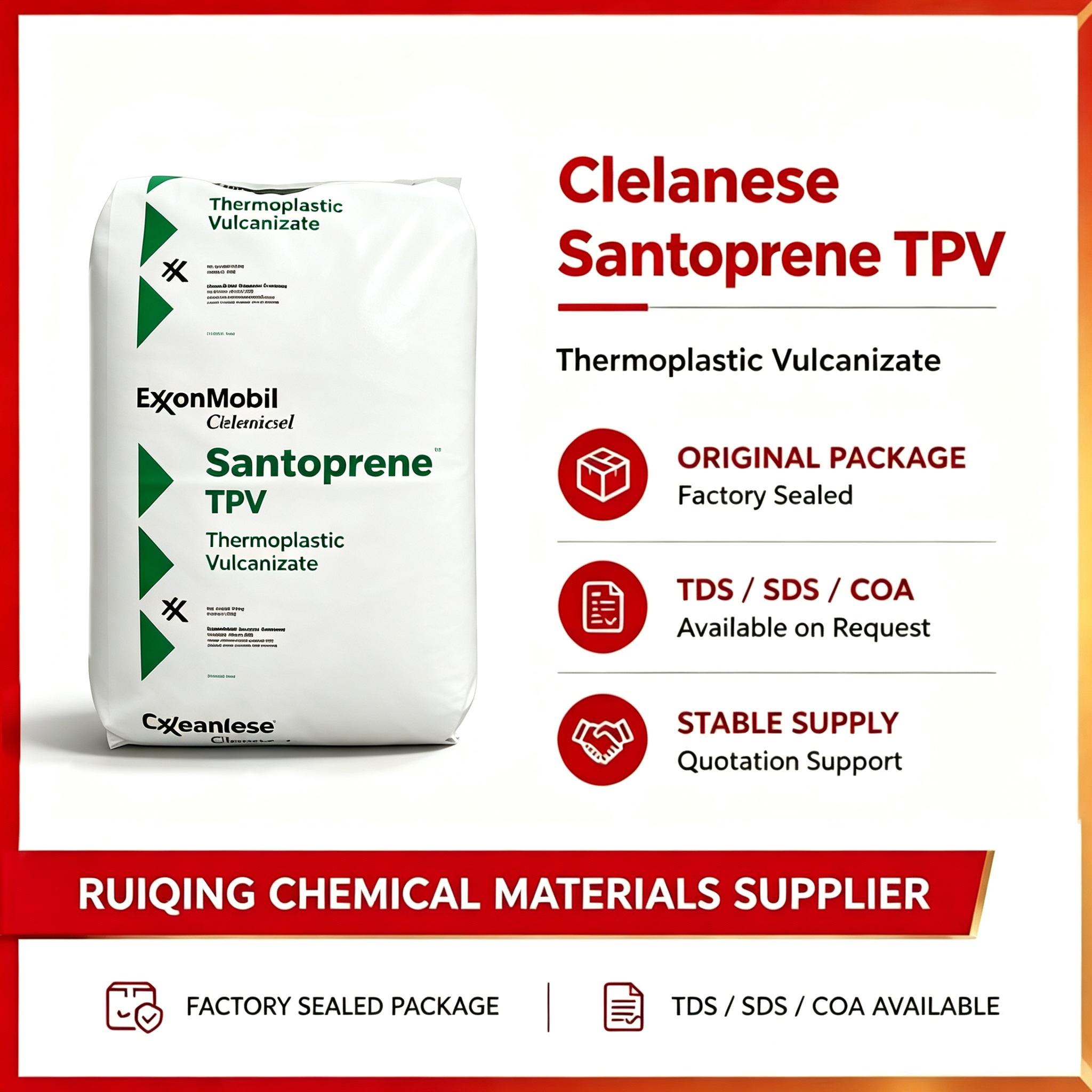
Santoprene 271-73 is a natural, colorable thermoplastic vulcanizate from Celanese developed for selected food-contact and food-equipment applications, especially applications involving non-fatty foods.
The grade combines rubber-like flexibility with thermoplastic processability, allowing manufacturers to produce seals, gaskets, closures, tubing, flexible grips and molded components without a conventional rubber curing cycle.
Celanese’s current Product Finder lists approximately 78 Shore A hardness, making Santoprene 271-73 a medium-firm elastomer within the 271 food-contact family.
Typical current mechanical values include:
- 490% elongation at break
- 8.8 MPa tensile stress at break
- 3.6 MPa tensile stress at 100% elongation
- 28% compression set under the published reference condition
The latest Celanese Materials Database also lists:
- 0.960 g/cm³ density
- -60°C brittleness temperature
- 37% compression set at 125°C / 70 h
- 28% compression set at 70°C / 24 h
This property balance makes Santoprene 271-73 useful where a food-contact elastomer needs more firmness than soft sealing grades while retaining high flexibility and recovery.
A major reason to select the grade is its regulatory positioning.
Celanese states that Santoprene 271-73 can, in principle, be used in food-contact applications in the United States under applicable FDA requirements, although migration or use limitations may apply. It is specifically positioned for non-fatty food-contact applications.
Santoprene 271-73 is also currently listed by NSF under NSF/ANSI 51 – Food Equipment Materials. NSF’s official listing shows the grade for food-zone use with several listed food categories and a maximum use temperature of 212°F / 100°C. NSF also notes that this material is acceptable for repeated use.
For more TPV products, visit our TPV Thermoplastic Vulcanizates Product Category →.
For the current Santoprene portfolio, see the Official Celanese Santoprene & Geolast Product Finder →.
Key Features of Santoprene 271-73
| Feature | Engineering Benefit |
|---|---|
| 78 Shore A Hardness | Provides a firm but still flexible elastomeric response |
| FDA Food-Contact Positioning | Suitable in principle for selected U.S. non-fatty food-contact uses |
| NSF/ANSI 51 Certified | Supports food-equipment applications |
| 490% Elongation at Break | Provides high flexibility and deformation capability |
| 8.8 MPa Tensile Stress at Break | Provides useful mechanical strength |
| 3.6 MPa Stress at 100% Elongation | Provides firmer sealing and support behavior |
| 28% Compression Set @ 70°C / 24 h | Supports elastic recovery under compression |
| -60°C Brittleness Temperature | Supports low-temperature flexibility |
| Excellent Flex-Fatigue Resistance | Suitable for repeatedly flexed parts |
| Natural / Colorable | Supports customized colors |
| Injection Moldable | Suitable for molded seals, closures and components |
| Extrudable | Suitable for tubing, profiles and sheets |
| Blow Moldable | Supports selected hollow components |
| Thermoformable / Vacuum Formable | Expands manufacturing options |
The strongest reason to select Santoprene 271-73 is its combination of 78A hardness, high elongation, food-contact positioning and NSF/ANSI 51 certification.
Typical Applications for Santoprene 271-73
Santoprene 271-73 is particularly suitable for food-equipment and consumer applications requiring a firmer flexible TPV.
| Application Area | Typical Use |
|---|---|
| Food Equipment Seals | Flexible sealing components |
| Gaskets | Food-zone and appliance sealing |
| Closures | Flexible closures for compatible food-contact applications |
| Tubing | Selected non-fatty food-contact tubing |
| Food Containers | Flexible seals and components |
| Kitchenware | Seals, flexible components and grips |
| Flexible Grips | Ergonomic soft-touch components |
| Filters | Flexible sealing and support parts |
| Small Appliances | Food-contact seals and flexible molded parts |
| White Goods | Flexible appliance components |
| Living Hinges | Repeated-flex technical parts |
| Packaging Components | Flexible closure and sealing components |
Because of its higher hardness, Santoprene 271-73 can be particularly useful where the part needs more dimensional support than a very soft TPV while still requiring elastomeric recovery.
Typical Properties of Santoprene 271-73
Physical Properties
| Property | Typical Value | Test Method |
|---|---|---|
| Density | 960 kg/m³ / 0.960 g/cm³ | ISO 1183 |
| Shore A Hardness, 15 s | 78 | ISO 48-4 / ISO 868 |
| Brittleness Temperature | -60°C | ASTM D746 / ISO 812 |
| Resin Identification | TPV | ISO 1043 |
| Part Marking Code | >TPV< | ISO 11469 |
| Product Form | Pellets / Granules | Manufacturer information |
| Appearance | Natural / Colorable | Manufacturer information |
The latest 2025 Celanese Materials Database revision lists 0.960 g/cm³ density, 78 Shore A hardness and -60°C brittleness temperature.
Mechanical Properties
| Property | Typical Value | Test Method |
|---|---|---|
| Tensile Stress at 100% Elongation | 3.6 MPa | ISO 37 |
| Tensile Stress at Break | 8.8 MPa | ISO 527-1/-2 or ISO 37 |
| Elongation at Break | 490% | ISO 527-1/-2 or ISO 37 |
| Compression Set, 70°C / 24 h | 28% | ISO 815 |
| Compression Set, 125°C / 70 h | 37% | ISO 815 |
| Shore A Hardness | 78 | ISO 48-4 / ISO 868 |
These values show that Santoprene 271-73 provides a useful balance between firmness and flexibility for seals, closures and flexible food-equipment components.
FDA Food-Contact Positioning
A major selling point of Santoprene 271-73 is its suitability for selected food-contact applications.
Celanese describes the grade as designed for non-fatty food-contact applications and states that it can, in principle, be used in food-contact applications in the USA under applicable FDA requirements. Migration or use limitations may apply.
Typical applications may include:
- Food-equipment seals
- Gaskets
- Closures
- Kitchenware
- Food containers
- Appliance components
- Flexible grips
- Selected tubing
For your product page, the safest and strongest wording is:
“Suitable for selected non-fatty food-contact applications under applicable U.S. FDA requirements.”
This is more accurate than simply describing the material as a universal food-grade TPV.
NSF/ANSI 51 Food Equipment Certification
Santoprene 271-73 is currently listed under NSF/ANSI 51 – Food Equipment Materials.
The current NSF listing includes:
- Alcohol greater than 8%
- Alcohol less than or equal to 8%
- Aqueous acidic foods
- Aqueous non-acidic foods
- Dairy / oil-in-water emulsions
- Dry solids
The listed maximum use temperature is 212°F / 100°C.
NSF also states that Santoprene 271-73 is acceptable for repeated use under the listed conditions.
This makes the grade particularly relevant to:
- Commercial food equipment
- Beverage equipment
- Food-processing machinery
- Kitchen appliances
- Food-contact sealing systems
- Reusable food-equipment components
Low-Temperature Flexibility
Santoprene 271-73 has a published brittleness temperature of approximately -60°C.
This gives the material useful low-temperature flexibility for applications where components may experience:
- Refrigerated environments
- Cold storage
- Low-temperature transport
- Temperature cycling
- Cold-start conditions
Flex-Fatigue Resistance
Celanese specifically recommends Santoprene 271-73 for applications requiring excellent flex-fatigue resistance.
This is useful for parts that repeatedly:
- Bend
- Flex
- Compress
- Recover
- Open and close
- Move during equipment operation
Typical examples include flexible grips, seals, tubing, closures and living-hinge-type components.
Why Choose Santoprene 271-73?
The main reason to choose Santoprene 271-73 is its balance of food-contact compliance and mechanical performance.
At approximately 78 Shore A, the material provides a firmer elastomeric response suitable for components that need both flexibility and structural support.
Its approximately 490% elongation at break allows large elastic deformation.
The typical 8.8 MPa tensile stress at break gives the material useful mechanical strength.
The approximately 3.6 MPa stress at 100% elongation provides a firmer response under load.
Its published 28% compression set at 70°C / 24 h supports sealing and compression applications, while the -60°C brittleness temperature supports low-temperature flexibility.
Most importantly, the grade combines FDA non-fatty food-contact positioning with current NSF/ANSI 51 certification.
For customers requiring a 78A natural/colorable TPV for food-equipment seals, gaskets, closures, tubing or flexible appliance components, Santoprene 271-73 is an important grade to evaluate.
Processing Guidelines for Santoprene 271-73
Santoprene 271-73 is a shear-dependent TPV and can be processed using conventional thermoplastic equipment.
Current Celanese data lists:
- Injection molding
- Extrusion
- Blow molding
- Thermoforming
- Vacuum forming
Current Grade-Specific Injection Conditions
| Processing Parameter | Celanese Guidance |
|---|---|
| Drying Recommended | Yes |
| Drying Temperature | 80°C |
| Drying Time | ≥3 hours |
| Processing Moisture Content | ≤0.08% |
| Maximum Regrind Level | 20% |
| Optimum Melt Temperature | 215°C |
| Minimum Melt Temperature | 200°C |
| Maximum Melt Temperature | 230°C |
| Optimum Mold Temperature | 30°C |
| Minimum Mold Temperature | 10°C |
| Maximum Mold Temperature | 50°C |
These values come from the latest Celanese Materials Database revision dated 2025-04-21.
Injection Molding Reference Conditions
Published historical grade-specific processing data also lists:
| Processing Parameter | Published Reference |
|---|---|
| Rear Barrel Temperature | 177°C |
| Middle Barrel Temperature | 182°C |
| Front Barrel Temperature | 188°C |
| Nozzle Temperature | 193–227°C |
| Processing Melt Temperature | 199–232°C |
| Mold Temperature | 10–52°C |
| Injection Speed | Fast |
| Back Pressure | 0.345–0.689 MPa |
| Screw Speed | 100–200 rpm |
| Vent Depth | 0.025 mm |
These older values remain useful as detailed machine-setting references, while the current Celanese database gives 215°C optimum melt temperature as the newer grade-specific starting point.
Extrusion Conditions
| Processing Parameter | Published Guidance |
|---|---|
| Drying Temperature | 82°C |
| Drying Time | 3 hours |
| Melt Temperature | 202°C |
| Die Temperature | 204°C |
| Back Pressure | 5–20 MPa |
These grade-specific extrusion values are available in manufacturer-derived processing data.
Shear-Dependent Flow
Santoprene 271-73 is explicitly identified as shear dependent.
As shear rate increases, apparent melt viscosity decreases.
Processors should optimize:
- Injection speed
- Screw speed
- Gate dimensions
- Melt temperature
- Mold temperature
- Die geometry
- Melt pressure
- Draw-down
- Cooling conditions
- Surface finish
Material Compatibility
Published Santoprene extrusion guidance states that Santoprene TPV is incompatible with acetal (POM) and PVC.
Equipment should therefore be thoroughly purged when changing between these materials and Santoprene 271-73.
Related Products
We supply Santoprene TPV grades for different food-contact, NSF, hardness and processing requirements.
Typical Santoprene product families include:
- Santoprene 271 Series
- Santoprene FDA food-contact grades
- Santoprene NSF 51 grades
- Santoprene food-equipment grades
- Santoprene sealing grades
- Santoprene tubing grades
- Santoprene appliance grades
- Santoprene specialty TPV grades
View More TPV Thermoplastic Vulcanizates →
If you need grade-selection support, send us your required food-contact condition, Shore hardness, operating temperature, processing method and application.
Technical Documents for Santoprene 271-73
| Document Type | Description |
|---|---|
| TDS | Physical, mechanical and processing data |
| SDS | Safety Data Sheet |
| FDA Information | Food-contact regulatory information for applicable uses |
| NSF 51 Information | Food Equipment Materials certification |
| UL Information | QMFZ2.E80017 / QMFZ8.E80017 |
| Processing Guide | Injection molding and extrusion guidance |
| Santoprene Product Finder | Celanese TPV portfolio and positioning |
| COA | Batch-specific quality information where available |
Need technical documents for Santoprene 271-73?
📧 Email: ruiqingchem@gmail.com
📝 Online form: Contact Us →
Please state Santoprene 271-73 and whether you require TDS, SDS, FDA, NSF or other technical documentation.
FAQ About Santoprene 271-73
Q1: What is Santoprene 271-73?
Santoprene 271-73 is a natural, colorable specialty TPV from Celanese designed for selected non-fatty food-contact and food-equipment applications.
Q2: What is the hardness of Santoprene 271-73?
The current typical hardness is approximately 78 Shore A.
Q3: Is Santoprene 271-73 suitable for FDA food-contact applications?
Celanese states that the material can, in principle, be used in applicable U.S. food-contact applications, subject to any relevant migration or use limitations. It is specifically designed for non-fatty food contact.
Q4: Is Santoprene 271-73 NSF 51 certified?
Yes. NSF’s current official listing includes Santoprene 271-73 TPV under NSF/ANSI 51 Food Equipment Materials.
Q5: What is the density?
The typical density is approximately 0.960 g/cm³.
Q6: What is the elongation at break?
The typical elongation at break is approximately 490%.
Q7: What is the tensile stress at break?
The typical value is approximately 8.8 MPa.
Q8: What is the tensile stress at 100% elongation?
The typical value is approximately 3.6 MPa.
Q9: What is the compression set?
The current Celanese sheet lists approximately 28% at 70°C / 24 h and 37% at 125°C / 70 h.
Q10: What is the low-temperature performance?
The published brittleness temperature is approximately -60°C.
Q11: What food types are covered by the NSF listing?
The current NSF listing includes alcoholic foods, aqueous acidic and non-acidic foods, dairy/oil-in-water emulsions and dry solids.
Q12: What is the NSF maximum use temperature?
The current NSF listing gives a maximum use temperature of 212°F / 100°C.
Q13: Is Santoprene 271-73 acceptable for repeated use?
Yes. NSF currently states that the material is acceptable for repeated use under the listed conditions.
Q14: Can Santoprene 271-73 be injection molded?
Yes. Injection molding is one of the published processing methods.
Q15: Can Santoprene 271-73 be extruded?
Yes. Extrusion is supported, and published grade-specific guidance gives approximately 202°C melt temperature and 204°C die temperature as reference values.
Q16: What injection melt temperature is recommended?
The latest Celanese Materials Database gives approximately 215°C optimum, with a grade-specific range of 200–230°C.
Request Santoprene 271-73 Price & Technical Support
For pricing, availability, technical documents or application support for Santoprene 271-73, please provide:
- Required quantity
- Destination country or port
- Food-equipment, appliance, tubing or sealing application
- Required Shore hardness
- Required color
- Food-contact requirement
- NSF 51 requirement
- Maximum service temperature
- Food type or contact medium
- Injection-molding, extrusion or blow-molding process
- TDS / SDS requirement
- FDA / NSF documentation requirement
- Sample requirement, if applicable
📧 Email: ruiqingchem@gmail.com