描述
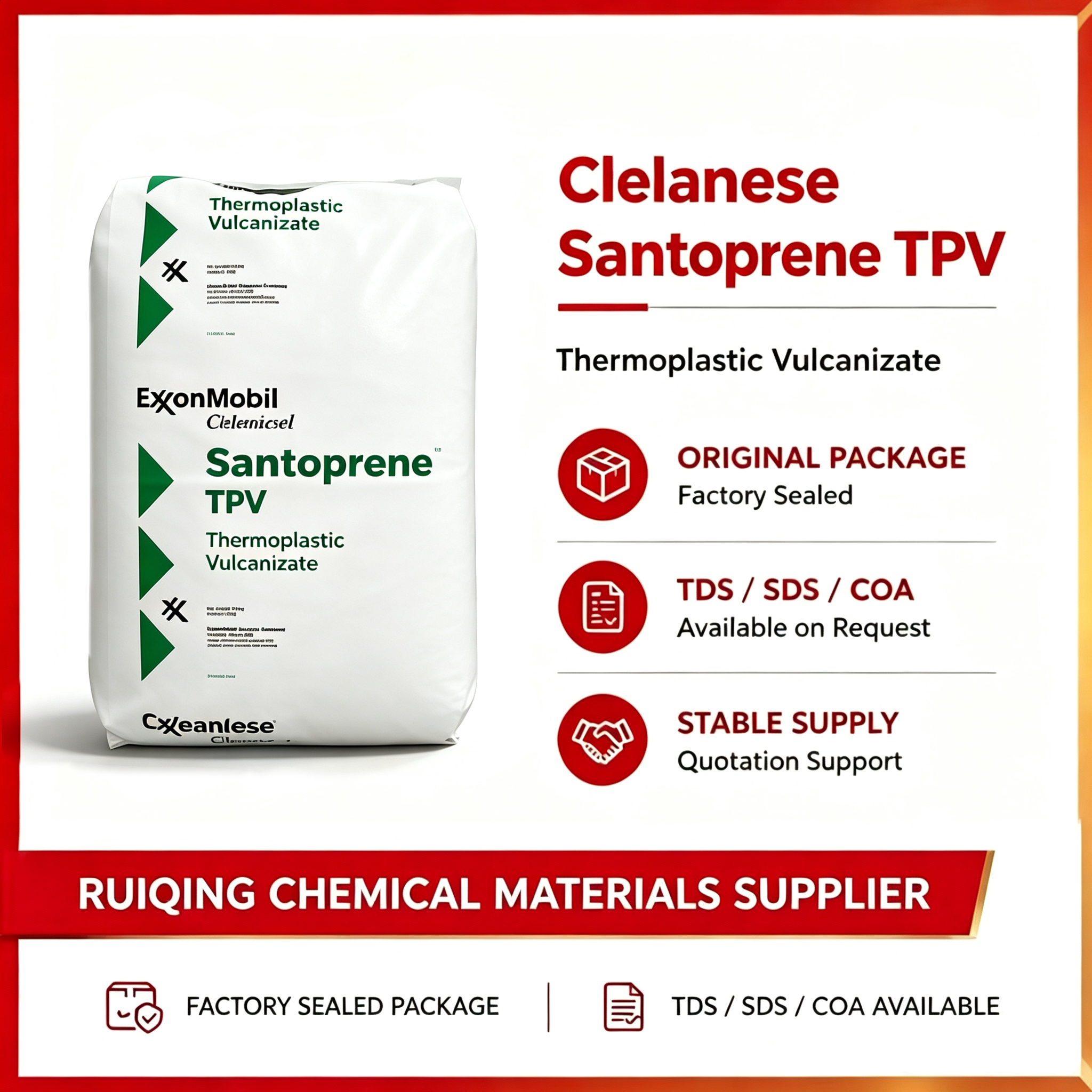
Santoprene 271-55 is a soft, natural and colorable thermoplastic vulcanizate from Celanese designed for selected non-fatty food-contact and food-equipment applications.
The grade combines elastomeric flexibility with thermoplastic processing, allowing manufacturers to produce seals, gaskets, closures, tubing and molded components using conventional injection-molding and extrusion equipment.
Current published data lists approximately 59 Shore A hardness, giving the material a soft and compliant feel suitable for sealing, gripping and flexible food-equipment components.
Its typical mechanical values include:
- 390% elongation at break
- 5.20 MPa tensile strength at break
- 2.10 MPa tensile stress at 100% elongation
- 16.0 kN/m tear strength
- -60°C brittleness temperature
The grade also provides useful compression-set performance, with published values of approximately 22% at 70°C and 38% at 125°C under the listed test conditions.
One of the most important reasons to choose Santoprene 271-55 is its regulatory positioning.
Celanese states that the material can, in principle, be used in food-contact applications in the United States under applicable FDA requirements, although migration or use limitations may apply. The grade is also certified to NSF/ANSI Standard 51: Food Equipment Materials.
NSF’s current official listing includes Santoprene 271-55 TPV for food-zone applications involving alcohol, aqueous acidic and non-acidic foods, dairy/oil-in-water emulsions and dry solids, with a listed maximum use temperature of 212°F / 100°C.
For more TPV products, visit our TPV Thermoplastic Vulcanizates Product Category →.
For the current Santoprene portfolio, see the Official Celanese Santoprene & Geolast Product Finder →.
Key Features of Santoprene 271-55
| Feature | Engineering Benefit |
|---|---|
| 59 Shore A Hardness | Provides soft and compliant elastomeric behavior |
| FDA Food-Contact Positioning | Suitable in principle for selected U.S. food-contact applications |
| NSF/ANSI 51 Certified | Supports use in food-equipment materials and components |
| 390% Elongation at Break | Provides high deformation capability |
| 5.20 MPa Tensile Strength at Break | Provides useful mechanical strength |
| 2.10 MPa Stress at 100% Elongation | Supports soft sealing and flexible-part performance |
| Excellent Flex-Fatigue Resistance | Useful for repeatedly flexed components |
| -60°C Brittleness Temperature | Supports low-temperature flexibility |
| Natural / Colorable | Supports customized colors |
| UL Recognized | QMFZ2.E80017 and QMFZ8.E80017 |
| Injection Moldable | Suitable for molded seals and technical parts |
| Extrudable | Suitable for tubing, profiles and sheets |
| Polyolefin Based | Combines elastomeric behavior with thermoplastic processing |
| Manufacturing-Stream Recyclability | Controlled process scrap may be reused |
The strongest reason to select Santoprene 271-55 is its combination of soft 59A hardness, food-contact suitability, NSF 51 certification and excellent flex-fatigue resistance.
Typical Applications for Santoprene 271-55
Santoprene 271-55 is particularly relevant to food-equipment and consumer applications requiring a soft, flexible TPV.
| Application Area | Typical Use |
|---|---|
| Food Equipment Seals | Flexible sealing components |
| Gaskets | Food-zone and appliance sealing |
| Closures | Flexible closures for compatible food-contact applications |
| Tubing | Selected non-fatty food-contact tubing |
| Food Containers | Flexible components and seals |
| Kitchenware | Soft-touch and sealing components |
| Flexible Grips | Soft, ergonomic gripping surfaces |
| Filters | Flexible sealing and support parts |
| Small Appliances | Food-contact seals and flexible components |
| White Goods | Flexible appliance components |
| Living Hinges | Repeated-flex technical parts |
| Packaging Components | Flexible sealing and closure parts |
Historic Celanese/ExxonMobil application data specifically lists filters, flexible grips, food containers, gaskets, kitchenware, living hinges, seals, tubing, white goods and small appliances.
Typical Properties of Santoprene 271-55
Physical Properties
| Property | Typical Value | Test Method |
|---|---|---|
| Density / Specific Gravity | 0.970 g/cm³ | ISO 1183 / ASTM D792 |
| Shore A Hardness, 15 s | 59 | ISO 868 |
| Product Form | Granules / Pellets | Manufacturer information |
| Appearance | Natural / Colorable | Manufacturer information |
| Polymer Family | TPV | Manufacturer information |
| Filler | Unfilled | Commercial Celanese listing |
Current commercial Celanese distribution data lists Santoprene 271-55 as an unfilled TPV in granular form with density 0.970 g/cm³.
Mechanical Properties
| Property | Typical Value | Test Method |
|---|---|---|
| Tensile Stress at 100% Elongation | 2.10 MPa | ASTM D412 |
| Tensile Strength at Break | 5.20 MPa | ASTM D412 |
| Elongation at Break | 390% | ASTM D412 |
| Tear Strength | 16.0 kN/m | ASTM D624 |
| Compression Set, 70°C | 22% | ASTM D395 |
| Compression Set, 125°C | 38% | ASTM D395 |
| Brittleness Temperature | -60°C | ASTM D746 |
These values show that Santoprene 271-55 is optimized toward softness, flexibility and sealing behavior rather than high structural stiffness.
FDA Food-Contact Positioning
A major selling point of Santoprene 271-55 is its suitability for selected food-contact applications.
Celanese describes the grade as designed for non-fatty food contact applications and states that, in principle, it can be used in food-contact applications in the United States under applicable FDA requirements. Migration or use limitations may apply.
Older manufacturer-derived data also states that the grade complies with FDA regulations applicable to rubber articles intended for repeated use and to closures and sealing gaskets contacting non-fatty, non-oily foods.
This makes the material relevant to:
- Food-equipment seals
- Closures
- Gaskets
- Kitchenware
- Food containers
- Appliance components
- Selected tubing applications
For a customer-facing page, the safest wording is “FDA food-contact suitable for selected non-fatty applications” rather than simply calling it a universal “food-grade TPV”.
NSF/ANSI 51 Food Equipment Certification
Santoprene 271-55 is certified to NSF/ANSI Standard 51: Food Equipment Materials.
NSF’s current official listing shows Santoprene 271-55 for food-zone use with:
- Alcohol greater than 8%
- Alcohol less than or equal to 8%
- Aqueous acidic foods
- Aqueous non-acidic foods
- Dairy and oil-in-water emulsions
- Dry solids
The current NSF listing gives a maximum use temperature of 212°F / 100°C for the listed food-zone application.
That official NSF listing is particularly useful for customers in:
- Commercial food equipment
- Beverage equipment
- Kitchen appliances
- Food-processing machinery
- Food-contact sealing systems
Flex-Fatigue Resistance
Celanese specifically recommends Santoprene 271-55 for applications requiring excellent flex-fatigue resistance.
This makes the material relevant to parts that repeatedly:
- Bend
- Flex
- Compress
- Recover
- Open and close
- Move during appliance operation
Typical examples include flexible grips, living hinges, tubing, seals and repetitive-motion components.
Why Choose Santoprene 271-55?
The main reason to choose Santoprene 271-55 is the combination of soft elastomeric behavior and food-equipment compliance.
At approximately 59 Shore A, the grade is soft enough for sealing, tubing, grips and flexible molded components.
Its approximately 390% elongation at break provides high flexibility.
The typical 5.20 MPa tensile strength at break provides useful mechanical performance.
The approximately -60°C brittleness temperature gives the material strong low-temperature flexibility.
Most importantly, the grade has both FDA food-contact positioning for selected applications and current NSF/ANSI 51 certification.
For customers requiring a soft, natural/colorable TPV for food-equipment seals, gaskets, closures, tubing or flexible appliance parts, Santoprene 271-55 is a relevant grade to evaluate.
Processing Guidelines for Santoprene 271-55
Santoprene 271-55 is shear dependent and can be processed on conventional thermoplastic equipment.
Current commercial Celanese listings include:
- Injection molding
- Multi-injection molding
- Extrusion
- Profile extrusion
- Sheet extrusion
- Blown-film extrusion
Drying & General Processing Conditions
| Processing Parameter | Published Guidance |
|---|---|
| Drying Temperature | 82°C |
| Drying Time | 3 hours |
| Maximum Moisture Content | 0.08% |
| Maximum Regrind | 20% |
| General Processing Window | 175–230°C |
| Screw Speed | 100–200 rpm |
Published processing data recommends approximately 3 hours drying at 80–82°C and a broad Santoprene processing range of approximately 175–230°C.
Injection Molding Conditions
| Processing Parameter | Published Guidance |
|---|---|
| Rear Barrel Temperature | 177°C |
| Middle Barrel Temperature | 182°C |
| Front Barrel Temperature | 182°C |
| Nozzle Temperature | 188–221°C |
| Mold Temperature | 10–52°C |
| Back Pressure | 0.345–0.689 MPa |
| Screw Speed | 100–200 rpm |
| Vent Depth | 0.025 mm |
These values come from manufacturer-derived historical grade data and remain useful as a starting point for process development.
Extrusion Conditions
| Processing Parameter | Published Guidance |
|---|---|
| Drying Temperature | 82°C |
| Drying Time | 3 hours |
| Melt Temperature | 196°C |
| Die Temperature | 199°C |
The 2023 Celanese Materials Database sheet lists 196°C extrusion melt temperature, with the broader processing guidance remaining approximately 175–230°C.
Shear-Dependent Flow
Santoprene 271-55 is a shear-dependent TPV.
As shear rate increases, apparent viscosity decreases, so processing can often be improved by optimizing:
- Injection speed
- Screw speed
- Gate size
- Melt pressure
- Die geometry
- Extrusion rate
- Cooling
- Draw-down
Material Compatibility
Celanese processing guidance states that Santoprene TPV is incompatible with acetal (POM) and PVC.
Equipment should be thoroughly purged when switching between these materials and Santoprene 271-55.
Related Products
We supply Santoprene TPV grades for different food-contact, NSF, hardness and processing requirements.
Typical Santoprene product families include:
- Santoprene 271 Series
- Santoprene FDA food-contact grades
- Santoprene NSF 51 grades
- Santoprene food-equipment grades
- Santoprene tubing grades
- Santoprene sealing grades
- Santoprene appliance grades
- Santoprene specialty TPV grades
View More TPV Thermoplastic Vulcanizates →
If you need grade-selection support, send us your food-contact requirement, Shore hardness, operating temperature, processing method and application.
Technical Documents for Santoprene 271-55
| Document Type | Description |
|---|---|
| TDS | Physical, mechanical and processing data |
| SDS | Safety Data Sheet |
| FDA Information | Food-contact regulatory information for applicable uses |
| NSF 51 Information | Food Equipment Materials certification |
| UL Information | QMFZ2.E80017 / QMFZ8.E80017 |
| Processing Guide | Injection molding and extrusion guidance |
| Santoprene Product Finder | Celanese TPV portfolio and positioning |
| COA | Batch-specific quality information where available |
Need technical documents for Santoprene 271-55?
📧 Email: ruiqingchem@gmail.com
📝 Online form: Contact Us →
Please state Santoprene 271-55 and whether you require TDS, SDS, FDA, NSF or other technical documentation.
FAQ About Santoprene 271-55
Q1: What is Santoprene 271-55?
Santoprene 271-55 is a soft, colorable specialty TPV from Celanese designed for selected non-fatty food-contact applications and food-equipment components.
Q2: What is the hardness of Santoprene 271-55?
The typical hardness is approximately 59 Shore A.
Q3: Is Santoprene 271-55 FDA food contact compliant?
Celanese states that the material can, in principle, be used in applicable U.S. food-contact applications, with migration or use limitations potentially applying. It is particularly positioned for non-fatty food contact.
Q4: Is Santoprene 271-55 NSF 51 certified?
Yes. NSF’s current official listing includes Santoprene 271-55 TPV under NSF/ANSI 51 Food Equipment Materials.
Q5: What is the density?
The typical density is approximately 0.970 g/cm³.
Q6: What is the elongation at break?
The typical elongation at break is approximately 390%.
Q7: What is the tensile strength at break?
The typical tensile strength at break is approximately 5.20 MPa.
Q8: What is the tensile stress at 100% elongation?
The typical value is approximately 2.10 MPa.
Q9: What is the low-temperature performance?
The published brittleness temperature is approximately -60°C.
Q10: What is the compression set?
Published values are approximately 22% at 70°C and 38% at 125°C under the listed test conditions.
Q11: Is Santoprene 271-55 suitable for food equipment?
Yes. NSF/ANSI 51 certification specifically supports its use as a material for applicable food-equipment components.
Q12: What food types are listed by NSF?
The current NSF listing includes alcoholic foods, aqueous acidic and non-acidic foods, dairy/oil-in-water emulsions and dry solids, under the listed conditions.
Q13: Can Santoprene 271-55 be injection molded?
Yes. Injection molding and multi-injection molding are listed processing methods.
Q14: Can Santoprene 271-55 be extruded?
Yes. Extrusion, profile extrusion and sheet extrusion are listed processing methods.
Q15: Does Santoprene 271-55 require drying?
Published guidance recommends approximately 80–82°C for 3 hours.
Q16: What extrusion melt temperature is recommended?
The 2023 Celanese Materials Database sheet gives approximately 196°C as the extrusion melt-temperature reference.
Request Santoprene 271-55 Price & Technical Support
For pricing, availability, technical documents or application support for Santoprene 271-55, please provide:
- Required quantity
- Destination country or port
- Food-equipment, appliance, tubing or sealing application
- Required Shore hardness
- Required color
- Food-contact requirement
- NSF 51 requirement
- Maximum service temperature
- Food type or contact medium
- Injection-molding or extrusion process
- TDS / SDS requirement
- FDA / NSF documentation requirement
- Sample requirement, if applicable
📧 Email: ruiqingchem@gmail.com