描述
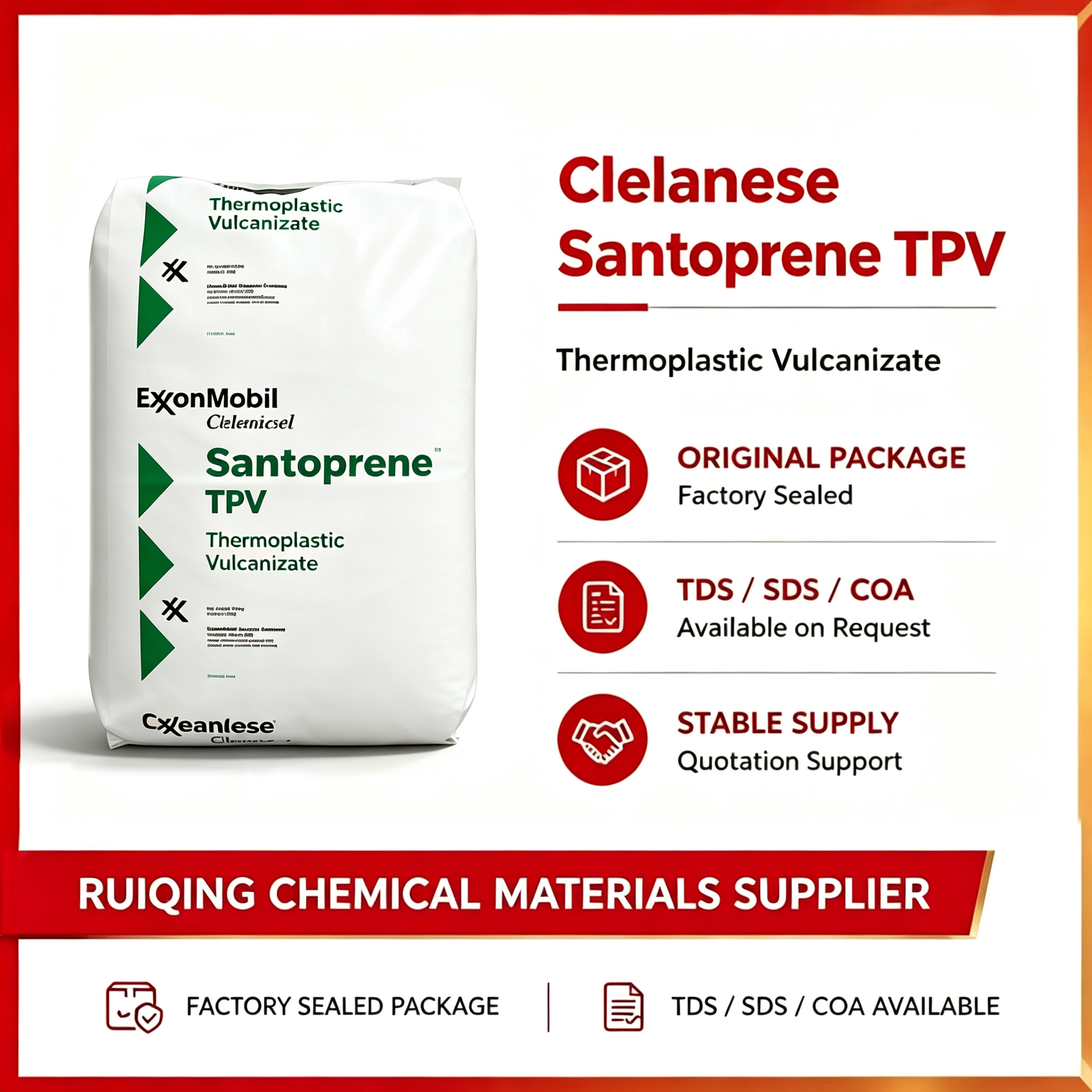
Santoprene 201-73W222 is a natural, colorable specialty thermoplastic vulcanizate (TPV) from Celanese designed for applications requiring a useful balance of fluid resistance, oxidative resistance, flex-fatigue resistance and ozone resistance.
Unlike black general-purpose Santoprene 101-series materials, Santoprene 201-73W222 is supplied in a natural form that can be colored for applications where appearance, identification or customer-specific color matching is important.
Celanese describes the grade as a soft, colorable specialty TPV in the thermoplastic elastomer family. It is polyolefin based and can be processed on conventional thermoplastic equipment.
The current Celanese grade sheet specifically states that Santoprene 201-73W222 combines good fluid and oxidative resistance for use in a wide range of applications.
It is also recommended where excellent flex-fatigue resistance and excellent ozone resistance are required.
These characteristics make the grade suitable for technical parts that may experience repeated bending, vibration, compression, outdoor exposure or contact with compatible fluids.
The current Shore A hardness is approximately 77, placing the material in the firmer end of the soft-elastomer range.
At the same time, Santoprene 201-73W222 retains high elongation. Current Celanese data lists approximately 460% elongation at break and approximately 3.3 MPa tensile stress at 100% elongation.
This combination allows the grade to provide greater support than softer 50–60 Shore A TPVs while remaining highly flexible.
The density is approximately 0.970 g/cm³, which is typical of a polyolefin-based Santoprene TPV.
A major advantage of Santoprene 201-73W222 is manufacturing flexibility. Celanese lists injection molding, multi-injection molding, extrusion, sheet extrusion, coextrusion and blow molding.
The material is also shear dependent. At low shear rates, Santoprene TPV has relatively high melt viscosity. As the shear rate increases, apparent melt viscosity decreases.
This behavior means that screw speed, gate design, injection speed and extrusion shear can have a strong influence on flow.
Because the material is thermoplastic, Santoprene 201-73W222 can be processed without the separate vulcanization step associated with conventional thermoset rubber.
Celanese also states that Santoprene TPV is recyclable within the manufacturing stream, allowing controlled production scrap to be reused where the application specification permits.
For more TPV materials, visit our TPV Thermoplastic Vulcanizates Product Category →.
For the official Celanese grade portfolio, see the Celanese Santoprene & Geolast TPV Product Finder →.
Key Features of Santoprene 201-73W222
| Feature | Engineering Benefit |
|---|---|
| Natural / Colorable | Supports custom-colored molded and extruded components |
| Shore A 77 | Firmer elastomeric response with good dimensional support |
| Good Fluid Resistance | Suitable for technical components exposed to compatible fluids |
| Good Oxidative Resistance | Helps support long-term durability under oxidative aging conditions |
| Excellent Flex-Fatigue Resistance | Useful for parts exposed to repeated movement or deformation |
| Excellent Ozone Resistance | Supports outdoor and atmospheric exposure |
| 460% Elongation at Break | Maintains high flexibility despite 77A hardness |
| Injection Molding | Suitable for complex molded elastomeric components |
| Extrusion / Coextrusion | Suitable for profiles, sheets and multi-material constructions |
| Blow Molding | Allows production of hollow flexible components |
| Polyolefin Based | Low density and conventional thermoplastic processing behavior |
| Manufacturing-Stream Recyclability | Supports controlled reuse of production scrap |
The central value of Santoprene 201-73W222 is the combination of colorability and specialty resistance performance in a 77 Shore A TPV.
Typical Applications for Santoprene 201-73W222
Celanese positions Santoprene 201-73W222 as a specialty grade for a wide range of applications rather than a narrowly defined single-use material.
Typical application areas include:
| Application Area | Typical Use |
|---|---|
| Flexible Seals | Colorable sealing components requiring fluid and oxidation resistance |
| Gaskets | Compressible technical gaskets in compatible environments |
| Protective Boots | Flexible protective components subject to repeated movement |
| Bellows | Cyclic flexing components benefiting from fatigue resistance |
| Flexible Housings | Soft technical housings and protective covers |
| Extruded Profiles | Natural or colored elastomeric profiles |
| Coextruded Components | Soft TPV layers combined with compatible substrates |
| Blow-Molded Parts | Hollow flexible components |
| Consumer Components | Colored flexible parts requiring durable elastomeric behavior |
| Industrial Components | Flexible technical components exposed to compatible fluids and ozone |
Because the current grade sheet does not define one exclusive end-use, application suitability should be selected around the published material characteristics of Santoprene 201-73W222 rather than assuming approval for a specific regulated market.
Typical Properties of Santoprene 201-73W222
Physical Properties
| Property | Typical Value | Test Method |
|---|---|---|
| Density | 970 kg/m³ / 0.970 g/cm³ | ISO 1183 |
| Shore A Hardness, 15 s | 77 | ISO 48-4 / ISO 868 |
| Resin Identification | TPV | ISO 1043 |
| Part Marking Code | >TPV< | ISO 11469 |
| Appearance | Natural / Colorable | Manufacturer information |
| Delivery Form | Pellets | Manufacturer information |
The natural appearance is one of the main differences between Santoprene 201-73W222 and many black general-purpose Santoprene grades.
Mechanical Properties
| Property | Typical Value | Test Method |
|---|---|---|
| Tensile Stress at 100% Elongation, Perpendicular | 3.3 MPa | ISO 37 |
| Elongation at Break, Perpendicular | 460% | ISO 527-1/-2 or ISO 37 |
| Shore A Hardness, 15 s | 77 | ISO 48-4 / ISO 868 |
The current Celanese grade sheet does not publish a tensile stress-at-break value for this grade. The page therefore retains only grade-specific values explicitly listed in the current technical data.
The 460% elongation confirms that Santoprene 201-73W222 remains highly extensible even at approximately 77 Shore A hardness.
Resistance Characteristics
| Characteristic | Celanese Positioning |
|---|---|
| Fluid Resistance | Good |
| Oxidative Resistance | Good |
| Flex-Fatigue Resistance | Excellent |
| Ozone Resistance | Excellent |
| Colorability | Yes |
| Recyclable in Manufacturing Stream | Yes |
These qualitative characteristics are explicitly stated by Celanese and are more useful for grade selection than transferring unsupported numerical values from neighboring Santoprene grades.
Why Choose Santoprene 201-73W222?
The main reason to choose Santoprene 201-73W222 is its specialty balance of resistance, colorability and elastomeric performance.
A standard black TPV may be acceptable when only hardness and basic flexibility matter.
However, some applications also require natural color for downstream pigmentation, better aesthetic flexibility, good fluid resistance, good oxidative resistance, excellent ozone resistance, high resistance to repeated flexing and conventional thermoplastic processing.
Santoprene 201-73W222 combines these characteristics in one material.
At Shore A 77, the grade provides firmer support than very soft TPVs.
Its 460% elongation allows substantial deformation before break.
Excellent flex-fatigue resistance is especially useful for components that bend, compress or move repeatedly during service.
Excellent ozone resistance supports outdoor and atmospheric exposure where ordinary elastomers may crack or degrade over time.
The natural base color is also commercially important. It allows processors to create customer-specific colors using compatible masterbatch systems rather than being limited to black components.
The material can also be injection molded, extruded, coextruded or blow molded, providing broad production flexibility.
For applications where colorability plus fluid, oxidative, flex-fatigue and ozone resistance are all important, Santoprene 201-73W222 is a more targeted option than a basic general-purpose TPV selected by hardness alone.
Processing Guidelines for Santoprene 201-73W222
Current Celanese data gives specific injection-processing conditions for Santoprene 201-73W222.
Injection Molding Conditions
| Processing Parameter | Celanese Guidance |
|---|---|
| Drying | Recommended |
| Drying Temperature | 80°C |
| Drying Time | ≥3 hours in a dehumidified dryer |
| Maximum Processing Moisture | ≤0.08% |
| Optimum Melt Temperature | 205°C |
| Minimum Melt Temperature | 190°C |
| Maximum Melt Temperature | 220°C |
| Optimum Mold Temperature | 30°C |
| Minimum Mold Temperature | 10°C |
| Maximum Mold Temperature | 50°C |
| Recommended Screw Speed | 100–200 rpm |
| Optional Back Pressure | 0.3–0.7 MPa |
| Holding Pressure | Approx. 50–75% of actual injection pressure |
These grade-specific values should be the preferred starting point when molding Santoprene 201-73W222.
General Santoprene TPV Processing Behavior
Celanese also states that Santoprene TPV has a broad processing window of approximately 175–230°C.
The grade-specific 190–220°C injection range is therefore more useful for initial machine setup.
Santoprene TPV has relatively high melt viscosity at low shear rates. As shear rate increases, melt viscosity decreases.
For this reason, higher screw speed can improve melt homogeneity, smaller gates can increase useful shear, and higher injection speed may improve flow. Increasing temperature alone may have less effect than increasing shear.
Drying
Celanese recommends desiccant drying at approximately 80°C for at least 3 hours.
The current grade sheet specifies a processing moisture content of ≤0.08%.
Drying is especially important when appearance and surface quality matter in natural or colored components.
Material Compatibility
Celanese states that Santoprene TPV is incompatible with acetal (POM) and PVC.
When equipment has previously processed POM or PVC, the barrel, screw, hot runner, die and other melt-contact areas should be properly purged before introducing Santoprene 201-73W222.
Santoprene 201-73W222 vs. Santoprene 201-67W171
| Feature | Santoprene 201-73W222 | Santoprene 201-67W171 |
|---|---|---|
| Material Family | TPV | TPV |
| Appearance | Natural / Colorable | Natural |
| Shore A Hardness | 77 | 71 |
| Elongation at Break | 460% | 450% |
| Tensile Stress @ 100% Elongation | 3.3 MPa | 2.8 MPa |
| Main Positioning | Good fluid & oxidative resistance | Profile extrusion; water or chemical foaming |
| Main Selection Difference | Firmer specialty resistance grade | Softer profile-extrusion / foaming grade |
The two grades should not be treated as simple hardness substitutes.
Santoprene 201-73W222 is more directly positioned around fluid and oxidative resistance, while 201-67W171 is specifically identified by Celanese for profile extrusion and water or chemical foaming.
Related Products
Santoprene 201-67W171 – Natural TPV for profile extrusion, including water or chemical foaming applications.
Santoprene 8211-85M350 – Natural specialty TPV with improved flow and improved abrasion resistance.
Santoprene 201-55W255 – Natural detergent-resistant TPV stabilized against copper and other metal-catalyzed degradation.
View More TPV Thermoplastic Vulcanizates →
Technical Documents for Santoprene 201-73W222
| Document Type | Description |
|---|---|
| TDS | Current Celanese grade-specific technical data |
| SDS | Safety Data Sheet |
| Santoprene Product Finder | Celanese TPV grade comparison and application positioning |
| Processing Guide | Injection molding and extrusion processing guidance |
| COA | Batch-specific quality information where available |
The current Celanese technical data sheet for Santoprene 201-73W222 was revised April 21, 2025.
Need documents or pricing?
📧 Email: ruiqingchem@gmail.com
📝 Online form: Contact Us →
FAQ About Santoprene 201-73W222
Q1: What is Santoprene 201-73W222?
Santoprene 201-73W222 is a natural, colorable specialty TPV from Celanese combining good fluid and oxidative resistance with excellent flex-fatigue and ozone resistance.
Q2: What is the hardness of Santoprene 201-73W222?
The current Celanese grade sheet lists approximately Shore A 77.
Q3: Is Santoprene 201-73W222 colorable?
Yes. Celanese specifically describes it as a natural, colorable specialty TPV.
Q4: What is the elongation at break?
Current Celanese data lists approximately 460% elongation at break.
Q5: What is the tensile stress at 100% elongation?
The current value is approximately 3.3 MPa.
Q6: Is Santoprene 201-73W222 resistant to fluids?
Celanese describes the grade as having good fluid resistance. Actual compatibility should be evaluated with the specific fluid, temperature and exposure conditions of the application.
Q7: Does Santoprene 201-73W222 have good ozone resistance?
Yes. Celanese specifically recommends the grade for applications requiring excellent ozone resistance.
Q8: Can Santoprene 201-73W222 be injection molded and extruded?
Yes. Celanese lists injection molding, multi-injection molding, extrusion, sheet extrusion, coextrusion and blow molding.
Q9: What processing temperature should be used?
The current grade-specific injection range is approximately 190–220°C, with an optimum melt temperature around 205°C.
Q10: Does Santoprene 201-73W222 need drying?
Yes. Celanese recommends drying at approximately 80°C for at least 3 hours in a dehumidified dryer and processing at moisture content ≤0.08%.
Request Santoprene 201-73W222 Price & Technical Support
For pricing, availability, technical documents or application support for Santoprene 201-73W222, please provide the required quantity, destination, application, required color, part type, fluid exposure, service temperature and processing method.
📧 Email: ruiqingchem@gmail.com
📝 Send Inquiry →