描述
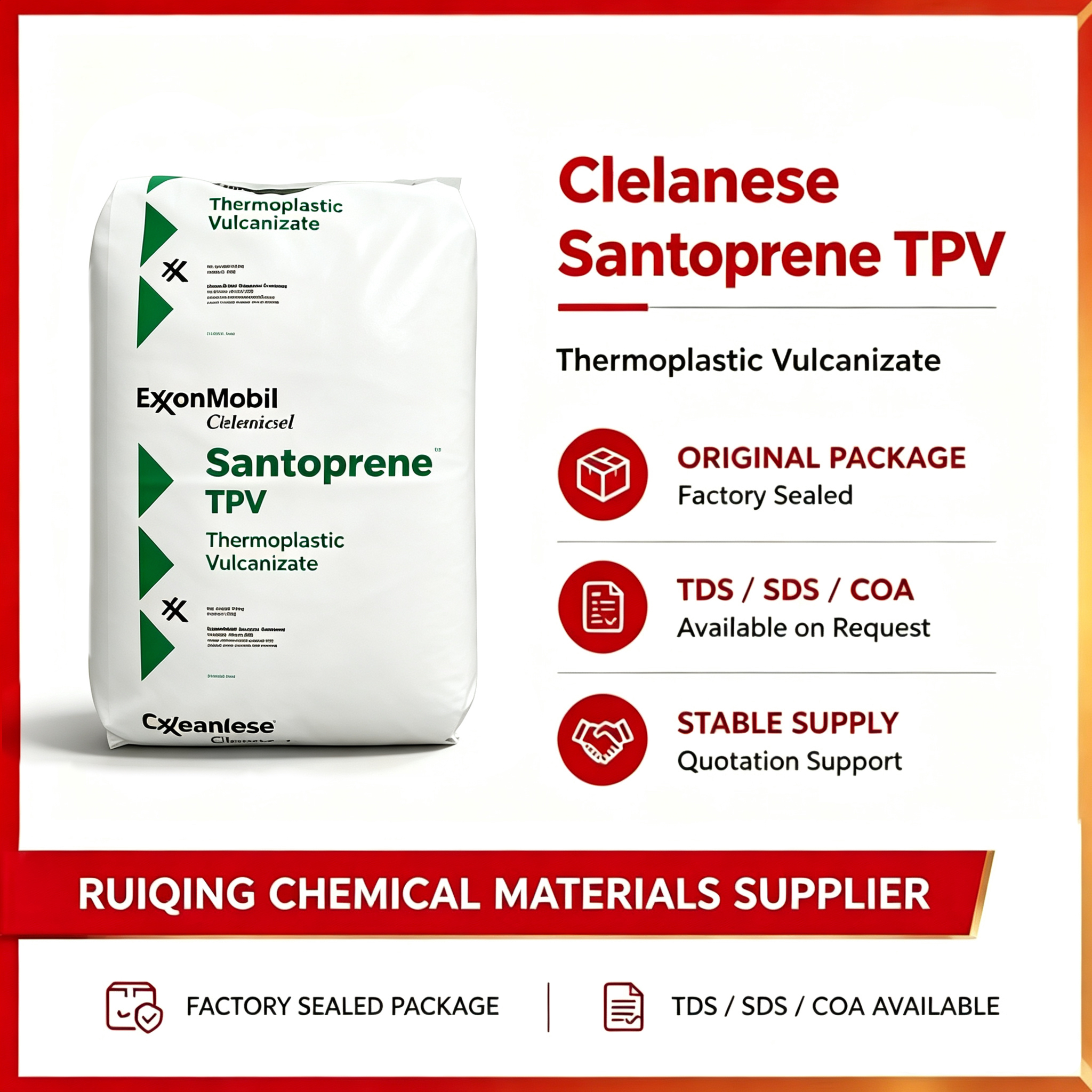
Santoprene 201-73 is a natural, colorable thermoplastic vulcanizate (TPV) from Celanese designed for general-purpose molding and extrusion applications that require a firm elastomeric response together with excellent flexibility and durability.
Celanese describes this grade as a soft, colorable and versatile TPV within the thermoplastic elastomer family. It combines good physical properties with chemical resistance and can be processed on conventional thermoplastic equipment.
A major advantage of Santoprene 201-73 is its natural color base. Unlike black general-purpose TPV grades, the natural formulation provides greater flexibility for customers who need custom colors or light-colored finished components.
The material has a Shore A hardness of approximately 78, placing it in a relatively firm elastomeric range while still maintaining very high elongation.
Current Celanese grade data lists approximately 490% elongation at break, 8.8 MPa stress at break, 3.6 MPa stress at 100% elongation and approximately 29 kN/m tear strength.
These properties give Santoprene 201-73 a useful combination of flexibility, strength and tear resistance for technical molded and extruded components.
Celanese specifically recommends the grade for applications requiring excellent flex-fatigue resistance. This makes it suitable for components that experience repeated bending, deformation or cyclic movement.
The grade also provides excellent ozone resistance, supporting use in outdoor, automotive and weather-exposed applications.
Low-temperature behavior is another important characteristic. Current data lists a brittleness temperature of approximately -60°C, demonstrating that the material can retain useful flexibility under cold conditions.
Compression set is approximately 28% at 70°C for 24 hours and approximately 37% at 125°C for 70 hours.
These values are important for sealing applications because a seal or gasket must recover after remaining compressed over long periods.
Current thermal information lists an electrical Relative Thermal Index of approximately 100°C at 1.5 mm, mechanical-strength RTI of approximately 90°C at 1.5 mm, and approximately 95°C at 3.0 mm.
The material is also UL recognized. Current Celanese documentation references QMFZ2.E80017 and QMFZ8.E80017.
For appliance-related suitability, current grade data lists detergent-resistance ratings of f3 under UL 749 and f4 under UL 2157.
The grade is polyolefin based and Celanese states that it is recyclable within the manufacturing stream.
Santoprene 201-73 can be processed by injection molding, extrusion, blow molding, thermoforming and vacuum forming, giving designers broad manufacturing flexibility.
For more TPV products, visit our TPV Thermoplastic Vulcanizates Product Category →.
For Celanese’s current Santoprene portfolio, see the Official Celanese Santoprene & Geolast Product Finder →.
Key Features of Santoprene 201-73
| Feature | Engineering Benefit |
|---|---|
| Natural / Colorable | Suitable for custom-colored parts where black TPV is not desired |
| Shore A 78 | Firm elastomeric response for seals and technical components |
| Excellent Flex-Fatigue Resistance | Supports repeated bending and cyclic movement |
| Excellent Ozone Resistance | Useful for weather-exposed and automotive applications |
| 490% Elongation at Break | Provides high deformability despite firm hardness |
| 8.8 MPa Stress at Break | Good mechanical strength for a TPV elastomer |
| 29 kN/m Tear Strength | Helps resist tearing around edges and thin sections |
| -60°C Brittleness Temperature | Supports low-temperature use |
| Good Chemical Resistance | Suitable for many industrial and automotive environments |
| UL Recognized | Current Celanese documentation lists E80017 |
| Injection Molding + Extrusion | Supports high-volume thermoplastic processing |
| Blow Molding | Suitable for selected hollow flexible components |
| Thermoforming / Vacuum Forming | Offers additional forming options |
| Manufacturing-Stream Recyclability | Helps reduce controlled process scrap |
The strongest value of Santoprene 201-73 is the combination of natural colorability, firm 78A hardness, strong tensile performance and excellent elastomeric durability.
Typical Applications for Santoprene 201-73
Santoprene 201-73 can be used in a wide range of automotive, industrial, appliance, electrical and consumer applications.
| Application Area | Typical Use |
|---|---|
| Seals & Gaskets | Static and dynamic elastomeric sealing components |
| Automotive Tubing | Flexible tubing and fluid-handling components |
| Air-Management Components | Ducts, couplings and flexible interfaces |
| Bellows & Boots | Repeated-flex protective components |
| Plugs & Grommets | Flexible protective and sealing parts |
| Diaphragms | Cyclic movement applications |
| Appliance Components | Molded and extruded flexible parts |
| Electrical Components | Flexible protective and insulating parts |
| Outdoor Profiles | Ozone-resistant seals and weather-exposed profiles |
| Consumer Products | Colorable flexible housings, grips and resilient parts |
| Blow-Molded Components | Hollow flexible parts |
| Thermoformed Parts | Shaped elastomeric sheet components |
Because Santoprene 201-73 is supplied in a natural color, it is especially attractive where product appearance or custom pigmentation is important.
Typical Properties of Santoprene 201-73
Physical Properties
| Property | Typical Value | Test Method |
|---|---|---|
| Density | 970 kg/m³ / 0.970 g/cm³ | ISO 1183 |
| Shore A Hardness, 15 s | 78 | ISO 48-4 / ISO 868 |
| Resin Identification | TPV | ISO 1043 |
| Part Marking Code | >TPV< | ISO 11469 |
| Color | Natural / Colorable | Manufacturer information |
| Product Form | Pellets / Granules | Manufacturer information |
The low density of approximately 0.970 g/cm³ is typical of polyolefin-based Santoprene TPV and can contribute to lightweight part design.
Mechanical Properties
| Property | Typical Value | Test Method |
|---|---|---|
| Stress at 100% Elongation | 3.6 MPa | ISO 527-1/-2 or ISO 37 |
| Stress at Break | 8.8 MPa | ISO 527-1/-2 or ISO 37 |
| Elongation at Break | 490% | ISO 527-1/-2 or ISO 37 |
| Tear Strength, Normal | 29 kN/m | ISO 34-1 |
| Brittleness Temperature | -60°C | ISO 974 |
| Brittleness Temperature | -60°C | ASTM D746 |
| Compression Set, 70°C / 24 h | 28% | ISO 815 |
| Compression Set, 125°C / 70 h | 37% | ISO 815 |
The combination of 490% elongation and 8.8 MPa stress at break gives Santoprene 201-73 a strong balance of flexibility and tensile performance.
Thermal Properties
| Property | Typical Value | Test Method |
|---|---|---|
| RTI Electrical, 1.5 mm | 100°C | UL 746B |
| RTI Strength, 1.5 mm | 90°C | UL 746B |
| RTI Strength, 3.0 mm | 95°C | UL 746B |
These values provide useful guidance for electrical and mechanical applications requiring documented long-term thermal performance.
Electrical Properties
| Property | Typical Value | Test Method |
|---|---|---|
| Comparative Tracking Index | PLC 0 | UL 746A |
| Arc Resistance Performance Level | PLC 6 | UL 746B |
| Electric Strength, Short Time, 2 mm | 30 kV/mm | ASTM D149 |
| High-Amperage Arc Ignition, 1.5 mm | PLC 0 | UL 746A |
| High-Voltage Arc Tracking Rate | PLC 1 | UL 746A |
The electrical data make Santoprene 201-73 useful for protective and insulating technical parts where elastomeric flexibility is required.
Flammability & Application Suitability
| Property | Typical Value / Rating | Standard |
|---|---|---|
| Burning Behavior @ 3 mm | HB | UL 94 |
| UL Recognition | Yes | UL 94 |
| Hot Wire Ignition @ 1.0 mm | PLC 4 | UL 746A |
| Hot Wire Ignition @ 1.5 mm | PLC 3 | UL 746A |
| Hot Wire Ignition @ 3.0 mm | PLC 3 | UL 746A |
| Detergent Resistance | f3 | UL 749 |
| Detergent Resistance | f4 | UL 2157 |
This grade is not positioned as a flame-retardant TPV. Its principal value lies in mechanical performance, flexibility, colorability and broad processing capability.
Automotive OEM References for Santoprene 201-73
Current Celanese Materials Database information lists several automotive specification references for Santoprene 201-73:
| OEM | Specification / Reference |
|---|---|
| Ford | WSD-M2D380-A1 |
| MAN | M3236 A7 |
| Stellantis / Chrysler | MS-AR-100 CGN |
| Volkswagen Group | VW50123 |
These references are useful for customers evaluating Santoprene 201-73 for automotive tubing, seals, flexible molded parts and under-hood elastomeric components.
OEM specification references should always be checked against the exact current component requirement and approval status for the intended program.
Why Choose Santoprene 201-73?
A key reason to choose Santoprene 201-73 is its natural, colorable appearance.
Many technical TPV applications need more than a black elastomer. Consumer products, appliance components, electrical parts, automotive interior or visible technical components may require custom colors.
The natural base gives compounders and molders greater flexibility for pigmentation.
At the same time, the material retains the strong elastomeric performance expected from the Santoprene 201 series.
The Shore A hardness of approximately 78 provides a firm response suitable for parts that must hold their shape while still flexing.
The stress at break of approximately 8.8 MPa and tear strength of approximately 29 kN/m provide useful mechanical durability.
The approximately 490% elongation means that the material can undergo substantial deformation before failure.
Excellent flex-fatigue resistance is important for bellows, diaphragms, tubing and flexible connections that move repeatedly during service.
Excellent ozone resistance supports outdoor and automotive environments where atmospheric exposure can damage conventional elastomers.
The -60°C brittleness temperature makes the grade suitable for cold-weather service.
Compression-set performance supports gaskets and seals that remain compressed over long periods.
The material also provides manufacturing advantages over traditional thermoset rubber. It can be injection molded, extruded or blow molded on thermoplastic equipment without a separate vulcanization stage.
Thermoforming and vacuum forming further extend the available processing options.
For customers who need a natural, colorable 78A TPV with high elongation, strong tear performance and proven general-purpose processing, Santoprene 201-73 is a strong candidate.
Processing Guidelines for Santoprene 201-73
Santoprene 201-73 can be processed by:
- Injection molding
- Multi-injection molding
- Extrusion
- Profile extrusion
- Sheet extrusion
- Coextrusion
- Blow molding
- Thermoforming
- Vacuum forming
Injection Processing
| Processing Parameter | Celanese Guidance |
|---|---|
| Drying Temperature | 82°C |
| Drying Time | 3 hours in a dehumidified dryer |
| Maximum Processing Moisture | 0.08% |
| Maximum Regrind Level | 20% |
| Mold Temperature | 10–52°C |
| Vent Depth | 25 µm |
| Back Pressure | 0.345–0.689 MPa |
| Injection Speed | Fast |
Celanese recommends drying the material before processing, particularly when surface quality and process stability are important.
Extrusion Processing
| Processing Parameter | Celanese Guidance |
|---|---|
| Drying Temperature | 82°C |
| Drying Time | 3 hours |
| Melt Temperature Reference | 202°C |
| General Santoprene TPV Processing Window | 175–230°C |
The current Celanese processing notes recommend desiccant drying for approximately 3 hours at 80°C.
Shear-Dependent Flow Behavior
Santoprene 201-73 is a shear-dependent TPV.
As shear rate increases, apparent viscosity decreases. This behavior is important when optimizing screw speed, injection speed, gate design, runner dimensions, melt temperature, mold temperature, extrusion die geometry, melt pressure, draw-down and surface finish.
For difficult-to-fill sections, increasing shear through process optimization can sometimes be more effective than simply raising melt temperature.
Material Compatibility During Processing
Celanese states that Santoprene TPV is incompatible with acetal (POM) and PVC.
When changing from POM or PVC to Santoprene 201-73, processors should thoroughly purge the barrel, screw, hot runner or extrusion line to minimize contamination.
Regrind
The current Celanese grade data lists a maximum regrind level of approximately 20%.
Actual regrind use should still be controlled according to appearance requirements, color consistency, mechanical-property requirements, OEM specifications, contamination control and number of reprocessing cycles.
Because this grade is natural and colorable, contamination control is especially important when light colors are required.
Related Products
Santoprene 201-64 – Natural colorable general-purpose TPV with approximately Shore A 69 hardness.
Santoprene 201-80 – Natural colorable higher-hardness general-purpose TPV for firmer elastomeric applications.
Santoprene 101-73 – Black general-purpose TPV in a similar hardness range for applications where black color is acceptable.
View More TPV Thermoplastic Vulcanizates →
Technical Documents for Santoprene 201-73
| Document Type | Description |
|---|---|
| TDS | Celanese physical, mechanical, thermal, electrical and processing data |
| SDS | Safety Data Sheet |
| UL Information | QMFZ2.E80017 / QMFZ8.E80017 recognition |
| Automotive Specification Information | Ford, MAN, Stellantis / Chrysler and VW references |
| Santoprene Product Finder | Celanese grade positioning and application information |
| Processing Guide | Injection molding, extrusion and related process guidance |
| COA | Batch-specific quality information where available |
Need technical documents for Santoprene 201-73?
📧 Email: ruiqingchem@gmail.com
📝 Online form: Contact Us →
Please state Santoprene 201-73 and the required document type when submitting your inquiry.
FAQ About Santoprene 201-73
Q1: What is Santoprene 201-73?
Santoprene 201-73 is a natural, colorable general-purpose TPV from Celanese with approximately Shore A 78 hardness.
Q2: Is Santoprene 201-73 colorable?
Yes. Celanese identifies the grade as natural and colorable, making it suitable for applications that require custom colors.
Q3: What is the hardness of Santoprene 201-73?
The current Shore A hardness is approximately 78.
Q4: What is the elongation at break?
Current Celanese grade data lists approximately 490% elongation at break.
Q5: What is the tensile stress at break?
The current stress at break is approximately 8.8 MPa.
Q6: What is the tear strength?
The current tear strength is approximately 29 kN/m.
Q7: How does Santoprene 201-73 perform at low temperature?
The current brittleness temperature is approximately -60°C, supporting use in cold-weather applications.
Q8: Can Santoprene 201-73 be injection molded and extruded?
Yes. Celanese lists injection molding, extrusion, blow molding, thermoforming and vacuum forming among the supported processes.
Q9: What drying conditions are recommended?
Current Celanese data lists approximately 82°C for 3 hours in a dehumidified dryer, with processing moisture content around 0.08% maximum.
Q10: What applications are suitable for Santoprene 201-73?
Typical applications include seals, gaskets, tubing, air-management parts, bellows, boots, appliance components, electrical protective parts, outdoor profiles and colorable consumer-product components.
Request Santoprene 201-73 Price & Technical Support
For pricing, availability, technical documents or application support for Santoprene 201-73, please provide:
- Required quantity
- Destination country or port
- Automotive, industrial, appliance, electrical or consumer application
- Required final color
- Seal, gasket, tube, profile or molded-part design
- Required Shore hardness
- Continuous and peak operating temperature
- Minimum service temperature
- Compression-set requirement
- Chemical or detergent exposure
- Outdoor / ozone exposure
- Injection-molding, extrusion, blow-molding or thermoforming process
- OEM specification requirement
- UL documentation requirement
- TDS, SDS or COA requirement
- Sample requirement, if applicable
📧 Email: ruiqingchem@gmail.com
📝 Send Inquiry →