描述
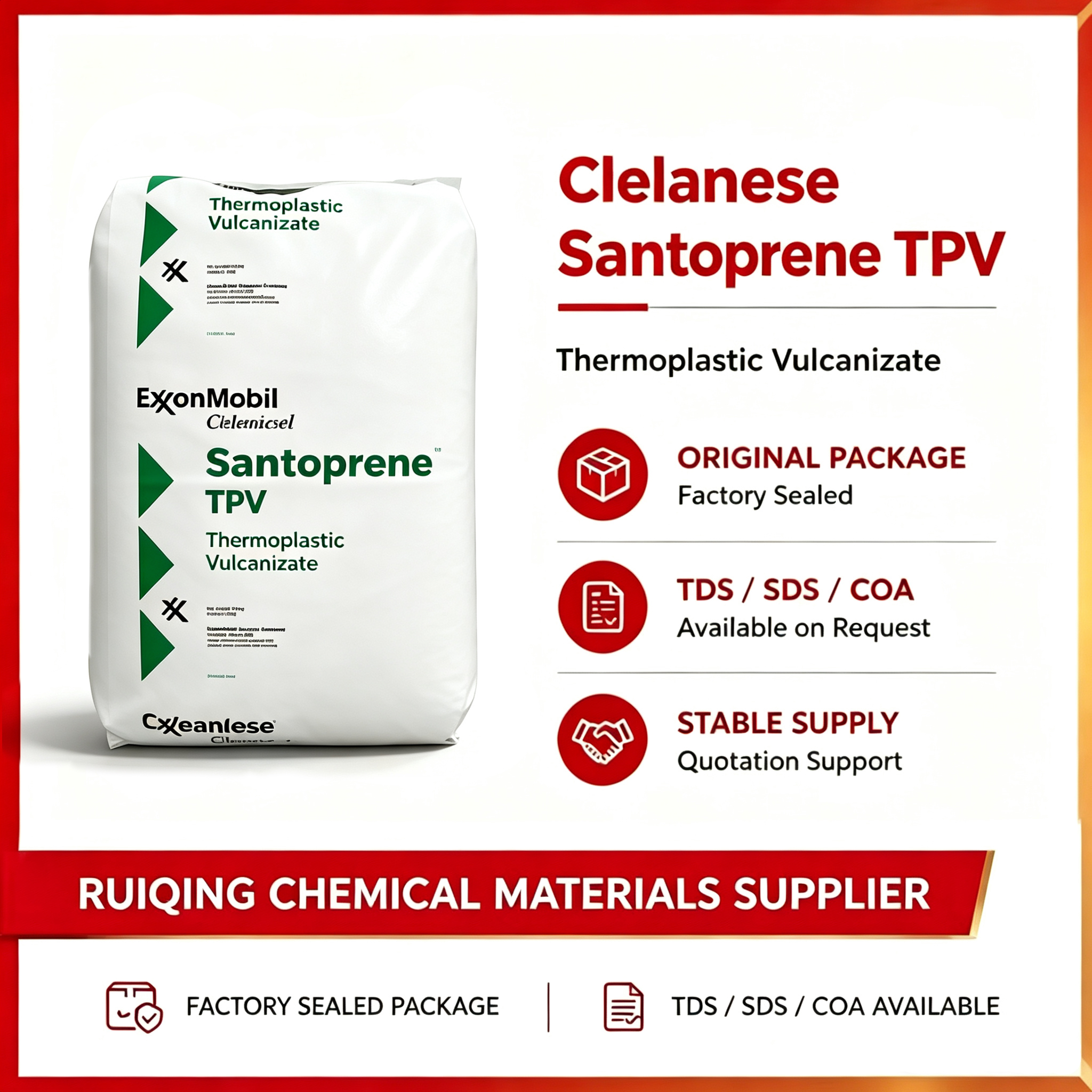
Santoprene 163-40F500 is a black thermoplastic vulcanizate (TPV) from Celanese developed specifically for coextrusion applications in automotive weatherseal systems.
The current Celanese grade description identifies a particularly focused application: the static foot of automotive weatherseal systems such as glass run channels.
This is an important distinction. Santoprene 163-40F500 is not positioned as a broad, generic TPV selected only by hardness. Its formulation is designed around the needs of continuous coextrusion production where dimensional consistency, stable throughput and clean die behavior are critical.
Celanese highlights three grade-specific features:
- Recommended for coextruded applications not exposed to UV light
- Recommended where excellent ozone resistance is required
- Designed to maximize run length with minimal material build-up on screen packs or narrow die sections
These points make Santoprene 163-40F500 particularly attractive for automotive extrusion lines where long production runs and reduced maintenance interruptions can directly improve manufacturing efficiency.
The grade has a Shore D hardness of approximately 43, which gives it a firmer elastomeric response than many Shore A Santoprene grades while still retaining very high extensibility.
Current Celanese data lists approximately 590% elongation at break, 18 MPa stress at break and 9.7 MPa tensile stress at 100% elongation.
This combination of high strength and very high elongation is useful in weatherseal constructions that must withstand assembly deformation, profile bending and long-term movement without brittle failure.
The density is approximately 0.940 g/cm³, helping reduce component mass in comparison with many conventional rubber systems.
As a Santoprene TPV, the material behaves like a rubber in service but processes like a thermoplastic. Celanese lists extrusion and thermoforming as the key processing methods for this grade.
The material is also polyolefin based and recyclable within the manufacturing stream, giving processors the potential to rework controlled production scrap where the product specification permits.
One of the most important points for material selection is the UV statement. Celanese specifically recommends Santoprene 163-40F500 for coextruded applications not exposed to UV light.
That means the grade is well suited to protected or internal portions of a weatherseal profile, such as the static foot of a glass run channel, but it should not automatically be treated as the exposed exterior sealing surface when direct sunlight is part of the service environment.
For more TPV products, visit our TPV Thermoplastic Vulcanizates Product Category →.
For the broader Santoprene TPV portfolio, visit the official Celanese Santoprene TPV page →.
Key Features of Santoprene 163-40F500
| Feature | Engineering Benefit |
|---|---|
| Automotive Weatherseal Coextrusion Grade | Developed for continuous multi-material weatherseal production |
| Static Foot / Glass Run Channel Focus | Well matched to protected structural sections of weatherseal systems |
| Shore D 43 | Provides a firmer elastomeric support section |
| 590% Elongation at Break | Allows substantial deformation without brittle failure |
| 18 MPa Stress at Break | High mechanical strength for a TPV weatherseal component |
| Excellent Ozone Resistance | Supports long-term automotive elastomer performance |
| Low Die / Screen-Pack Build-Up | Helps extend production run length and reduce cleaning interruptions |
| Shear-Dependent Flow | Supports efficient extrusion when shear and temperature are optimized |
| Low Density – 0.940 g/cm³ | Helps reduce weight compared with many denser rubber materials |
| Extrusion Processing | Suitable for continuous weatherseal profile manufacture |
| Thermoforming Capability | Provides additional forming flexibility |
| Polyolefin Based | Compatible with conventional TPV processing principles |
| Manufacturing-Stream Recyclability | Controlled production scrap can be reprocessed where permitted |
The most distinctive advantage of Santoprene 163-40F500 is not simply its mechanical performance. It is the combination of high elongation, ozone resistance and extrusion-line cleanliness for automotive weatherseal production.
Typical Applications for Santoprene 163-40F500
The current Celanese grade sheet gives a narrow and clearly defined application focus.
| Application Area | Typical Use |
|---|---|
| Automotive Weatherseals | Coextruded sealing systems |
| Glass Run Channels | Static foot or protected structural section |
| Window Sealing Profiles | Internal or non-UV-exposed profile section |
| Coextruded Multi-Material Profiles | Firmer TPV support layer in a weatherseal construction |
| Protected Automotive Extrusions | Ozone-resistant profiles not directly exposed to UV |
| Long-Run Extrusion Profiles | Applications where reduced die build-up is important |
The exact grade positioning matters here: Santoprene 163-40F500 should be considered primarily for protected weatherseal sections rather than exposed UV surfaces.
Automotive Weatherseal Design Role
Automotive weatherseal systems often use more than one material or more than one hardness within the same profile.
A glass run channel, for example, can contain a structural support section, a soft sealing lip, a low-friction contact surface, a static foot or anchoring section and reinforcement features.
Santoprene 163-40F500 is specifically positioned for the static foot of this type of system.
The Shore D 43 hardness gives the static foot more support than a softer weatherseal lip material. This can help the profile maintain its location and shape after installation.
With approximately 590% elongation at break, the grade can tolerate significant strain during extrusion, assembly and profile bending.
The approximately 18 MPa stress at break gives the material a strong mechanical profile for an elastomeric TPV.
Automotive elastomeric components can be exposed to ozone throughout their service life. Celanese specifically identifies excellent ozone resistance as a key feature of this grade.
Screen-pack and die build-up can cause pressure variation, surface defects and line stoppages. Celanese states that Santoprene 163-40F500 is designed to maximize run length with minimal build-up on screen packs or narrow die sections.
For high-volume automotive extrusion, this is a commercially important processing feature.
Typical Properties of Santoprene 163-40F500
Physical Properties
| Property | Typical Value | Test Method |
|---|---|---|
| Density | 940 kg/m³ / 0.940 g/cm³ | ISO 1183 |
| Shore D Hardness, 15 s | 43 | ISO 48-4 / ISO 868 |
| Resin Identification | TPV | ISO 1043 |
| Part Marking Code | >TPV< | ISO 11469 |
| Color | Black | Manufacturer information |
| Product Form | Pellets | Manufacturer information |
The density of approximately 0.940 g/cm³ is relatively low and is one of the advantages of a polyolefin-based TPV system.
Mechanical Properties
| Property | Typical Value | Test Method |
|---|---|---|
| Tensile Stress at 100% Elongation, Perpendicular | 9.7 MPa | ISO 37 |
| Stress at Break, Perpendicular | 18 MPa | ISO 527-1/-2 or ISO 37 |
| Elongation at Break, Perpendicular | 590% | ISO 527-1/-2 or ISO 37 |
| Shore D Hardness, 15 s | 43 | ISO 48-4 / ISO 868 |
The combination of Shore D 43 hardness with approximately 590% elongation is notable. It gives the material a relatively firm response while still allowing extensive deformation.
Application-Specific Performance
| Characteristic | Current Celanese Positioning |
|---|---|
| Ozone Resistance | Excellent |
| UV Exposure | Recommended for applications not exposed to UV light |
| Coextrusion | Recommended |
| Automotive Weatherseals | Recommended |
| Static Foot of Glass Run Channels | Specifically identified application |
| Screen-Pack / Die Build-Up | Designed to minimize build-up and maximize run length |
These application notes are more important for Santoprene 163-40F500 than generic TPV family claims because they explain why this exact grade exists.
Why Choose Santoprene 163-40F500?
Santoprene 163-40F500 should be selected when the application requires a firmer TPV section within a coextruded automotive weatherseal and production stability is a major concern.
The grade’s most valuable feature is its targeted formulation for continuous extrusion.
In a long coextrusion run, deposits can accumulate on screens, adapters or narrow die regions. Build-up can increase melt pressure, affect profile dimensions, create visible defects and eventually force the line to stop for cleaning.
Celanese specifically designed Santoprene 163-40F500 to reduce this build-up behavior.
That makes the material particularly relevant to high-volume automotive weatherseal suppliers.
Its mechanical performance also supports the static-foot function. The grade is firm enough to support the profile, strong enough to resist damage during installation and still flexible enough to accommodate complex channel geometry.
Excellent ozone resistance contributes to long-term durability.
The grade’s UV limitation should also be treated correctly. The profile can use Santoprene 163-40F500 in a protected internal section and select another material for exposed sealing lips when direct UV resistance is required.
Processing Guidelines for Santoprene 163-40F500
Santoprene 163-40F500 is primarily intended for extrusion-based processing and Celanese also lists thermoforming.
Current Grade-Specific Extrusion Conditions
| Processing Parameter | Celanese Guidance |
|---|---|
| Drying Temperature | 82°C |
| Drying Time | 3 hours in a dehumidified dryer |
| Melt Temperature Range | 177–204°C |
| General Santoprene TPV Processing Window | 175–230°C |
| Maximum Drawdown | 15% |
Celanese recommends desiccant drying for approximately 3 hours at 80–82°C before extrusion.
The current exact-grade extrusion melt-temperature range is 177–204°C.
Although Santoprene TPV as a family can be processed over a broader temperature range, the grade-specific range should be used as the more relevant starting point for Santoprene 163-40F500.
Drawdown Control
Celanese states that drawdown should not exceed 15%.
This is especially important for weatherseal extrusion because excessive drawdown can change profile dimensions, wall thickness, orientation, surface quality and mechanical behavior.
Shear-Dependent Flow
Santoprene TPV is shear dependent.
As shear rate increases, apparent viscosity decreases. In extrusion, screw speed, melt temperature, screen pack, adapter design, die land, head pressure, line speed, drawdown and cooling conditions should therefore be optimized together.
The goal is stable profile dimensions and clean, consistent melt flow over long production runs.
Material Compatibility
Celanese states that Santoprene TPV is incompatible with acetal (POM) and PVC.
When changing materials, the extrusion line should be thoroughly purged to avoid contamination, especially around screen packs, adapters and narrow die passages.
Coextrusion Considerations
For a successful Santoprene 163-40F500 weatherseal profile, processors should evaluate the entire construction rather than only the TPV.
Important factors include:
- Adjacent material compatibility
- Melt-temperature balance
- Viscosity balance between coextruded layers
- Interfacial adhesion
- Die design
- Material residence time
- Profile geometry
- Cooling rate
- Line speed
- Drawdown
- Surface requirements
Because the grade is intended for a protected static-foot section, the design may combine it with a softer or UV-stabilized material in other parts of the same weatherseal.
This allows each region of the profile to use a material optimized for its own mechanical and environmental function.
Current Data Status
The available Celanese Materials Database grade sheet for Santoprene 163-40F500 is marked PRELIMINARY and was revised on June 24, 2024.
The published exact-grade values currently available include density, Shore D hardness, tensile stress at 100% elongation, stress at break, elongation at break, drying conditions and extrusion melt-temperature range.
This page therefore uses only the exact properties currently published for Santoprene 163-40F500 and does not transfer unrelated numerical values from other Santoprene grades.
Related Products
You can browse additional general-purpose, weatherseal and specialty TPV grades in our:
TPV Thermoplastic Vulcanizates Product Category →
Santoprene product families include general-purpose TPV grades, automotive weatherseal grades, UV-resistant grades, detergent-resistant grades, high-resilience grades, food and potable-water grades, medical grades and specialty extrusion grades.
Technical Documents for Santoprene 163-40F500
| Document Type | Description |
|---|---|
| TDS | Current Celanese grade-specific mechanical and processing data |
| SDS | Safety Data Sheet |
| Processing Information | Extrusion and coextrusion guidance |
| Santoprene Product Information | Celanese TPV family and application information |
| COA | Batch-specific quality documentation where available |
Need technical documents for Santoprene 163-40F500?
📧 Email: ruiqingchem@gmail.com
📝 Online form: Contact Us →
Please state Santoprene 163-40F500 and the required document type when submitting your inquiry.
FAQ About Santoprene 163-40F500
Q1: What is Santoprene 163-40F500?
Santoprene 163-40F500 is a black Celanese TPV developed for automotive weatherseal coextrusion, especially the static foot of glass run channel systems.
Q2: What is the hardness of Santoprene 163-40F500?
The current Celanese grade sheet lists approximately Shore D 43.
Q3: What is the elongation at break?
Current data lists approximately 590% elongation at break.
Q4: What is the tensile strength?
The current stress at break is approximately 18 MPa, while tensile stress at 100% elongation is approximately 9.7 MPa.
Q5: Is Santoprene 163-40F500 UV resistant?
Celanese specifically recommends the grade for coextruded applications not exposed to UV light. It should therefore be used in protected sections rather than automatically selected for direct exterior UV exposure.
Q6: Does Santoprene 163-40F500 have good ozone resistance?
Yes. Excellent ozone resistance is one of the grade-specific features identified by Celanese.
Q7: Why is Santoprene 163-40F500 suitable for long extrusion runs?
Celanese designed the grade to maximize run length with minimal material build-up on screen packs and narrow die sections.
Q8: What processing method is recommended?
The grade is designed primarily for extrusion / coextrusion, and Celanese also lists thermoforming.
Q9: What extrusion temperature should be used?
The current grade-specific melt-temperature range is approximately 177–204°C.
Q10: Does Santoprene 163-40F500 require drying?
Yes. Current Celanese data recommends approximately 3 hours at 80–82°C in a dehumidified dryer before processing.
Request Santoprene 163-40F500 Price & Technical Support
For pricing, availability, technical documents or application support for Santoprene 163-40F500, please provide:
- Required quantity
- Destination country or port
- Automotive weatherseal application
- Glass run channel or other profile design
- Static-foot dimensions
- Coextruded adjacent material
- Extrusion line configuration
- Required line speed
- Current die / screen-pack build-up issue, if any
- UV exposure condition
- Ozone-resistance requirement
- Target hardness
- Profile drawing or dimensions
- TDS, SDS or COA requirement
- Sample requirement, if applicable
📧 Email: ruiqingchem@gmail.com
📝 Send Inquiry →