描述
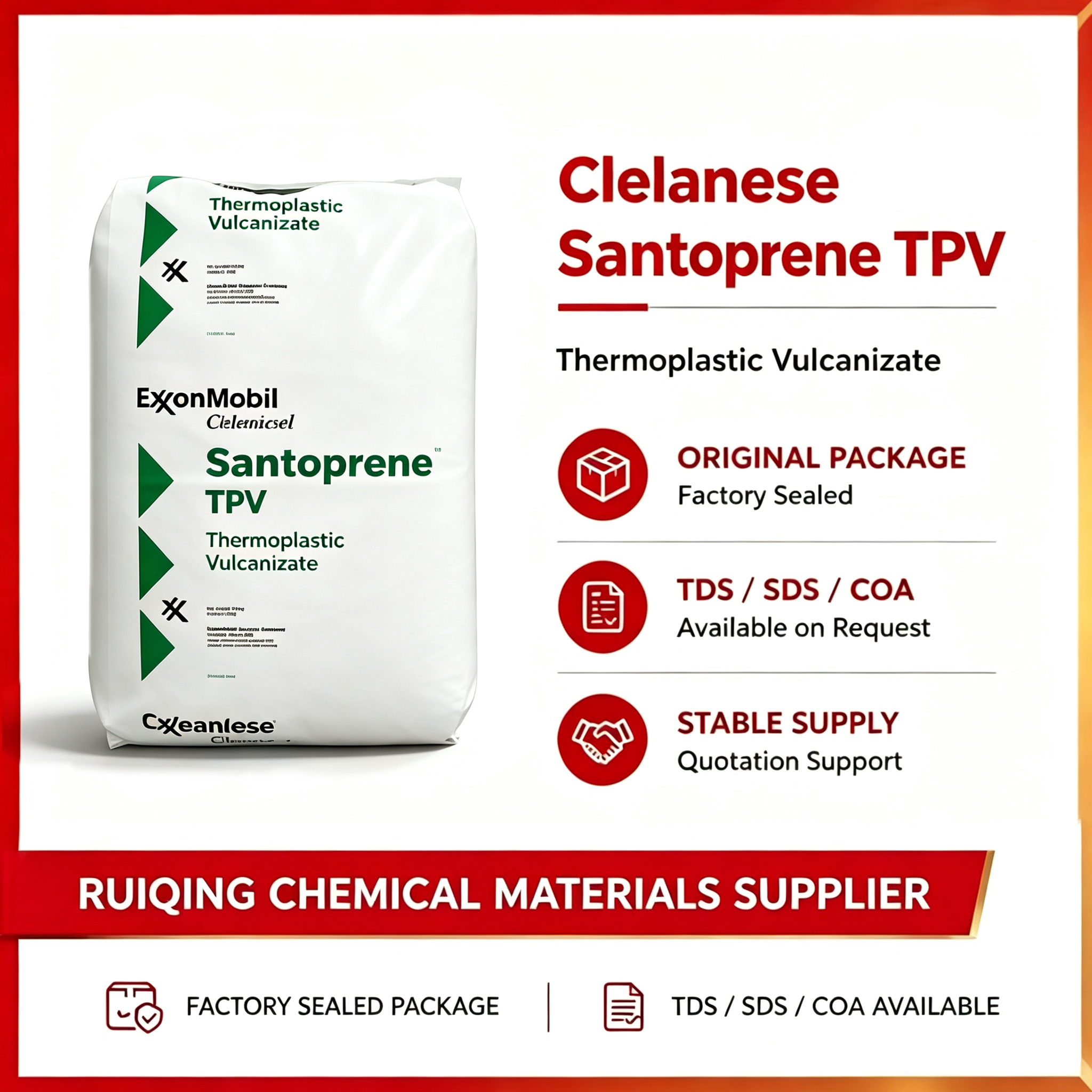
Santoprene 151-70W256 is a black, flame-retardant thermoplastic vulcanizate (TPV) from Celanese developed for demanding photovoltaic, electrical and outdoor connector applications.
This grade is significantly different from standard general-purpose Santoprene 101-series materials. Its main design objective is not simply elastomeric flexibility. It combines rubber-like flexibility with a dedicated flame-retardant system and electrical performance suitable for safety-critical outdoor components.
Celanese positions Santoprene 151-70W256 within its flame-retardant TPV portfolio. The material is designed for photovoltaic-system components such as junction boxes and connectors, including applications where the TPV functions as part of an enclosure or electrical-insulation system.
The material is black and has a Shore A hardness of approximately 75.
Current Celanese portfolio information lists approximately 480% elongation at break, 4.8 MPa tensile stress at break and 2.3 MPa stress at 100% elongation.
The grade also carries a density of approximately 1.26 g/cm³, which is noticeably higher than many general-purpose Santoprene grades because of its flame-retardant formulation.
One of the most important technical advantages of Santoprene 151-70W256 is its UL flammability performance.
The grade achieves UL 94 V-1 down to 1.5 mm and UL 94 5VA down to 1.8 mm. Current UL certification information for the black grade under file E80017 confirms V-1 at 1.5 mm and V-1/5VA at 1.8 mm and 3.0 mm.
The current UL listing also confirms f1 outdoor suitability, indicating suitability for outdoor use with respect to ultraviolet-light exposure, water exposure and immersion under UL 746C.
This outdoor rating is especially important for photovoltaic systems because junction boxes, connectors and cable interfaces can be exposed to sunlight, moisture, rain and temperature cycling for long service periods.
Electrical performance is another key reason to select Santoprene 151-70W256.
Published grade data lists a dielectric strength of approximately 28 kV/mm at 2.0 mm, CTI category PLC 1, High Amp Arc Ignition PLC 0, High Voltage Arc Resistance PLC 6, and an inclined-plane tracking time of approximately 107 minutes at 2.5 kV.
Celanese also reports high-frequency dielectric data for the material. At 37 GHz, the grade has a dielectric constant of approximately 2.33 and dielectric loss of approximately 0.0027.
These figures broaden the technical relevance of the grade beyond conventional photovoltaic components to selected high-frequency electrical and connectivity applications where a flexible, outdoor-capable, flame-retardant TPV is required.
The material remains a thermoplastic elastomer and therefore retains processing advantages compared with thermoset rubber.
Santoprene 151-70W256 is shear dependent and can be processed on conventional thermoplastic injection-molding equipment. It is polyolefin based and recyclable within the manufacturing stream.
For more TPV materials, visit our TPV Thermoplastic Vulcanizates Product Category →.
For Celanese’s current Santoprene portfolio, see the Official Celanese Santoprene & Geolast Product Finder →.
Key Features of Santoprene 151-70W256
| Feature | Engineering Benefit |
|---|---|
| UL 94 V-1 @ 1.5 mm | Supports flame-retardant electrical components at relatively thin wall sections |
| UL 94 5VA @ 1.8 mm | Strong flammability performance for enclosures and connector components |
| Outdoor Suitability f1 | Suitable for UV, water-exposure and outdoor-service environments |
| Shore A 75 | Balances flexibility with structural support |
| 480% Elongation at Break | Allows substantial deformation without brittle fracture |
| 4.8 MPa Tensile Stress at Break | Provides useful mechanical strength for flexible electrical components |
| 28 kV/mm Dielectric Strength | Supports insulation and electrical-protection applications |
| CTI PLC 1 | Documented electrical tracking performance |
| 107 min Inclined-Plane Tracking @ 2.5 kV | Useful for demanding electrical insulation environments |
| RoHS-Compliant Flame-Retardant System | Supports electrical and electronics compliance programs |
| Black Color | Suitable for outdoor photovoltaic and electrical components |
| Shear-Dependent Flow | Supports efficient thermoplastic injection molding |
| Polyolefin Based | Provides TPV processing and recyclability benefits |
| Manufacturing-Stream Recyclability | Allows controlled process-scrap reuse where specifications permit |
The defining value of Santoprene 151-70W256 is the combination of flame retardancy, outdoor durability, electrical insulation performance and elastomeric flexibility.
Typical Applications for Santoprene 151-70W256
Santoprene 151-70W256 is specifically suited to electrical and photovoltaic environments.
| Application Area | Typical Use |
|---|---|
| Photovoltaic Junction Boxes | Flexible enclosure, sealing and insulation components |
| PV Connectors | Connector bodies, flexible seals and insulation elements |
| Solar-System Electrical Components | Outdoor elastomeric electrical parts |
| Electrical Enclosures | Flexible flame-retardant housing components |
| Connector Seals | Weather-resistant sealing around electrical interfaces |
| Cable Interfaces | Flexible protection and sealing around cable-entry points |
| Outdoor Electrical Components | Parts exposed to UV, moisture and weather |
| Flexible Insulating Components | Elastomeric electrical-insulation parts |
| 5G / Connectivity Components | Selected flexible electrical components requiring low dielectric loss |
| Overmolded Electrical Parts | TPV sections molded around compatible substrates |
Celanese originally developed this grade around requirements for photovoltaic junction boxes and connectors, making this the strongest application positioning for Santoprene 151-70W256.
Typical Properties of Santoprene 151-70W256
Physical & Mechanical Properties
| Property | Typical Value | Test Method |
|---|---|---|
| Density | 1.26 g/cm³ | ISO 1183 |
| Specific Gravity | 1.26 | ASTM D792 |
| Shore A Hardness, 15 s | 75 | ISO 868 |
| Tensile Stress at 100% Elongation | 2.30 MPa | ISO 37 / ASTM D412 |
| Tensile Stress at Break | 4.80 MPa | ISO 37 / ASTM D412 |
| Elongation at Break | 480% | ISO 37 / ASTM D412 |
| Color | Black | Manufacturer information |
| Product Form | Pellets | Manufacturer information |
The combination of Shore A 75 hardness and approximately 480% elongation gives Santoprene 151-70W256 a useful balance of flexibility and structural support.
Flammability Properties
| Property | Typical Value / Classification | Test Method |
|---|---|---|
| UL 94 @ 1.5 mm | V-1 | UL 94 |
| UL 94 @ 1.8 mm | V-1 / 5VA | UL 94 |
| UL 94 @ 3.0 mm | V-1 / 5VA | UL 94 |
| Oxygen Index | 24% | ASTM D2863 / ISO 4589-2 |
| UL File | E80017 | UL |
| Outdoor Suitability | f1 | UL 746C |
The 5VA classification at 1.8 mm is one of the most important selling points of the grade.
Current UL Relative Thermal Index Information
Current UL certification for black Santoprene 151-70W256 under E80017 lists:
| Thickness | RTI Electrical | RTI Impact | RTI Strength |
|---|---|---|---|
| 1.5 mm | 100°C | 95°C | 95°C |
| 1.8 mm | 100°C | 95°C | 95°C |
| 3.0 mm | 100°C | 100°C | 100°C |
Earlier Santoprene datasheets referenced a general RTI value of approximately 90°C. For certification-sensitive projects, the current UL file E80017 should be checked because UL certification data can be updated independently of older published product datasheets.
Electrical Properties
| Property | Typical Value | Test Method |
|---|---|---|
| Dielectric Strength @ 2.0 mm | 28 kV/mm | ASTM D149 |
| Comparative Tracking Index | PLC 1 | UL 746 |
| High Amp Arc Ignition | PLC 0 | UL 746 |
| High Voltage Arc Resistance to Ignition | PLC 6 | UL 746 |
| Hot-Wire Ignition @ 1.5 mm | PLC 2 | UL 746 |
| Hot-Wire Ignition @ 1.8 mm | PLC 2 | UL 746 |
| Hot-Wire Ignition @ 3.0 mm | PLC 1 | UL 746 |
| Inclined-Plane Tracking @ 2.5 kV | 107 min | UL 746 / ASTM D2303 |
| Dielectric Constant @ 37 GHz | 2.33 | ASTM D2520 |
| Dielectric Loss @ 37 GHz | 0.0027 | ASTM D2520 |
The high-frequency dielectric data is particularly useful for modern connectivity applications where a flexible material must combine flame performance with controlled dielectric behavior.
Why Choose Santoprene 151-70W256?
The main reason to choose Santoprene 151-70W256 is that it combines properties that are difficult to obtain simultaneously in a soft elastomer.
A photovoltaic connector or junction-box component may need to provide:
- Electrical insulation
- Flame resistance
- Outdoor UV resistance
- Moisture resistance
- Flexible sealing
- Long-term dimensional stability
- Mechanical compliance
- Processability on thermoplastic equipment
A general-purpose TPV can provide flexibility and weather resistance but may not provide the required flame classification.
A conventional rigid flame-retardant thermoplastic may provide strong flame performance but lack the flexibility needed for sealing and resilient connector components.
Santoprene 151-70W256 bridges these two requirements.
Its Shore A 75 hardness keeps the material flexible, while UL 94 V-1 and 5VA ratings provide documented flame performance.
The f1 outdoor rating is equally important. Solar equipment is expected to remain outdoors for years, so resistance to UV and water exposure is not a secondary property.
The material’s electrical tracking and dielectric performance further support use around energized electrical components.
Its 480% elongation also allows the grade to accommodate assembly deformation and thermal movement.
From a manufacturing perspective, Santoprene 151-70W256 can be injection molded on conventional thermoplastic equipment and does not require the curing step associated with thermoset rubber.
For customers looking for a black, flame-retardant, outdoor-rated 75A TPV for photovoltaic or electrical applications, this grade is one of the most targeted Santoprene options.
Processing Guidelines for Santoprene 151-70W256
Santoprene 151-70W256 is primarily processed by:
- Injection molding
- Multi-injection molding
Celanese also positions the grade in its flame-retardant portfolio for extrusion and injection-molding applications.
Published Processing Guidance
| Processing Parameter | Recommended Starting Point |
|---|---|
| Drying Temperature | 80°C |
| Drying Time | 3 hours |
| General Santoprene TPV Processing Window | 175–230°C |
| Processing Behavior | Shear dependent |
Celanese recommends desiccant drying for approximately 3 hours at 80°C.
The published Santoprene TPV family processing window is approximately 175–230°C.
Because Santoprene 151-70W256 is shear dependent, melt flow is strongly influenced by shear rate.
As shear increases, apparent viscosity decreases. Processors should therefore evaluate:
- Screw speed
- Injection speed
- Gate size
- Gate location
- Back pressure
- Melt temperature
- Mold temperature
- Venting
- Cooling time
- Part-wall thickness
For flame-retardant electrical parts, consistent processing is especially important because excessive residence time or overheating can negatively affect material quality.
Material Compatibility
Santoprene TPV is incompatible with acetal (POM) and PVC.
When changing from POM or PVC to Santoprene 151-70W256, the screw, barrel, hot runner and other melt-contact areas should be thoroughly purged.
Regrind
The grade is polyolefin based and recyclable within the manufacturing stream.
Any use of regrind in UL-sensitive photovoltaic or electrical parts should follow the applicable product specification, quality-control system and certification requirements.
Santoprene 151-70W256 vs. Santoprene 251-70W232
| Feature | Santoprene 151-70W256 | Santoprene 251-70W232 |
|---|---|---|
| Material Family | Flame-retardant TPV | Flame-retardant TPV |
| Color | Black | Natural / colorable |
| Shore A Hardness | 75 | 75 |
| Elongation at Break | 480% | 550% |
| Tensile Stress at Break | 4.8 MPa | 6.3 MPa |
| Stress @ 100% Elongation | 2.3 MPa | 2.7 MPa |
| UL Flame Positioning | 5VA @ 1.8 mm; V-1 @ 1.5 mm | V-0 @ 1.5 mm |
| Outdoor Suitability | f1 | Verify by required certification |
| UV Resistance | Yes / outdoor-focused | Different positioning |
| Key Selection Reason | Black, outdoor PV/electrical, 5VA | Natural/colorable, V-0 flame-retardant TPV |
These two materials have similar Shore A hardness but different flame and color positioning.
Choose Santoprene 151-70W256 when black color, outdoor suitability and UL 5VA performance are central to the design.
Choose Santoprene 251-70W232 when a natural/colorable flame-retardant TPV with V-0 positioning is preferred.
Related Products
Santoprene 251-70W232 – Natural/colorable 75A flame-retardant TPV with UL 94 V-0 positioning.
Santoprene 251-80W232 – Higher-hardness natural/colorable flame-retardant TPV for electrical applications.
Santoprene 121-60M200 – Black electrical-oriented TPV with lower density and strong dielectric performance where 5VA flame performance is not the primary requirement.
View More TPV Thermoplastic Vulcanizates →
Technical Documents for Santoprene 151-70W256
| Document Type | Description |
|---|---|
| TDS | Physical, mechanical, electrical, flammability and processing data |
| SDS | Safety Data Sheet |
| UL Information | Current E80017 UL certification data |
| Santoprene Product Finder | Celanese grade-selection and flame-retardant portfolio information |
| Electrical Application Guide | Celanese electrical and photovoltaic application information |
| COA | Batch-specific quality information where available |
Need technical documents for Santoprene 151-70W256?
📧 Email: ruiqingchem@gmail.com
📝 Online form: Contact Us →
Please state Santoprene 151-70W256 and the required document type when submitting your inquiry.
FAQ About Santoprene 151-70W256
Q1: What is Santoprene 151-70W256?
Santoprene 151-70W256 is a black flame-retardant TPV from Celanese developed for photovoltaic junction boxes, connectors and other demanding outdoor electrical applications.
Q2: What is the hardness of Santoprene 151-70W256?
The published Shore A hardness is approximately 75.
Q3: What UL 94 rating does Santoprene 151-70W256 have?
The current UL listing shows V-1 at 1.5 mm and V-1 plus 5VA at 1.8 mm and 3.0 mm.
Q4: Is Santoprene 151-70W256 suitable for outdoor use?
Yes. The grade has an f1 outdoor-suitability rating under UL 746C.
Q5: What is the tensile strength?
Published tensile stress at break is approximately 4.8 MPa.
Q6: What is the elongation at break?
Published elongation at break is approximately 480%.
Q7: What is the dielectric strength of Santoprene 151-70W256?
Published dielectric strength is approximately 28 kV/mm at 2.0 mm thickness.
Q8: Can Santoprene 151-70W256 be used for photovoltaic connectors?
Yes. The grade was specifically developed around photovoltaic junction-box and connector requirements.
Q9: What processing temperature should be used?
Celanese publishes a broad Santoprene TPV processing window of approximately 175–230°C and recommends 3 hours of desiccant drying at 80°C.
Q10: What is the difference between Santoprene 151-70W256 and 251-70W232?
Both are approximately 75 Shore A flame-retardant TPV grades. 151-70W256 is black, outdoor-focused and provides 5VA performance at 1.8 mm, while 251-70W232 is natural/colorable and positioned around UL 94 V-0 performance.
Request Santoprene 151-70W256 Price & Technical Support
For pricing, availability, technical documents or application support for Santoprene 151-70W256, please provide:
- Required quantity
- Destination country or port
- Photovoltaic, connector or electrical application
- Required UL 94 classification
- Minimum wall thickness
- Outdoor / UV exposure requirement
- Operating voltage
- Electrical tracking requirement
- Continuous operating temperature
- Injection-molding or extrusion process
- Overmolding substrate, if applicable
- Required RoHS / UL documentation
- TDS, SDS or COA requirement
- Sample requirement, if applicable
📧 Email: ruiqingchem@gmail.com
📝 Send Inquiry →