描述
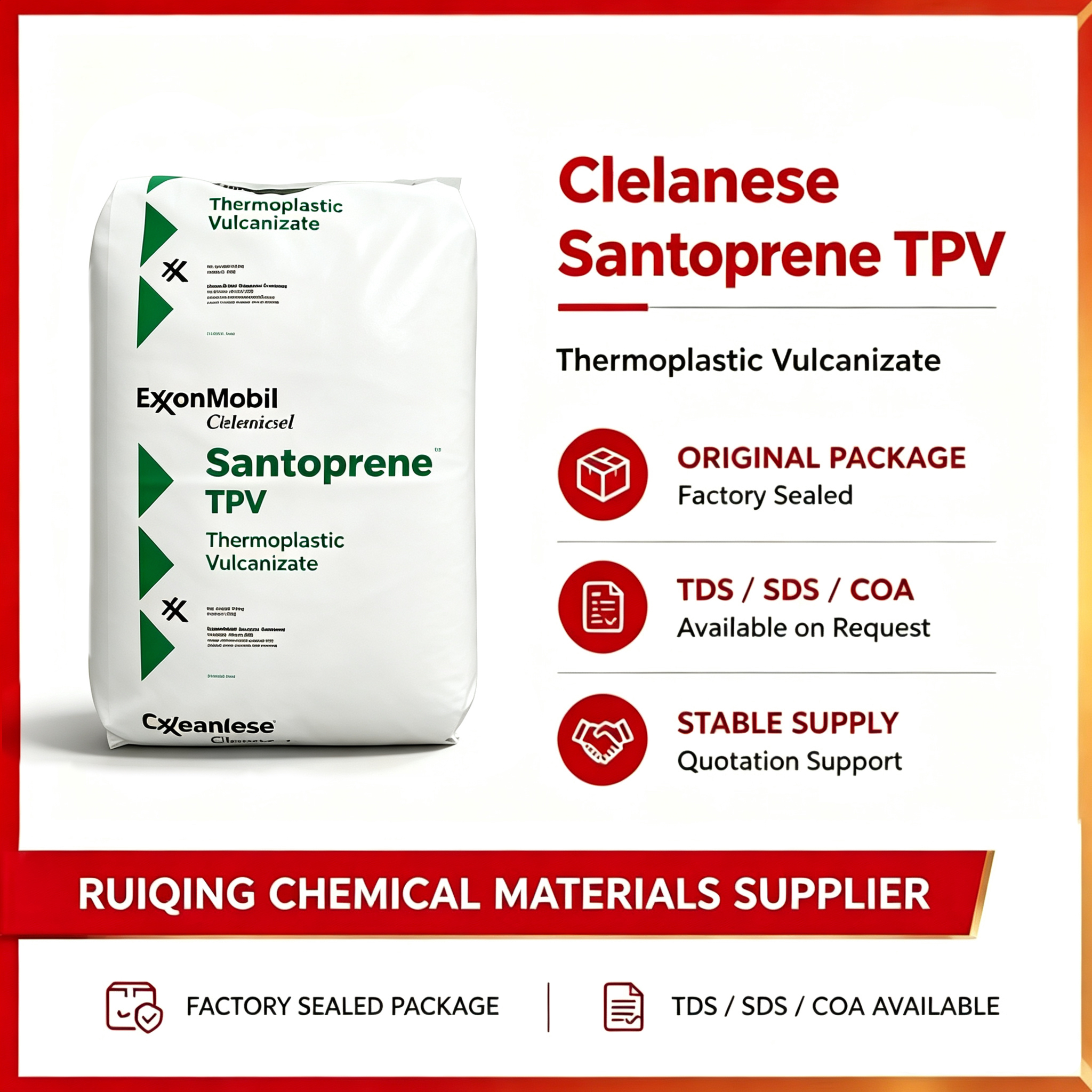
Santoprene 103-50 is a hard, black, versatile thermoplastic vulcanizate (TPV) from Celanese designed for general-purpose technical applications requiring substantially more rigidity and tear resistance than conventional soft Shore A TPV grades.
Celanese classifies the material in the Santoprene TPV family and describes it as a polyolefin-based elastomer with good physical properties, chemical resistance and excellent ozone resistance.
Unlike softer Santoprene 101-series materials that are typically specified in Shore A hardness, Santoprene 103-50 is characterized at approximately Shore D 51. This places the grade in a much firmer elastomeric range and makes it particularly useful when a component must retain shape, resist deformation and still provide more flexibility than a conventional rigid thermoplastic.
The grade is shear dependent and can be processed on conventional thermoplastic equipment.
Current Celanese data lists the following processing methods for Santoprene 103-50:
- Injection molding
- Multi-injection molding
- Extrusion
- Sheet extrusion
- Coextrusion
- Blow molding
- Thermoforming
The current product description also states that the material can be processed by vacuum-forming techniques.
The combination of thermoplastic processability and rubber-like environmental resistance is one of the major reasons Santoprene TPV is used as an alternative to conventional thermoset rubber in many automotive, industrial and electrical applications.
Current Celanese mechanical data lists a yield stress of approximately 12 MPa and a yield strain of approximately 31%. The grade also has a high tear strength of approximately 93 kN/m, which is particularly useful for components with edges, thin walls, retention features or repeated mechanical loading.
The low-temperature brittleness value is approximately -41°C, supporting use in many outdoor, automotive and industrial environments where cold-weather performance is required.
Compression set is approximately 59% at 70°C for 24 hours and 74% at 125°C for 70 hours. Because this grade is relatively hard, it is normally selected when firmness, dimensional support and tear strength are more important than the very low compression set expected from softer sealing compounds.
The current density is approximately 0.950 g/cm³, which is relatively low for a hard elastomeric material and can help reduce component weight.
Santoprene 103-50 is UL recognized and current Celanese data references QMFZ2.E80017 and QMFZ8.E80017.
The grade also has documented detergent-resistance ratings of f3 under UL 749 and f4 under UL 2157.
Current flammability data lists HB at 1.0 mm and 1.5 mm, with FMVSS Class B and a burning rate of approximately 35 mm/min at 2 mm thickness.
Electrical properties include a relative permittivity of approximately 2.4 at 60 Hz, CTI PLC 0, arc-resistance category PLC 5, and high-amperage arc-ignition category PLC 0.
The grade is also represented in multiple current automotive OEM specification systems, including General Motors, Hyundai, Mercedes-Benz, Renault, Stellantis and Volkswagen Group.
For more TPV products, visit our TPV Thermoplastic Vulcanizates Product Category →.
For the broader Santoprene portfolio, visit the Official Celanese Santoprene TPV Page →.
Key Features of Santoprene 103-50
| Feature | Engineering Benefit |
|---|---|
| Shore D 51 Hardness | Provides much greater firmness than conventional soft TPV grades |
| 12 MPa Yield Stress | Supports semi-structural elastomeric components |
| 31% Yield Strain | Retains useful deformation capacity despite high hardness |
| 93 kN/m Tear Strength | Strong resistance to tearing at edges and thin sections |
| Excellent Ozone Resistance | Suitable for automotive and outdoor environments |
| Good Chemical Resistance | Supports broad industrial use |
| -41°C Brittleness Temperature | Useful low-temperature performance |
| UL Recognized | Current Celanese data lists E80017 recognition |
| Detergent Resistance f3 / f4 | Useful in appliance and cleaning-related environments |
| Low Density – 0.950 g/cm³ | Supports lightweight component design |
| Injection Molding + Extrusion | Broad conventional thermoplastic processing capability |
| Blow Molding / Thermoforming | Suitable for hollow and formed technical components |
| Shear-Dependent Flow | High shear reduces apparent melt viscosity and improves processing |
The strongest reason to choose Santoprene 103-50 is its unusual combination of Shore D-level firmness, high tear strength, ozone resistance and thermoplastic processability.
Typical Applications for Santoprene 103-50
Santoprene 103-50 can be used in a broad range of automotive, industrial, appliance and electrical applications.
| Application Area | Typical Use |
|---|---|
| Automotive Air-Management Components | Ducts, interfaces and flexible/semi-rigid components |
| Boots & Bellows | Steering, suspension and protective applications |
| Plugs & Grommets | Firmer protective and sealing parts |
| Bumpers & Stops | High-hardness elastomeric impact components |
| Clips & Retention Parts | Flexible components requiring stronger shape retention |
| Tubing | Semi-rigid technical tubing |
| Automotive Under-Hood Parts | Ozone- and chemical-resistant components |
| Appliance Components | Firm molded and formed elastomeric parts |
| Electrical Components | Protective housings, grommets and insulation-related components |
| Diaphragms | Technical flexible components where stiffness is required |
| Consumer Products | Durable hard-elastomer parts |
| Thermoformed Components | Formed TPV sheets and technical covers |
This grade is particularly attractive when a softer Shore A TPV does not provide enough shape retention or tear strength.
Typical Properties of Santoprene 103-50
Physical Properties
| Property | Typical Value | Test Method |
|---|---|---|
| Density | 950 kg/m³ / 0.950 g/cm³ | ISO 1183 |
| Shore D Hardness, 15 s | 51 | ISO 48-4 / ISO 868 |
| Resin Identification | TPV | ISO 1043 |
| Part Marking Code | >TPV< | ISO 11469 |
| Color | Black | Manufacturer information |
| Product Form | Pellets | Manufacturer information |
The Shore D 51 value clearly differentiates Santoprene 103-50 from the softer 101-series TPV grades that are normally measured on the Shore A scale.
Mechanical Properties
| Property | Typical Value | Test Method |
|---|---|---|
| Yield Stress, Perpendicular | 12 MPa | ISO 527-1/-2 or ISO 37 |
| Yield Strain, Perpendicular | 31% | ISO 527-1/-2 or ISO 37 |
| Tear Strength, Normal | 93 kN/m | ISO 34-1 |
| Brittleness Temperature | -41°C | ASTM D746 |
| Low-Temperature Brittleness | -41°C | ISO 812 |
| Compression Set, 70°C / 24 h | 59% | ISO 815 |
| Compression Set, 125°C / 70 h | 74% | ISO 815 |
The high tear strength is one of the standout mechanical characteristics of Santoprene 103-50.
Thermal & Aging Properties
| Property | Typical Value | Test Method |
|---|---|---|
| RTI Electrical, 1.5 mm | 85°C | UL 746B |
| RTI Electrical, 3.0 mm | 85°C | UL 746B |
| RTI Strength, 1.5 mm | 85°C | UL 746B |
| RTI Strength, 3.0 mm | 85°C | UL 746B |
| Tensile Strength Change, 150°C / 168 h | -32% | ISO 188 |
| Tensile Strain-at-Break Change, 150°C / 168 h | -27% | ISO 188 |
| Shore D Hardness Change, 150°C / 168 h | +5 | ISO 188 |
These aging values provide useful context for evaluating long-term heat exposure.
Electrical Properties
| Property | Typical Value | Test Method |
|---|---|---|
| Relative Permittivity @ 60 Hz | 2.4 | IEC 62631-2-1 |
| Comparative Tracking Index | PLC 0 | UL 746A |
| Arc Resistance Performance Level | PLC 5 | UL 746B |
| High-Amperage Arc Ignition @ 1.5 mm | PLC 0 | UL 746A |
These properties make the material relevant to protective electrical components where a tough, hard elastomeric material is preferred.
Flammability & Application Suitability
| Property | Typical Value / Rating | Standard |
|---|---|---|
| Burning Behavior @ 1.5 mm | HB | IEC 60695-11-10 / UL 94 |
| Burning Behavior @ 1.0 mm | HB | IEC 60695-11-10 / UL 94 |
| UL Recognition | Yes | UL 94 |
| FMVSS Class | B | ISO 3795 / FMVSS 302 |
| Burning Rate @ 2 mm | 35 mm/min | ISO 3795 / FMVSS 302 |
| Detergent Resistance | f3 | UL 749 |
| Detergent Resistance | f4 | UL 2157 |
The grade is not positioned as a flame-retardant material. Its main strengths are hardness, tear resistance, ozone resistance and processability.
Automotive OEM References for Santoprene 103-50
Current Celanese Materials Database information lists several automotive specification references for Santoprene 103-50:
| OEM | Specification / Reference |
|---|---|
| Chery | Q/SQR.04.1195-2011 |
| General Motors | GMW15813P-TPV-(EPDM+PP)-Type 10 |
| Hyundai | MS220-05 Type H |
| Mercedes-Benz | DBL 5562 |
| Renault | FRM 18-27-034 / special part approval context |
| Stellantis | B62 0300 / B63 0300 / MS-AR-100 GGN and related references |
| Volkswagen Group | VW 50123 |
These references are particularly useful when evaluating the grade for automotive ducts, boots, plugs, grommets, coolant-hose related components and other hard-elastomer applications.
Why Choose Santoprene 103-50?
The main reason to select Santoprene 103-50 is that it occupies a different property range from conventional soft TPV.
A 50–80 Shore A elastomer can provide excellent sealing and flexibility but may be too soft for parts that need dimensional support.
A rigid polyolefin can provide stiffness but may lack the elasticity, fatigue behavior and ozone resistance needed in a dynamic automotive or industrial component.
Santoprene 103-50 bridges this gap.
Its Shore D 51 hardness gives the material a firm, semi-rigid elastomeric feel.
The 12 MPa yield stress provides useful load-bearing capability, while the 31% yield strain confirms that the material can still deform significantly before yielding.
The 93 kN/m tear strength is particularly useful in parts with clips, edges, holes, retaining features or thin sections.
Excellent ozone resistance is valuable in outdoor, under-hood and weather-exposed applications.
The -41°C brittleness temperature supports low-temperature service across many automotive markets.
The low density of 0.950 g/cm³ can also provide weight advantages compared with denser elastomeric systems.
Thermoplastic processing simplifies manufacturing compared with fully cured rubber. The material can be injection molded, extruded, blow molded and thermoformed without a separate vulcanization cycle.
For customers seeking a hard black TPV with Shore D 51 hardness, high tear strength and proven automotive use, Santoprene 103-50 is a strong candidate.
Processing Guidelines for Santoprene 103-50
Santoprene 103-50 supports multiple thermoplastic processes:
- Injection molding
- Multi-injection molding
- Extrusion
- Sheet extrusion
- Coextrusion
- Blow molding
- Thermoforming
Current Grade-Specific Injection Conditions
| Processing Parameter | Celanese Guidance |
|---|---|
| Drying | Recommended |
| Drying Temperature | 80°C |
| Drying Time | ≥3 hours in a dehumidified dryer |
| Processing Moisture Content | ≤0.08% |
| Maximum Regrind Level | 20% |
| Optimum Melt Temperature | 220°C |
| Minimum Melt Temperature | 205°C |
| Maximum Melt Temperature | 230°C |
| Optimum Mold Temperature | 30°C |
| Minimum Mold Temperature | 10°C |
| Maximum Mold Temperature | 50°C |
| Screw Speed | 100–200 rpm recommended |
| Holding Pressure | Approx. 50–75% of actual injection pressure |
| Optional Back Pressure | Approx. 0.3–0.7 MPa |
The current 2025 Celanese grade data gives 220°C as the optimum injection melt temperature, with a recommended range of approximately 205–230°C.
Extrusion Conditions
| Processing Parameter | Celanese Guidance |
|---|---|
| Drying Temperature | 82°C |
| Drying Time | 3 hours |
| Melt Temperature Reference | 210°C |
Shear-Dependent Processing Behavior
Santoprene TPV has relatively high melt viscosity at low shear rates.
As shear rate rises, apparent viscosity decreases.
For Santoprene 103-50, this means that:
- Higher screw speed can improve melt homogeneity
- Smaller gates can increase shear and improve flow
- Injection speed can have a strong effect on filling
- Increasing melt temperature alone may have only a limited effect on viscosity
- Gate, runner and die design are important to surface quality
Celanese also notes that Santoprene TPV has a broad family processing window of approximately 175–230°C.
Material Compatibility
Santoprene TPV is incompatible with acetal (POM) and PVC.
When changing materials, processors should thoroughly purge the barrel, screw, hot runner or extrusion line.
Santoprene 103-50 vs. Santoprene 103-40
| Feature | Santoprene 103-50 | Santoprene 103-40 |
|---|---|---|
| Material Family | TPV | TPV |
| Color | Black | Black |
| Product Positioning | Hard general-purpose TPV | Hard general-purpose TPV |
| Shore Hardness | D 51 | D 41 |
| Brittleness Temperature | -41°C | -52°C |
| Tear Strength | 93 kN/m | 64 kN/m |
| Compression Set, 70°C / 24 h | 59% | 54% |
| Compression Set, 125°C / 70 h | 74% | 61% |
| Main Selection Difference | Harder and higher tear strength | Softer, better low-temperature and compression-set values |
Choose Santoprene 103-50 when the design requires maximum firmness and higher tear resistance within the 103-series range.
Choose Santoprene 103-40 when somewhat lower hardness, improved low-temperature flexibility and lower compression set are more important.
Related Products
Santoprene 103-40 – Hard black TPV with approximately Shore D 41 hardness, strong elongation and lower-temperature flexibility.
Santoprene 101-87 – High-hardness black general-purpose TPV measured on the Shore A scale, suitable when a softer material than the 103 series is preferred.
Santoprene 101-80 – Black general-purpose high-hardness TPV for molded and extruded applications requiring greater flexibility than Shore D materials.
View More TPV Thermoplastic Vulcanizates →
Technical Documents for Santoprene 103-50
| Document Type | Description |
|---|---|
| TDS | Current Celanese physical, mechanical, thermal, electrical and processing data |
| SDS | Safety Data Sheet |
| UL Information | QMFZ2.E80017 / QMFZ8.E80017 recognition |
| Automotive Specification Information | GM, Hyundai, Mercedes-Benz, Stellantis, VW and other references |
| Santoprene Product Finder | Grade comparison and positioning |
| Processing Guide | Injection molding, extrusion and blow-molding guidance |
| COA | Batch-specific quality information where available |
Need technical documents for Santoprene 103-50?
📧 Email: ruiqingchem@gmail.com
📝 Online form: Contact Us →
Please state Santoprene 103-50 and the required document type when submitting your inquiry.
FAQ About Santoprene 103-50
Q1: What is Santoprene 103-50?
Santoprene 103-50 is a hard black general-purpose TPV from Celanese with approximately Shore D 51 hardness, excellent ozone resistance and broad thermoplastic processing capability.
Q2: What is the hardness of Santoprene 103-50?
The current Celanese value is approximately Shore D 51.
Q3: What is the yield stress?
Current Celanese data lists approximately 12 MPa yield stress.
Q4: What is the tear strength?
The current tear-strength value is approximately 93 kN/m.
Q5: What is the low-temperature performance?
The current brittleness temperature is approximately -41°C.
Q6: What is the compression set?
Current values are approximately 59% at 70°C / 24 h and 74% at 125°C / 70 h.
Q7: Is Santoprene 103-50 suitable for automotive applications?
Yes. Current Celanese information lists OEM specification references from General Motors, Hyundai, Mercedes-Benz, Renault, Stellantis, Volkswagen Group and others.
Q8: Can Santoprene 103-50 be injection molded and extruded?
Yes. Celanese lists injection molding, multi-injection molding, extrusion, sheet extrusion, coextrusion, blow molding and thermoforming.
Q9: What processing temperature is recommended?
Current grade-specific data lists an injection melt range of approximately 205–230°C, with an optimum around 220°C. Extrusion melt temperature is approximately 210°C.
Q10: What is the difference between Santoprene 103-50 and 103-40?
Both are hard black general-purpose TPV grades. Santoprene 103-50 is harder at Shore D 51 and has higher tear strength, while 103-40 is softer at Shore D 41 and offers better low-temperature and compression-set values.
Request Santoprene 103-50 Price & Technical Support
For pricing, availability, technical documents or application support for Santoprene 103-50, please provide:
- Required quantity
- Destination country or port
- Automotive, industrial, appliance or electrical application
- Part type and dimensions
- Required Shore hardness
- Continuous and peak operating temperature
- Minimum service temperature
- Tear-strength requirement
- Compression-set requirement
- Chemical or detergent exposure
- Outdoor / ozone exposure
- Injection molding, extrusion, blow molding or thermoforming process
- OEM specification requirement
- UL documentation requirement
- TDS, SDS or COA requirement
- Sample requirement, if applicable
📧 Email: ruiqingchem@gmail.com
📝 Send Inquiry →