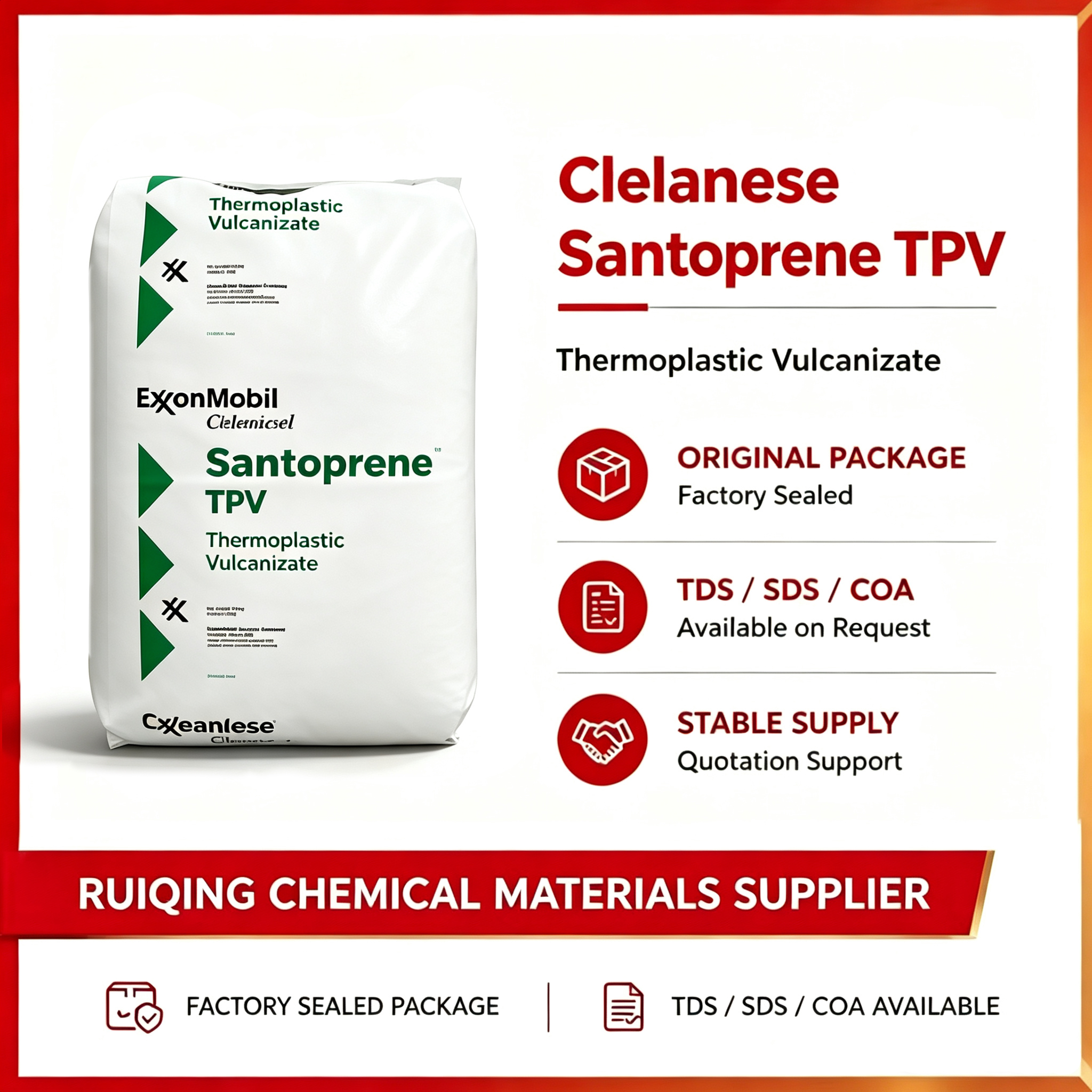
描述
Santoprene 101-73E100 is a black thermoplastic vulcanizate (TPV) grade from Celanese designed as a versatile elastomeric material for a broad range of technical applications.
Current Celanese-derived public material information describes Santoprene 101-73E100 as a soft, black and versatile TPV that combines good physical properties and chemical resistance with the processing advantages of conventional thermoplastics.
The two grade-specific performance features highlighted in the current public record are excellent flex-fatigue resistance and excellent ozone resistance.
These properties make Santoprene 101-73E100 relevant to parts that experience repeated bending, compression, vibration, flexing or environmental exposure during service.
The material is polyolefin based and behaves like a rubber while being processed as a thermoplastic. That combination is the central advantage of Santoprene TPV technology.
Unlike conventional thermoset EPDM rubber, Santoprene 101-73E100 does not require a separate vulcanization step during normal thermoplastic processing. This can simplify production, shorten processing sequences and enable recycling of suitable manufacturing scrap within a controlled production stream.
Current grade-level information lists a broad range of processing technologies:
- Injection molding
- Extrusion
- Blow molding
- Thermoforming
- Vacuum forming
This makes Santoprene 101-73E100 useful for molded components, extruded profiles, flexible tubes, hollow parts, sheet-based parts and technical elastomeric components.
The grade is also described as shear dependent. As with other Santoprene TPV materials, apparent melt viscosity decreases as shear rate increases. Processors therefore need to consider screw speed, injection speed, gate design, die geometry and shear history rather than relying on temperature alone to control flow.
Celanese’s current Santoprene portfolio describes TPV technology as offering sealing performance, ozone and weathering resistance, chemical and oil resistance, elastic recovery over a wide temperature range, high flex-fatigue resistance and thermoplastic processability.
These family-level characteristics support the positioning of Santoprene 101-73E100, but grade-specific selection should still be based on the exact current grade data and application conditions.
An important point for buyers is that the current Celanese all-grades Product Finder lists Santoprene 101-73 in the general-purpose family, while the exact 101-73E100 designation is separately present in current Celanese-derived technical databases. The public Product Finder does not explain the E100 suffix or state that the two grades are numerically identical.
For that reason, the property values of standard 101-73 should not automatically be copied onto Santoprene 101-73E100. This page keeps the exact grade identity separate and uses only properties that are supported for the E100 designation.
For additional TPV grades, visit our TPV Thermoplastic Vulcanizates Product Category →.
For Celanese’s current Santoprene technology overview, visit the Official Celanese Santoprene TPV Page →.
Key Features of Santoprene 101-73E100
| Feature | Engineering Benefit |
|---|---|
| Black TPV | Suitable for technical, automotive and industrial components |
| Excellent Flex-Fatigue Resistance | Supports repeated bending and cyclic deformation |
| Excellent Ozone Resistance | Helps maintain performance in outdoor and automotive environments |
| Good Physical Properties | Supports durable elastomeric component design |
| Chemical Resistance | Useful in many demanding technical environments |
| Shear-Dependent Flow | Can be processed efficiently when shear conditions are optimized |
| Injection Moldable | Suitable for complex molded elastomeric parts |
| Extrudable | Suitable for profiles, tubing and continuous sections |
| Blow Moldable | Supports hollow flexible component production |
| Thermoformable | Enables shaped parts from suitable sheet constructions |
| Vacuum Formable | Adds design flexibility for formed TPV components |
| Polyolefin Based | Supports low-density elastomeric design and familiar thermoplastic processing |
| Manufacturing-Stream Recyclability | Suitable process scrap may be reworked under controlled production conditions |
The core value of Santoprene 101-73E100 is the combination of rubber-like durability and thermoplastic manufacturing flexibility.
Typical Applications for Santoprene 101-73E100
Because Santoprene 101-73E100 is positioned as a versatile general-purpose black TPV, it can be considered for a range of elastomeric applications where flex fatigue, ozone resistance and chemical resistance are important.
| Application Area | Typical Use |
|---|---|
| Automotive Seals | Flexible sealing parts requiring repeated compression and recovery |
| Gaskets | Static and semi-dynamic sealing components |
| Bellows & Boots | Protective components exposed to repeated flexing |
| Air-Management Components | Flexible ducts, couplings and interfaces |
| Plugs & Grommets | Protective and sealing components |
| Flexible Tubing | Technical tubing where TPV chemical resistance is suitable |
| Extruded Profiles | Continuous elastomeric sealing and protective profiles |
| Industrial Components | Flexible covers, protective parts and vibration-management components |
| Appliance Parts | Molded and extruded flexible components |
| Consumer Products | Flexible housings, resilient parts and soft technical components |
| Blow-Molded Components | Hollow flexible parts |
| Thermoformed Parts | Shaped TPV components produced from sheet or suitable preforms |
Application approval should be based on actual temperature, fluid exposure, compression, dimensional requirements and any OEM specification that applies to the finished part.
Typical Properties of Santoprene 101-73E100
Grade-Specific Publicly Confirmed Property Categories
Current Celanese-derived public information confirms that the following properties are reported for Santoprene 101-73E100:
| Property | Test Method / Status |
|---|---|
| Shore A Hardness | ISO 48-4 / ISO 868 |
| Tensile Strength at Break | ISO 527-1/-2 or ISO 37 |
| Tensile Stress | ISO 37 |
| Elongation at Break | ISO 527-1/-2 or ISO 37 |
| Tear Strength | ISO 34-1 |
| Compression Set | ISO 815 |
| Brittleness Temperature | ASTM D746 |
| Flame Spread / Burning Rate | ISO 3795 / FMVSS 302 |
| Extrusion Melt Temperature | Grade data contains a reported processing value |
| Injection Ejection Temperature | Grade data contains a reported processing value |
| Drying Temperature | Grade data contains a reported processing value |
| Drying Time | Grade data contains a reported processing value |
| Maximum Regrind | Grade data contains a reported processing value |
| Back Pressure | Grade data contains a reported processing value |
The currently searchable text-only public record confirms these test items but does not expose the complete numeric table. Therefore, this page does not substitute standard Santoprene 101-73 values for Santoprene 101-73E100.
What the Current Grade Record Confirms
Santoprene 101-73E100 is specifically described as:
- Soft
- Black
- Versatile
- Thermoplastic vulcanizate
- Chemically resistant
- Shear dependent
- Suitable for conventional thermoplastic processing
- Polyolefin based
- Recyclable within the manufacturing stream
- Recommended for applications requiring excellent flex-fatigue resistance
- Excellent in ozone resistance
These are the most defensible technical selling points for the exact grade.
Santoprene 101-73E100 and the 101-73 General-Purpose Family
The current Celanese Product Finder places standard Santoprene 101-73 in the general-purpose TPV family.
For reference, the current official Product Finder reports the following values for standard 101-73, not for E100:
| Property | Santoprene 101-73 Reference |
|---|---|
| Hardness | Shore A 78 |
| Elongation at Break | 478% |
| Tensile Strength at Break | 8.0 MPa |
| Tensile Stress at 100% Elongation | 3.4 MPa |
| Compression Set, 70°C | 27% |
| Appearance | Black |
| Positioning | General-purpose extrusion and molding grade |
These values are useful for understanding the performance region of the 101-73 family, but they should not be presented as certified Santoprene 101-73E100 values unless the exact current E100 TDS confirms them.
This distinction is important for automotive approvals, regulated applications, engineering calculations and customer specification work.
Why Choose Santoprene 101-73E100?
Santoprene 101-73E100 is attractive when the application requires a black TPV with broad processing options and durable elastomeric behavior.
Flex-Fatigue Resistance
Repeated bending is demanding on elastomers.
Bellows, boots, flexible ducts, diaphragms and sealing lips can experience thousands or millions of movement cycles during service. Celanese specifically identifies excellent flex-fatigue resistance as a key feature of Santoprene 101-73E100.
Ozone Resistance
Ozone can cause cracking and surface degradation in susceptible rubber materials.
Excellent ozone resistance makes Santoprene 101-73E100 relevant to outdoor, automotive and industrial applications where long-term atmospheric exposure is expected.
Chemical Resistance
The grade is described as combining good physical properties with chemical resistance.
This makes it useful for technical components exposed to compatible oils, cleaners, water-based fluids or industrial environments, subject to actual chemical compatibility testing.
Thermoplastic Processing
Traditional thermoset rubber production can require mixing, curing and secondary trimming operations.
Santoprene TPV is supplied as ready-to-process pellets and can be handled on conventional thermoplastic equipment.
For Santoprene 101-73E100, supported technologies include molding, extrusion, blow molding, thermoforming and vacuum forming.
Recycling Within the Manufacturing Stream
Celanese describes this grade as recyclable within the manufacturing stream.
This gives processors an opportunity to reduce scrap compared with fully crosslinked thermoset rubber, provided regrind is controlled according to part-performance and quality requirements.
Processing Guidelines for Santoprene 101-73E100
Current grade information confirms that Santoprene 101-73E100 is suitable for multiple thermoplastic processes.
Supported Processes
- Injection molding
- Extrusion
- Blow molding
- Thermoforming
- Vacuum forming
Shear-Dependent Processing Behavior
One of the most important processing characteristics of Santoprene 101-73E100 is shear dependence.
As shear increases, apparent viscosity decreases. This means process optimization should focus on the interaction of:
- Screw speed
- Injection speed
- Gate dimensions
- Runner design
- Die geometry
- Back pressure
- Melt temperature
- Mold or cooling temperature
- Cooling rate
- Part wall thickness
A processor should not assume that increasing barrel temperature is always the best way to improve filling.
Higher shear through optimized screw speed, gate design or injection velocity can significantly change flow behavior.
Family-Level Santoprene Processing Context
Celanese describes Santoprene TPV as easy to process on conventional thermoplastic equipment and lists injection molding, blow molding, extrusion, physical foaming, chemical foaming and calendaring across the product family.
Celanese technical literature for Santoprene also commonly references processing temperatures around 200°C as a practical family-level context.
This should be treated as family guidance, not a replacement for the exact Santoprene 101-73E100 processing table.
Drying and Regrind
The exact grade record includes drying temperature, drying time and maximum-regrind entries.
For production setup, use the current grade-specific Celanese TDS values rather than transferring values from standard 101-73 or another E100 grade.
Purging and Contamination Control
Good contamination control is important when processing TPV.
Before production:
- Clean the hopper and feed system
- Remove incompatible resin residues
- Purge the barrel and screw
- Clean the die or hot runner
- Control regrind separately
- Keep color or additive additions consistent
Stable material handling helps maintain surface quality and mechanical consistency.
Santoprene 101-73E100 vs. Santoprene 101-73
| Feature | Santoprene 101-73E100 | Santoprene 101-73 |
|---|---|---|
| Manufacturer | Celanese | Celanese |
| Material | TPV | TPV |
| Appearance | Black | Black |
| Positioning | Versatile black TPV | General-purpose TPV |
| Flex-Fatigue Resistance | Excellent | Excellent |
| Ozone Resistance | Excellent | Excellent |
| Injection Molding | Yes | Yes |
| Extrusion | Yes | Yes |
| Blow Molding | Yes | Yes |
| Thermoforming | Yes | Yes |
| Exact Numeric Public Table | Not fully exposed in current public text view | Published in current Product Finder |
| E100 Suffix | Exact public meaning not stated in current Product Finder | Not applicable |
The safest selection rule is simple: do not treat Santoprene 101-73E100 and standard 101-73 as automatically interchangeable solely because the base designation is similar.
If the customer specification explicitly calls for 101-73E100, supply and document the exact E100 grade.
Related Products
Santoprene 101-73 – Black general-purpose TPV in the same 101 family, currently listed by Celanese at Shore A 78.
Santoprene 101-64 – Softer black general-purpose TPV for applications requiring greater compliance.
Santoprene 101-80E100 – Higher-hardness E100-designated black Santoprene TPV grade.
View More TPV Thermoplastic Vulcanizates →
Technical Documents for Santoprene 101-73E100
| Document Type | Description |
|---|---|
| TDS | Exact grade physical, mechanical and processing properties |
| SDS | Safety Data Sheet |
| Processing Data | Drying, melt temperature, ejection temperature, regrind and back-pressure information |
| Santoprene Product Information | Celanese TPV family positioning and processing capabilities |
| COA | Batch-specific quality information where supplied |
Need documents or a quotation for Santoprene 101-73E100?
📧 Email: ruiqingchem@gmail.com
📝 Online form: Contact Us →
FAQ About Santoprene 101-73E100
Q1: What is Santoprene 101-73E100?
Santoprene 101-73E100 is a black thermoplastic vulcanizate from Celanese combining rubber-like flexibility with thermoplastic processing.
Q2: What are the key features of Santoprene 101-73E100?
The current grade description highlights excellent flex-fatigue resistance, excellent ozone resistance, good physical properties and chemical resistance.
Q3: Is Santoprene 101-73E100 a TPV or TPE?
It is a thermoplastic vulcanizate (TPV), which is a high-performance category within thermoplastic elastomers.
Q4: What color is Santoprene 101-73E100?
The current grade record identifies the material as black.
Q5: Can Santoprene 101-73E100 be injection molded?
Yes. Injection molding is one of the supported conventional thermoplastic processes for this grade.
Q6: Can Santoprene 101-73E100 be extruded?
Yes. The grade is suitable for extrusion and can be considered for technical profiles, tubing and continuous elastomeric sections.
Q7: Can Santoprene 101-73E100 be blow molded?
Yes. Blow molding is listed among the supported processes.
Q8: Is Santoprene 101-73E100 suitable for outdoor applications?
The grade has excellent ozone resistance, which is favorable for environmental exposure. Final outdoor suitability should still be checked against the application’s UV, weathering and service-life requirements.
Q9: Is Santoprene 101-73E100 the same as Santoprene 101-73?
They are closely named grades, but the current public Celanese Product Finder does not explain the E100 suffix or state that the numeric property tables are identical. Exact customer requirements should therefore follow the requested grade designation.
Q10: Where can I buy Santoprene 101-73E100 and obtain technical documents?
Shenzhen Ruiqing International Trading Co., Ltd. supplies engineering polymers and elastomers for international customers. Contact us with the exact Santoprene 101-73E100 designation, quantity, destination and document requirements.
Request Santoprene 101-73E100 Price & Technical Support
For pricing, availability and technical support for Santoprene 101-73E100, please provide:
- Required quantity
- Destination country or port
- Automotive, industrial, appliance or consumer application
- Seal, gasket, boot, profile, tube or molded-part design
- Required hardness range
- Operating-temperature range
- Chemical or fluid exposure
- Outdoor or ozone exposure
- Injection molding, extrusion, blow molding or thermoforming process
- OEM specification, if applicable
- Required TDS, SDS or COA
- Sample requirement, if applicable
📧 Email: ruiqingchem@gmail.com
📝 Send Inquiry →