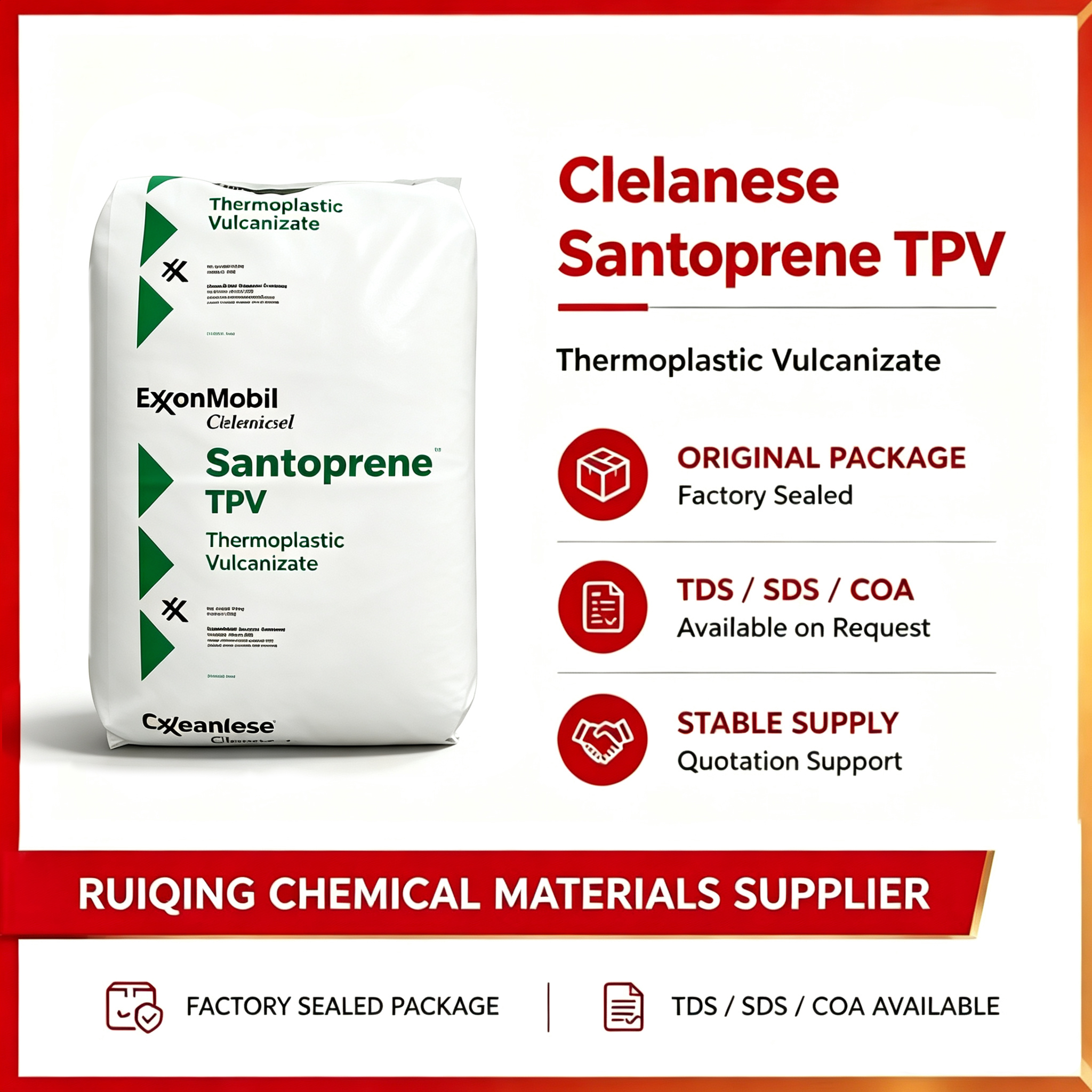
描述
Santoprene 101-55W255 is a soft, black thermoplastic vulcanizate (TPV) from Celanese specifically developed for residential washing-machine and dishwasher applications.
Unlike a general-purpose Santoprene grade selected mainly by hardness, this material includes a dedicated stabilization package for protection against copper and other metal-catalyzed degradation. Celanese also highlights its ability to retain properties in the presence of typical dishwasher and washing-machine detergent solutions.
These two characteristics define the main application value of Santoprene 101-55W255.
Appliance seals can operate in a demanding combination of water, detergent chemistry, temperature cycling, compression and contact with metal hardware. Certain metals can accelerate oxidative degradation in elastomeric materials. For applications close to copper-containing components, clamps, fittings or other metallic assemblies, the specialized stabilization system can therefore be more important than simply selecting a TPV with the correct hardness.
The grade has a Shore A hardness of approximately 61, giving it a medium-soft elastomeric feel suitable for seals and gaskets that need more support than very soft 40–50 Shore A TPV while still retaining substantial flexibility.
Current grade-specific data lists approximately 510% elongation at break, a tensile stress at break of approximately 5.2 MPa, and a tensile stress at 100% elongation of approximately 1.8 MPa.
This high elongation makes the material useful for gaskets and flexible appliance components that must deform repeatedly without brittle failure.
The material density is approximately 0.970 g/cm³, consistent with a polyolefin-based TPV structure and useful for lightweight molded and extruded components.
Santoprene 101-55W255 is shear dependent. Its apparent melt viscosity decreases as shear rate increases, which is a characteristic behavior of Santoprene TPV. The material can therefore be processed efficiently on conventional thermoplastic machinery when the screw speed, gate design and injection or extrusion conditions are optimized.
Celanese lists injection molding, multi-injection molding, extrusion, profile extrusion, sheet extrusion and coextrusion as suitable processing routes.
This is a major manufacturing advantage compared with conventional thermoset rubber. There is no separate vulcanization step during normal TPV molding, and production scrap can be recyclable within the manufacturing stream where the quality specification allows it.
The grade is also UL recognized, with Celanese referencing QMFZ2.E80017 and QMFZ8.E80017.
Current flammability data lists HB at 1.5 mm and 3.0 mm, confirming that this is not a dedicated flame-retardant TPV. It is primarily an appliance sealing material selected for flexibility, detergent resistance and metal-catalyzed degradation protection.
For more TPV materials, visit our TPV Thermoplastic Vulcanizates Product Category →.
For Celanese’s current TPV portfolio, see the Official Celanese Santoprene & Geolast Product Finder →.
Key Features of Santoprene 101-55W255
| Feature | Engineering Benefit |
|---|---|
| Shore A 61 | Medium-soft elastomeric sealing performance |
| Detergent Resistance | Designed for washing-machine and dishwasher detergent exposure |
| Copper / Metal Stabilization | Helps protect against metal-catalyzed degradation |
| 510% Elongation at Break | Supports highly flexible seals and gaskets |
| 5.2 MPa Stress at Break | Provides useful mechanical strength for soft TPV |
| Polyolefin-Based TPV | Low density and conventional thermoplastic processing |
| Injection Molding | Suitable for molded appliance seals and components |
| Extrusion / Profile Extrusion | Suitable for continuous sealing profiles |
| Coextrusion | Supports soft TPV sections in multi-material profiles |
| UL Recognized | Current Celanese documentation lists E80017 |
| Manufacturing-Stream Recyclability | Helps reduce controlled process scrap |
| Shear-Dependent Flow | Flow improves as shear rate increases |
The strongest reason to specify Santoprene 101-55W255 is the combination of detergent resistance, metal-catalyzed degradation protection and 61 Shore A sealing performance.
Typical Applications for Santoprene 101-55W255
Santoprene 101-55W255 is primarily designed for appliance sealing and flexible components.
| Application Area | Typical Use |
|---|---|
| Washing Machine Seals | Flexible seals exposed to detergent solutions and repeated cycles |
| Dishwasher Seals | Door and fluid-path sealing components |
| Appliance Gaskets | Compressible gaskets around housings and interfaces |
| Metal-Contact Seals | Parts located near copper or other metallic components |
| Coextruded Sealing Profiles | Soft TPV layer combined with compatible rigid profiles |
| Injection-Molded Gaskets | Molded appliance sealing parts |
| Flexible Appliance Components | Soft components requiring detergent resistance |
| Extruded Profiles | Continuous sealing and protective profiles |
The grade is especially relevant when the component must combine softness, repeated detergent exposure and proximity to metal hardware.
Typical Properties of Santoprene 101-55W255
Physical Properties
| Property | Typical Value | Test Method |
|---|---|---|
| Density | 0.970 g/cm³ | ISO 1183 |
| Shore A Hardness, 15 s | 61 | ISO 48-4 / ISO 868 |
| Resin Identification | TPV | ISO 1043 |
| Part Marking Code | >TPV< | ISO 11469 |
| Color | Black | Manufacturer information |
| Product Form | Pellets / Granules | Manufacturer information |
The density of approximately 0.970 g/cm³ helps keep seals and gaskets lightweight.
Mechanical Properties
| Property | Typical Value | Test Method |
|---|---|---|
| Tensile Stress at 100% Elongation | 1.8 MPa | ISO 37 |
| Stress at Break | 5.2 MPa | ISO 527-1/-2 or ISO 37 |
| Elongation at Break | 510% | ISO 527-1/-2 or ISO 37 |
| Shore A Hardness | 61 | ISO 48-4 / ISO 868 |
The 510% elongation is especially useful for sealing parts that must accommodate assembly deformation, movement and repeated compression.
Flammability Properties
| Property | Typical Value | Test Method |
|---|---|---|
| Burning Behavior @ 1.5 mm | HB | IEC 60695-11-10 / UL 94 |
| Burning Behavior @ 3.0 mm | HB | IEC 60695-11-10 / UL 94 |
| UL Recognition | Yes | UL 94 |
| Burning Rate, 2 mm | 38.6 mm/min | ISO 3795 / FMVSS 302 |
The grade is not intended as a flame-retardant TPV. Where V-0, V-1 or other advanced flame performance is required, a dedicated flame-retardant elastomer should be selected.
Detergent & Metal-Stability Performance
Celanese specifically identifies two grade-level performance features for Santoprene 101-55W255:
- Property retention in typical dishwasher detergent solutions
- Property retention in typical washing-machine detergent solutions
- Stabilization against copper-catalyzed degradation
- Stabilization against other metal-catalyzed degradation
These are manufacturer-defined application features rather than single numerical test values.
Why Choose Santoprene 101-55W255?
The main reason to choose Santoprene 101-55W255 is that it is optimized for a very specific service environment rather than being only a generic 60 Shore A TPV.
A washing-machine or dishwasher seal may remain compressed for long periods, flex during every operating cycle and contact hot water and detergent repeatedly.
At the same time, the seal may sit next to metal housings, fittings, springs, clamps or copper-containing components.
Metal ions can accelerate oxidative degradation in some elastomer systems. A standard TPV grade may therefore meet the hardness target but still be less suitable for this combination of chemical and metal exposure.
Santoprene 101-55W255 includes a stabilization system specifically designed to address this risk.
Its Shore A 61 hardness provides more support than the softer 101-45W255 while remaining appropriate for compliant sealing.
The 510% elongation at break gives the grade excellent deformability.
Its thermoplastic processing behavior also simplifies high-volume appliance production. Injection molding can produce complex gasket geometries, while profile extrusion supports continuous sealing sections.
Coextrusion is another important option. A soft sealing section can be combined with a compatible rigid or semi-rigid substrate in a continuous profile, reducing downstream assembly steps.
Because the material is polyolefin based, its density is below 1.0 g/cm³, and controlled production scrap can be recyclable within the manufacturing stream.
For customers requiring a black 61 Shore A appliance TPV with detergent resistance and dedicated metal-stabilization technology, Santoprene 101-55W255 is more appropriate than a standard general-purpose Santoprene grade.
Processing Guidelines for Santoprene 101-55W255
Santoprene 101-55W255 can be processed by:
- Injection molding
- Multi-injection molding
- Extrusion
- Profile extrusion
- Sheet extrusion
- Coextrusion
Grade-Specific Processing Conditions
| Processing Parameter | Celanese Guidance |
|---|---|
| Drying Temperature | 80°C |
| Drying Time | Approx. 3 hours |
| Maximum Processing Moisture | 0.08% |
| Optimum Melt Temperature | 200°C |
| Melt Temperature Range | 185–220°C |
| Optimum Mold Temperature | 30°C |
| Mold Temperature Range | 10–50°C |
| General Santoprene TPV Processing Window | 175–230°C |
The grade-specific melt window of 185–220°C and optimum value of approximately 200°C are better starting points than using only the broader family processing window.
Shear-Dependent Melt Behavior
Santoprene TPV is strongly shear dependent. As shear rate increases, apparent viscosity decreases.
In practice, this means:
- Screw speed influences melt quality
- Gate dimensions influence shear and filling
- Injection speed can significantly affect flow
- Increasing temperature alone may not improve flow as effectively as optimizing shear
- Extrusion die design should account for elastic melt behavior
Drying
Celanese recommends drying at approximately 80°C for 3 hours in a dehumidified dryer and maintaining moisture content at or below approximately 0.08% before processing.
Material Compatibility
Santoprene TPV is incompatible with acetal (POM) and PVC.
When changing materials, processors should purge barrels, screws, hot runners and extrusion equipment carefully to avoid contamination.
Santoprene 101-55W255 vs. Santoprene 101-45W255
| Feature | Santoprene 101-55W255 | Santoprene 101-45W255 |
|---|---|---|
| Material Family | TPV | TPV |
| Color | Black | Black |
| Main Application | Washing machine & dishwasher seals | Washing machine & dishwasher seals |
| Detergent Resistance | Yes | Yes |
| Copper / Metal Stabilization | Yes | Yes |
| Shore A Hardness | 61 | 48 |
| Elongation at Break | 510% | 400% |
| Stress at Break | 5.2 MPa | 4.0 MPa |
| Stress @ 100% Elongation | 1.8 MPa | 1.4 MPa |
| Main Selection Reason | Higher hardness and strength | Softer sealing behavior |
Choose Santoprene 101-55W255 when the design requires a firmer seal, higher tensile strength and the same detergent / metal-stabilization concept.
Choose Santoprene 101-45W255 when a softer, more compliant seal is preferred.
Related Products
Santoprene 101-45W255 – Softer black detergent-resistant TPV with Shore A 48 hardness and metal-catalyzed degradation stabilization.
Santoprene 201-55W255 – Natural-color detergent-resistant TPV with similar metal-stabilization technology.
Santoprene 101-55 – General-purpose black 60 Shore A TPV for seals, gaskets, flexible molded parts and extrusion applications.
View More TPV Thermoplastic Vulcanizates →
Technical Documents for Santoprene 101-55W255
| Document Type | Description |
|---|---|
| TDS | Current Celanese mechanical, physical, flammability and processing data |
| SDS | Safety Data Sheet |
| UL Information | QMFZ2.E80017 / QMFZ8.E80017 recognition |
| Santoprene Product Finder | Grade comparison and application positioning |
| Processing Guide | Injection molding and extrusion guidance |
| COA | Batch-specific quality information where available |
Need technical documents for Santoprene 101-55W255?
📧 Email: ruiqingchem@gmail.com
📝 Online form: Contact Us →
Please state Santoprene 101-55W255 and the required document type when submitting your inquiry.
FAQ About Santoprene 101-55W255
Q1: What is Santoprene 101-55W255?
Santoprene 101-55W255 is a soft black TPV from Celanese designed for residential washing-machine and dishwasher applications.
Q2: What is the Shore hardness?
The current Shore A hardness is approximately 61.
Q3: Is Santoprene 101-55W255 detergent resistant?
Yes. Celanese specifically highlights property retention in typical dishwasher and washing-machine detergent solutions.
Q4: Why is the grade stabilized against copper?
Copper and certain other metals can catalyze polymer degradation. The grade contains a stabilization package designed to improve resistance to this mechanism.
Q5: What is the elongation at break?
Current grade data lists approximately 510%.
Q6: What is the tensile stress at break?
The current stress at break is approximately 5.2 MPa.
Q7: What applications are recommended?
The strongest applications are washing-machine seals, dishwasher seals, appliance gaskets, flexible components and sealing profiles.
Q8: Can Santoprene 101-55W255 be injection molded and extruded?
Yes. Celanese lists injection molding, multi-injection molding, extrusion, profile extrusion, sheet extrusion and coextrusion.
Q9: What processing temperature should be used?
The grade-specific melt-temperature range is approximately 185–220°C, with an optimum around 200°C.
Q10: What is the difference between Santoprene 101-55W255 and 101-45W255?
Both are detergent-resistant black TPV grades with copper / metal stabilization. 101-55W255 is harder at Shore A 61 and has higher tensile strength, while 101-45W255 is softer at Shore A 48.
Request Santoprene 101-55W255 Price & Technical Support
For pricing, availability, technical documents or application support for Santoprene 101-55W255, please provide:
- Required quantity
- Destination country or port
- Washing-machine, dishwasher or appliance application
- Seal, gasket or profile design
- Required hardness
- Detergent type and concentration
- Water temperature
- Contact with copper or other metals
- Injection-molding or extrusion process
- Part dimensions
- Required UL documentation
- TDS, SDS or COA requirement
- Sample requirement, if applicable
📧 Email: ruiqingchem@gmail.com
📝 Send Inquiry →