描述
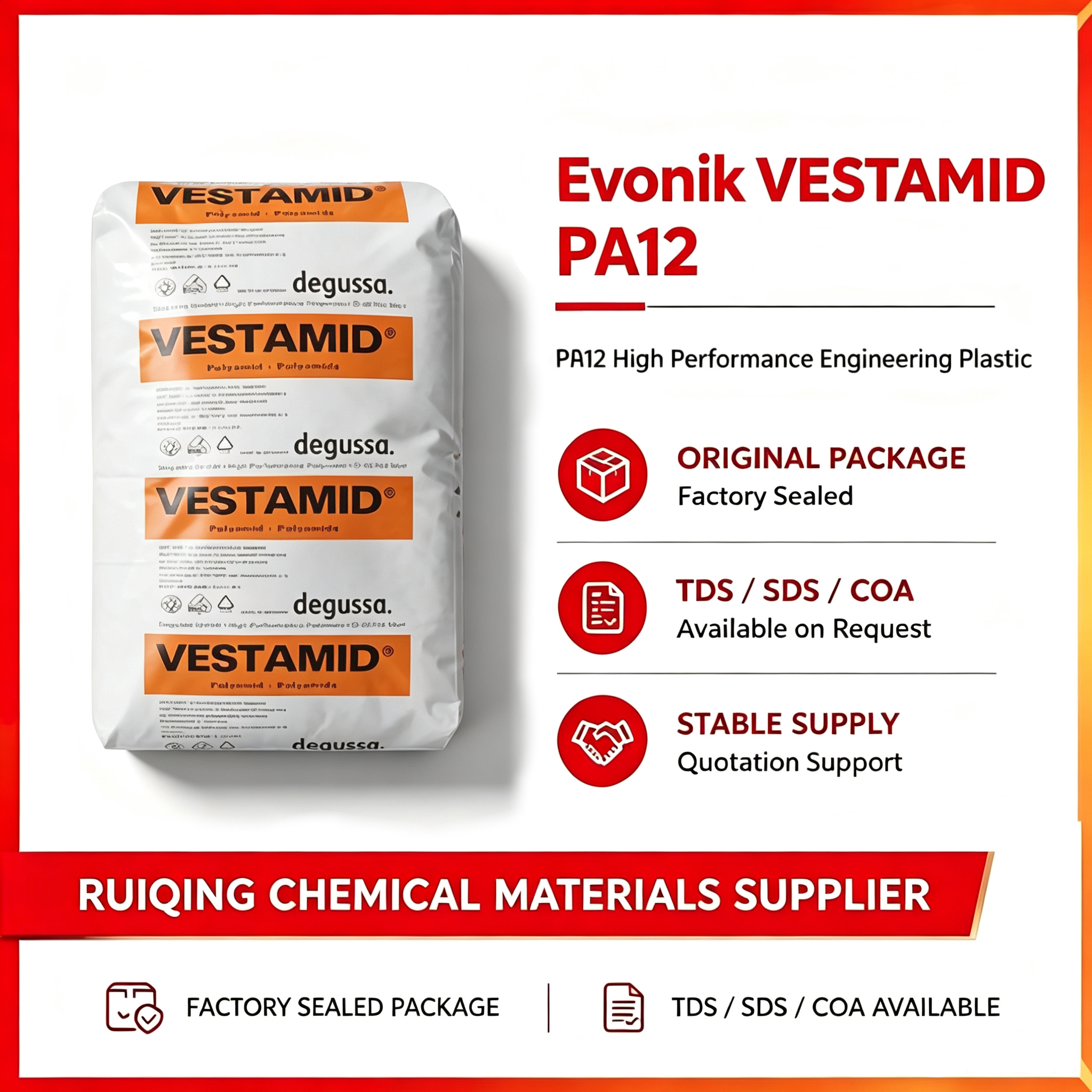
VESTAMID X7393 BK 9.7507 is a high-viscosity, plasticized, impact-modified, heat- and light-stabilized polyamide 12 compound from Evonik Operations GmbH developed for semi-rigid automotive tubing and hose extrusion.
The defining feature of this grade is not simply flexibility. Evonik specifically positions VESTAMID X7393 BK 9.7507 for tubing that needs optimized cold-temperature impact resistance together with increased burst-pressure resistance.
This makes the grade particularly useful when a tube must remain tougher and more pressure capable than a softer, highly flexible PA12 hose grade while still retaining the installation advantages of plasticized PA12.
Current Evonik-derived product information associates the material with automotive tubing according to DIN 73378 and DIN 74324, Type PA12-PHLY. Older Evonik grade overviews also position X7393 for air-brake tubing and higher-working-pressure line applications.
The polymer is black, unfilled and supplied as pellets in moisture-proof packaging. It contains plasticizer, impact modifier, heat stabilizer, light stabilizer and lubricant.
The high-viscosity formulation supports extrusion stability. Current rheological data lists an MVR of approximately 8 cm³/10 min at 230°C / 5 kg.
A major mechanical advantage is the dry tensile modulus of approximately 560 MPa, which is higher than softer X7293-type flexible tubing grades. Conditioned tensile modulus remains approximately 495 MPa.
The higher modulus helps support pressure resistance and shape retention while the plasticizer and impact modifier preserve ductility.
Current yield stress is approximately 31 MPa dry and 28 MPa conditioned, with yield strain approximately 26%.
Low-temperature impact performance is particularly strong. Unnotched Charpy specimens show no break at both 23°C and -30°C, while notched impact remains approximately 8 kJ/m² at -30°C.
At room temperature, the grade provides very high notched Charpy performance of approximately 115 kJ/m² dry and 124 kJ/m² conditioned.
The PA12 base also provides low moisture sensitivity. Water absorption is approximately 1.2% and humidity absorption approximately 0.6%, so properties change relatively little with changing humidity compared with more hygroscopic short-chain polyamides.
Chemical resistance is another major strength. Current grade data covers motor oil, insulating oil, diesel, EN 590 diesel, alcohol-containing fuels, reference fuels, methanol, ethanol, hydrocarbons, salt solutions, brake fluid and water.
The low coefficient of friction is also specifically identified by Evonik and is useful for tube routing, assembly and dynamic contact with clips or adjacent vehicle components.
For more PA12 products, visit our PA12 Polyamide 12 Product Category →.
For manufacturer information about VESTAMID automotive line systems, visit the Official Evonik VESTAMID Fuel-Line Systems Page →.
Key Features of VESTAMID X7393 BK 9.7507
| Feature | Engineering Benefit |
|---|---|
| High Viscosity | Supports stable pipe and tube extrusion |
| Plasticized PA12 | Provides useful flexibility for vehicle routing |
| Impact Modified | Improves shock resistance and cold-weather durability |
| Heat Stabilized | Supports automotive thermal environments |
| Light / Weathering Stabilized | Helps long-term technical service |
| Semi-Rigid Tubing Positioning | Higher stiffness than softer flexible PA12 tube grades |
| Increased Burst-Pressure Resistance | Key reason for selecting X7393 over softer tubing grades |
| Excellent Cold Impact | Unnotched Charpy shows no break at -30°C |
| Low Coefficient of Friction | Supports routing and assembly |
| Low Moisture Absorption | Helps dimensional and mechanical stability |
| Fuel / Oil Resistance | Important for automotive tubing |
| Broad Chemical Resistance | Suitable for exposure to many automotive fluids |
The main engineering value of VESTAMID X7393 BK 9.7507 is its balance of semi-rigid tube stiffness, pressure capability and low-temperature toughness.
Typical Applications for VESTAMID X7393 BK 9.7507
VESTAMID X7393 BK 9.7507 is primarily intended for automotive tubing and hose systems that need more stiffness and burst-pressure capability than very soft PA12 formulations.
| Application Area | Typical Use |
|---|---|
| Air-Brake Tubing | Semi-rigid PA12 lines designed around automotive tube standards |
| Pneumatic Lines | Compressed-air tubing with pressure and cold-impact requirements |
| Automotive Fluid Lines | Semi-rigid routed fluid tubing |
| Fuel-Related Tubing | Selected fuel and return-line systems after qualification |
| Vacuum Lines | Automotive vacuum tubing |
| Hydraulic / Control Lines | Selected low- to medium-pressure technical lines |
| Industrial Pneumatic Tubing | Chemical-resistant semi-rigid PA12 tubing |
| Profile Extrusion | Technical semi-rigid extruded profiles |
| Tube Fittings / Components | Injection-molded or extruded components where grade compatibility is required |
The grade is particularly relevant when the tube design needs higher working pressure or burst-pressure resistance without moving to a rigid PA12 formulation.
Typical Properties of VESTAMID X7393 BK 9.7507
Physical & Rheological Properties
| Property | Typical Value | Test Method |
|---|---|---|
| Density | 1.02 g/cm³ | ISO 1183 |
| Water Absorption | 1.2% | Similar to ISO 62 |
| Humidity Absorption | 0.6% | Similar to ISO 62 |
| MVR | 8 cm³/10 min | ISO 1133 |
| MVR Condition | 230°C / 5 kg | ISO 1133 |
| Molding Shrinkage – Parallel | 0.8% | ISO 294-4 / 2577 |
| Molding Shrinkage – Normal | 1.4% | ISO 294-4 / 2577 |
| Viscosity Number, Specification Range | 170–205 cm³/g | ISO 307 |
| Viscosity Number after Extraction, Calculated | 190–230 cm³/g | ISO 307 |
The MVR must always be quoted together with its test temperature and load. Flow values measured under different conditions cannot be compared directly.
Mechanical Properties
| Property | Dry / Conditioned | Test Method |
|---|---|---|
| Tensile Modulus | 560 / 495 MPa | ISO 527 |
| Tensile Strength | 31 / 28 MPa | ISO 527 |
| Yield Stress | 31 / 28 MPa | ISO 527 |
| Yield Strain | 26 / 26% | ISO 527 |
| Stress at 50% Strain | 30 / 27 MPa | ISO 527 |
| Stress at Break | 44 / 42 MPa | ISO 527 |
| Nominal Strain at Break | >50% / >50% | ISO 527 |
| Charpy Impact, 23°C | No Break / No Break | ISO 179/1eU |
| Charpy Impact, -30°C | No Break / No Break | ISO 179/1eU |
| Charpy Notched Impact, 23°C | 115 / 124 kJ/m² | ISO 179/1eA |
| Charpy Notched Impact, -30°C | 8 / 8 kJ/m² | ISO 179/1eA |
| Flexural Modulus, 23°C | 715 / 480 MPa | ISO 178 |
These properties explain why VESTAMID X7393 BK 9.7507 is described as semi-rigid rather than highly flexible.
Thermal Properties
| Property | Typical Value | Test Method |
|---|---|---|
| Melting Temperature | 173°C | ISO 11357-1/-3 |
| Glass Transition Temperature | 24°C | ISO 11357-1/-2 |
| HDT @ 1.80 MPa | 45°C | ISO 75-1/-2 |
| HDT @ 0.45 MPa | 115°C | ISO 75-1/-2 |
| Vicat Softening Temperature A | 170°C | ISO 306 |
| Vicat Softening Temperature B | 130°C | ISO 306 |
| CTE, Parallel | 140 × 10⁻⁶/K | ISO 11359-1/-2 |
| CTE, Normal | 140 × 10⁻⁶/K | ISO 11359-1/-2 |
| Flammability @ 1.6 mm | HB | IEC 60695-11-10 |
The 173°C melting temperature and 24°C glass-transition temperature reflect the plasticized PA12 structure of the grade.
Electrical Properties
| Property | Typical Dry Value | Test Method |
|---|---|---|
| Relative Permittivity, 100 Hz | 7.0 | IEC 62631-2-1 |
| Relative Permittivity, 1 MHz | 4.2 | IEC 62631-2-1 |
| Dissipation Factor, 100 Hz | 0.190 | IEC 62631-2-1 |
| Dissipation Factor, 1 MHz | 0.110 | IEC 62631-2-1 |
| Volume Resistivity | 1 × 10¹⁰ Ω·m | IEC 62631-3-1 |
| Electric Strength | 27 kV/mm | Similar to IEC 60243-1 |
| Comparative Tracking Index | 600 | IEC 60112 |
Electrical properties are secondary to the tubing application but can be relevant where lines are routed close to electrical systems.
Chemical Resistance
Current grade-specific data includes evaluation with:
- SAE 10W40 motor oil
- Insulating oil
- ISO 1817 Liquid 1
- ISO 1817 Liquid 2
- ISO 1817 Liquid 3
- ISO 1817 Liquid 4
- Standard fuel without alcohol
- Standard fuel with alcohol
- Diesel fuel
- Diesel fuel at elevated temperature
- Diesel EN 590 at 100°C
- Methanol
- Ethanol
- Isopropyl alcohol
- n-Hexane
- Toluene
- Iso-octane
- Acetic acid solution
- Citric acid solution
- Sodium hydroxide solutions
- Sodium chloride solution
- DOT 4 brake fluid at 120°C
- Water
This broad chemical-resistance profile supports demanding automotive and industrial tubing applications.
Why Choose VESTAMID X7393 BK 9.7507?
The main reason to choose VESTAMID X7393 BK 9.7507 is that it occupies a useful position between a highly flexible PA12 hose material and a rigid engineering PA12.
For pressure tubing, stiffness matters because the wall must resist deformation under internal pressure. However, excessive stiffness can make routing difficult and can reduce cold-temperature toughness.
The approximately 560 MPa dry tensile modulus of X7393 provides more structural support than softer flexible PA12 grades while still remaining far below the modulus of rigid unplasticized PA12.
The impact-modified formulation compensates for the higher stiffness by maintaining strong impact performance.
The no-break unnotched Charpy result at -30°C is particularly important for air-brake and pneumatic tubing used in cold climates.
Burst-pressure resistance is another defining factor. Evonik specifically describes X7393 as optimized for semi-rigid tubing with increased burst-pressure resistance.
Low friction also improves practical installation. Tubes are commonly routed through clips, guides and confined spaces where a lower-friction surface can simplify assembly and reduce abrasion.
Low moisture absorption helps keep tube dimensions and mechanical behavior relatively stable across changing humidity.
The chemical-resistance dataset covers fuels, oils, alcohols, hydrocarbons, salt solutions and brake fluid, supporting automotive service.
For a customer who finds X7293 too flexible but still wants a tough plasticized PA12 tubing compound, VESTAMID X7393 BK 9.7507 is a logical grade to evaluate.
Processing Guidelines for VESTAMID X7393 BK 9.7507
VESTAMID X7393 BK 9.7507 supports:
- Pipe / tube extrusion
- Profile extrusion
- Other extrusion
- Injection molding
Current grade-specific standardized specimen conditions are:
| Processing Parameter | Published Value |
|---|---|
| ISO Test Melt Temperature | 220°C |
| ISO Test Mold Temperature | 60°C |
| ISO Test Injection Velocity | 200 mm/s |
| ISO Test Holding Pressure | 70 MPa |
| MVR Test Condition | 230°C / 5 kg |
The 220°C / 60°C / 200 mm/s values are ISO test-specimen conditions. They should not be treated as a universal production tube-extrusion recipe.
For commercial tube extrusion, optimize:
- Barrel-zone temperatures
- Adapter temperature
- Die temperature
- Screw speed
- Melt pressure
- Residence time
- Line speed
- Tube outside diameter
- Wall thickness
- Draw-down ratio
- Vacuum sizing
- Cooling-water conditions
- Ovality
- Surface finish
- Burst pressure
- Cold-impact performance
The current grade sheet supplies the resin ready for use in moisture-proof bags. Material in original undamaged packaging has a shelf life of at least two years when stored dry at temperatures not exceeding 30°C.
If packaging has been damaged or the material has been exposed to ambient air, follow the latest Evonik VESTAMID drying recommendations before processing.
VESTAMID X7393 BK 9.7507 vs. VESTAMID X7293 BK 9.7507
| Feature | VESTAMID X7393 BK 9.7507 | VESTAMID X7293 BK 9.7507 |
|---|---|---|
| Base Polymer | Plasticized impact-modified PA12 | Plasticized impact-modified PA12 |
| Color | Black | Black |
| Viscosity | High | High |
| Main Positioning | Semi-rigid tubing with higher burst resistance | More flexible tubing and hose |
| Tensile Modulus | 560 MPa dry | Approx. 410 MPa dry |
| Yield Stress | 31 MPa dry | Approx. 26 MPa dry |
| Notched Charpy, 23°C | 115 kJ/m² dry | Approx. 120 kJ/m² dry |
| Notched Charpy, -30°C | 8 kJ/m² dry | Approx. 7 kJ/m² dry |
| MVR | 8 cm³/10 min @230°C/5 kg | 53 cm³/10 min @275°C/5 kg |
| Melting Temperature | 173°C | Approx. 172°C |
| Main Selection Reason | Higher stiffness / increased burst-pressure resistance | Greater flexibility / easier routing |
The MVR values are measured at different test temperatures, so they must not be compared directly as a simple measure of flow.
Choose VESTAMID X7393 BK 9.7507 when the tube needs greater stiffness and burst-pressure capability.
Choose VESTAMID X7293 BK 9.7507 when the design prioritizes greater flexibility and very high elongation.
Related Products
VESTAMID X7293 BK 9.7507 – Flexible plasticized impact-modified PA12 for automotive tubing and hose.
VESTAMID X7293 NC – Natural-color flexible PA12 tubing grade for automotive applications.
VESTAMID X7297 BK 9.7507 – Flexible PA12 with strong historical positioning in multilayer automotive fuel-line systems.
View More PA12 Polyamide 12 Materials →
Technical Documents for VESTAMID X7393 BK 9.7507
| Document Type | Description |
|---|---|
| TDS | Current physical, rheological, mechanical, thermal and electrical data |
| SDS | Safety Data Sheet |
| General Material Specification | Viscosity, density, tensile and impact specification ranges |
| Automotive Tubing Information | DIN 73378 / DIN 74324 application context |
| Processing Guide | VESTAMID extrusion, handling and drying recommendations |
| COA | Batch-specific quality information where available |
Need technical documents for VESTAMID X7393 BK 9.7507?
📧 Email: ruiqingchem@gmail.com
📝 Online form: Contact Us →
Please state VESTAMID X7393 BK 9.7507 and the required document type when submitting your inquiry.
FAQ About VESTAMID X7393 BK 9.7507
Q1: What is VESTAMID X7393 BK 9.7507?
VESTAMID X7393 BK 9.7507 is a high-viscosity, plasticized, impact-modified, heat- and light-stabilized PA12 from Evonik for semi-rigid automotive tubing and hose.
Q2: What is the main advantage of VESTAMID X7393 BK 9.7507?
Its main advantage is the combination of optimized low-temperature impact and increased burst-pressure resistance in a semi-rigid PA12 tubing compound.
Q3: Is VESTAMID X7393 BK 9.7507 a plasticized grade?
Yes. Plasticizer is explicitly listed in current grade-specific information.
Q4: Which automotive tube standards are associated with the grade?
Evonik product information references DIN 73378 and DIN 74324, Type PA12-PHLY.
Q5: What is the tensile modulus?
The current tensile modulus is approximately 560 MPa dry and 495 MPa conditioned.
Q6: How does VESTAMID X7393 BK 9.7507 perform at low temperature?
Unnotched Charpy specimens show no break at -30°C, while notched Charpy impact is approximately 8 kJ/m² at -30°C.
Q7: What is the MVR?
The current grade-specific MVR is approximately 8 cm³/10 min at 230°C / 5 kg.
Q8: Is VESTAMID X7393 BK 9.7507 resistant to fuel and oil?
Yes. Current grade data includes resistance testing with diesel, EN 590 diesel, alcohol-containing fuels, motor oil, hydrocarbons and other automotive fluids.
Q9: What is the difference between X7393 and X7293?
X7393 is more semi-rigid and has a higher tensile modulus, giving it stronger burst-pressure positioning. X7293 is softer and more flexible for routing.
Q10: Can you provide VESTAMID X7393 BK 9.7507 TDS and SDS?
Yes. Please request the latest technical documents through our Contact Page → or email ruiqingchem@gmail.com.
Request VESTAMID X7393 BK 9.7507 Price & Technical Support
For pricing, availability, technical documents or application support for VESTAMID X7393 BK 9.7507, please provide:
- Required quantity
- Destination country or port
- Air-brake, pneumatic, fuel or other tubing application
- Tube outside diameter
- Wall thickness
- Minimum bend radius
- Working pressure
- Required burst pressure
- Continuous and peak operating temperature
- Minimum cold-impact temperature
- Fluid or chemical medium
- DIN / OEM requirement
- Extrusion-line information
- TDS, SDS or COA requirement
- Sample requirement, if applicable
📧 Email: ruiqingchem@gmail.com
📝 Send Inquiry →