描述
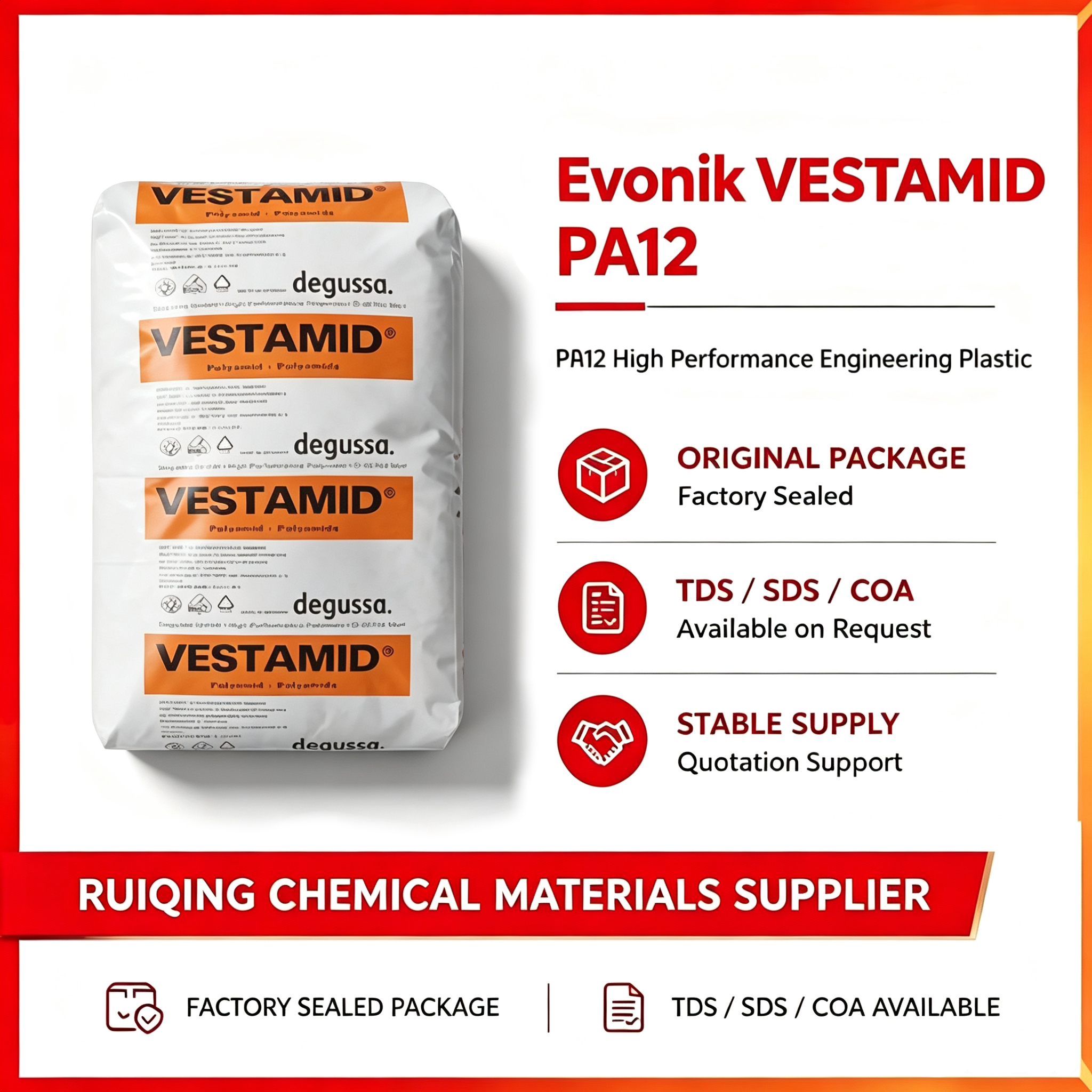
VESTAMID LX9029 is a high-viscosity, plasticized, heat- and light-stabilized polyamide 12 compound from Evonik Operations GmbH developed especially for the manufacture of highly flexible tubes and hoses.
The current Evonik product information identifies the natural-color grade as VESTAMID LX9029 NC. The material is designed for extrusion and injection molding, with profile extrusion and flexible tube/hose applications forming the main commercial positioning.
The key difference between VESTAMID LX9029 and conventional unplasticized PA12 is flexibility. The current datasheet lists a tensile modulus of only approximately 240 MPa, while nominal strain at break reaches approximately 320%. This combination makes the material suitable for tubing that must bend easily, tolerate repeated movement and resist brittle failure.
The plasticizer lowers stiffness and increases flexibility while the PA12 matrix retains important engineering-plastic advantages such as low moisture absorption, dimensional stability, impact resistance and chemical resistance.
The grade is also high viscosity. This is valuable in extrusion because sufficient melt strength helps maintain tube shape, wall-thickness control and dimensional stability as the melt leaves the die.
Another important feature is impact performance. Unnotched Charpy specimens show no break at 23°C and -30°C, while typical notched impact strength is approximately 110 kJ/m² at 23°C. This demonstrates that VESTAMID LX9029 remains extremely tough in normal service conditions.
At -30°C, the published notched impact value is approximately 4 kJ/m². The value is lower than at room temperature, but the material still combines substantial flexibility with PA12’s characteristic low-temperature toughness.
The current datasheet also identifies the grade as UV/light/weathering stabilized and high heat resistant. These characteristics support outdoor, industrial and engineering applications where tubes or hoses may experience light exposure or elevated service temperatures.
The melting temperature is approximately 166°C, noticeably lower than many unplasticized PA12 grades because of the plasticized formulation.
For additional PA12 grades, visit our PA12 Polyamide 12 Product Category →.
For official manufacturer information about the VESTAMID family, visit the Evonik VESTAMID PA12 Page →.
Key Features of VESTAMID LX9029
| Feature | Benefit |
|---|---|
| Plasticized PA12-P | Provides much greater flexibility than standard unplasticized PA12 |
| High Viscosity | Supports stable tube, hose and profile extrusion |
| Very Low Tensile Modulus | Approx. 240 MPa for soft, bendable components |
| Very High Elongation | Approx. 320% nominal strain at break |
| Strong Impact Resistance | No break in unnotched Charpy tests at 23°C and -30°C |
| Heat Stabilized | Supports demanding thermal environments |
| UV / Light / Weathering Stabilized | Supports applications exposed to light and outdoor conditions |
| Low Water Absorption | Helps minimize humidity-related dimensional changes |
| Dimensional Stability | Important for tubing dimensions and connection consistency |
| Semi-Crystalline PA12 Base | Combines flexibility with engineering-plastic durability |
| Electrically Insulating | Current grade information classifies the material as insulating |
| Natural Color | Allows application-specific coloration where required |
The defining advantage of VESTAMID LX9029 is not maximum stiffness. It is the ability to deliver a highly flexible PA12 tube or hose while retaining strong toughness and dimensional stability.
Typical Applications for VESTAMID LX9029
VESTAMID LX9029 is primarily intended for flexible extrusion applications.
| Application Area | Typical Use |
|---|---|
| Highly Flexible Tubes | Technical tubing requiring low stiffness and high bendability |
| Flexible Hoses | Hose applications requiring large deformation without brittle failure |
| Industrial Tubing | Flexible lines in industrial and engineering systems |
| Sports & Lifestyle Tubing | Flexible components requiring toughness and weather resistance |
| Profile Extrusion | Soft or flexible PA12 profiles |
| Injection-Molded Flexible Parts | Selected molded components requiring high elongation |
| Outdoor Technical Products | UV/light-stabilized flexible PA12 components |
| Engineering Components | Parts requiring low moisture absorption and dimensional stability |
The current datasheet specifically identifies tube and hose as the application category, so these should remain the primary focus when presenting the grade to customers.
Typical Properties of VESTAMID LX9029
Physical & Rheological Properties
| Property | Typical Value | Test Method |
|---|---|---|
| Density | 1.02 g/cm³ | ISO 1183 |
| Molding Shrinkage – Parallel | 0.7% | ISO 294-4 / 2577 |
| Molding Shrinkage – Normal | 1.1% | ISO 294-4 / 2577 |
| Viscosity Number | 150 cm³/g | ISO 307 / 1157 / 1628 |
| Corrected Viscosity Number | 220 cm³/g | ISO 307 / 1157 / 1628 |
| Structure | Semi-crystalline PA12 | Manufacturer information |
| Color | Natural Color | Manufacturer information |
| Additive | Plasticizer | Manufacturer information |
The corrected viscosity number of approximately 220 cm³/g supports the manufacturer’s high-viscosity classification of VESTAMID LX9029.
Mechanical Properties
| Property | Typical Value | Test Method |
|---|---|---|
| Tensile Modulus | 240 MPa | ISO 527 |
| Stress at 50% Strain | 19 MPa | ISO 527 |
| Stress at Break | 40 MPa | ISO 527 |
| Nominal Strain at Break | 320% | ISO 527 |
| Charpy Impact Strength, 23°C | No Break | ISO 179/1eU |
| Charpy Impact Strength, -30°C | No Break | ISO 179/1eU |
| Charpy Notched Impact, 23°C | 110 kJ/m² | ISO 179/1eA |
| Charpy Notched Impact, -30°C | 4 kJ/m² | ISO 179/1eA |
The 240 MPa tensile modulus and 320% nominal strain at break clearly show the flexible character of the grade.
Thermal Properties
| Property | Typical Value | Test Method |
|---|---|---|
| Melting Temperature | 166°C | ISO 11357-1/-3 |
| Melting Temperature | 166°C | ASTM D3418 |
| Heat Stabilization | Yes | Manufacturer information |
| UV / Light / Weathering Stabilization | Yes | Manufacturer information |
| Heat-Resistance Positioning | High heat resistant | Manufacturer information |
The current grade-specific product information does not publish HDT or Vicat values for VESTAMID LX9029, so this page does not substitute those values from another PA12 grade.
Sustainability & LCA Data
Current Evonik product information includes TÜV Rheinland-certified LCA values for the VESTAMID L compound category associated with this grade.
| LCA Property | Published Value | Standard |
|---|---|---|
| LCA Certificate Name | VESTAMID L Compound high | ISO 14040 / 14044 |
| LCA Certifier | TÜV Rheinland | ISO 14040 / 14044 |
| Blue Water Consumption | 23.9 kg | ISO 14040 / 14044 |
| GWP incl. Biogenic Carbon incl. LUC | 5.8 kg CO₂ eq./kg | ISO 14040 / 14044 |
| GWP excl. Biogenic Carbon incl. LUC | 5.8 kg CO₂ eq./kg | ISO 14040 / 14044 |
| Land Use – ReCiPe 2016 | 0.1 annual crop eq.·y | ISO 14040 / 14044 |
| GWP Saving vs. 2023 Reference | 2.1 kg CO₂ eq./kg lower | ISO 14040 / 14044 |
This quantified LCA information can support customers working on product-carbon-footprint calculations or material sustainability comparisons.
Why Choose VESTAMID LX9029?
The main reason to choose VESTAMID LX9029 is its unusually high flexibility for a PA12 engineering material.
A conventional PA12 tube offers excellent toughness and chemical resistance but may still be too stiff for applications requiring tight routing, repeated bending or soft hose behavior.
The plasticized formulation of VESTAMID LX9029 reduces the tensile modulus to approximately 240 MPa. This provides a much softer response while maintaining a stress at break of approximately 40 MPa and very high elongation.
The grade is also highly impact resistant. A no-break result in unnotched Charpy testing at both 23°C and -30°C shows that the material can absorb substantial impact energy without brittle fracture.
High viscosity supports extrusion stability. Flexible materials can be difficult to process if melt strength is too low, but the high-viscosity design of LX9029 helps support tube and profile extrusion.
Low water absorption is another important PA12 advantage. Tube dimensions and mechanical behavior are less sensitive to humidity than many shorter-chain polyamides.
Finally, heat, light and UV/weathering stabilization broaden the range of environments in which VESTAMID LX9029 can be considered.
Processing Guidelines for VESTAMID LX9029
VESTAMID LX9029 is intended for extrusion and injection molding, with profile extrusion and tube/hose production as the most important process/application combination.
The current grade-specific datasheet provides these published reference conditions:
| Processing Parameter | Published Value |
|---|---|
| Primary Processing | Extrusion / Profile Extrusion |
| Additional Processing | Injection Molding |
| Test Melt Temperature | 220°C |
| Test Mold Temperature | 60°C |
| Test Injection Velocity | 200 mm/s |
| Supply Form | Cylindrical pellets / granules |
| Packaging | Moisture-proof polyethylene bags |
| Shelf Life | At least 2 years in original undamaged packaging at ≤30°C |
The 220°C melt temperature and 60°C mold temperature are standardized test-specimen conditions. They should not automatically be used as a fixed tube-extrusion recipe.
For extrusion of highly flexible tubing, processors should optimize:
- Barrel-temperature profile
- Adapter and die temperature
- Screw speed
- Melt pressure
- Line speed
- Vacuum sizing
- Tube diameter
- Wall thickness
- Cooling intensity
- Take-off speed
- Ovality and dimensional control
The plasticized formulation should also be considered when selecting drying conditions and residence time. Intact moisture-proof packaging helps keep the material ready for processing.
Because pigments can affect material values, customers requiring colored LX9029 should qualify the final colored formulation rather than assuming that every property remains identical to the natural-color grade.
VESTAMID LX9029 vs. VESTAMID L2124 NC
| Feature | VESTAMID LX9029 | VESTAMID L2124 NC |
|---|---|---|
| Material Family | PA12-P | PA12-P |
| Plasticized | Yes | Yes |
| Viscosity | High | High |
| Primary Positioning | Highly flexible tubes and hoses | Flexible tubing, hoses, oil/petrochemical applications |
| Tensile Modulus | Approx. 240 MPa | Approx. 400 MPa |
| Relative Flexibility | Higher | Lower |
| Melting Temperature | Approx. 166°C | Approx. 169°C |
| 23°C Notched Impact | Approx. 110 kJ/m² | Approx. 140 kJ/m² |
| Main Selection Reason | Maximum flexibility and very high elongation | More balanced flexible tubing performance |
Choose VESTAMID LX9029 when a very soft, highly flexible tube or hose is the main design requirement.
Choose VESTAMID L2124 NC when the application needs a somewhat stiffer plasticized PA12 with a broader established tubing and petrochemical application profile.
Related Products
VESTAMID L2124 NC – High-viscosity plasticized PA12-P for flexible tubing and hoses.
VESTAMID LX9013 BK 9.7507 – Plasticized, impact-modified PA12-I for flexible hot diesel fuel lines.
VESTAMID X7293 BK 9.7507 – Plasticized, impact-modified PA12-I for flexible automotive tubing.
View More PA12 Polyamide 12 Materials →
Technical Documents for VESTAMID LX9029
| Document Type | Description |
|---|---|
| TDS | Current product information with mechanical, thermal, rheological and LCA data |
| SDS | Safety Data Sheet |
| COA | Batch-specific Certificate of Analysis where available |
| Processing Information | Extrusion and injection-molding guidance |
| LCA Information | TÜV Rheinland-certified environmental data |
| Application Support | Tube, hose and profile-extrusion material selection |
Need technical documents for VESTAMID LX9029?
📧 Email: ruiqingchem@gmail.com
📝 Online form: Contact Us →
Please state VESTAMID LX9029 and the required document type when submitting your inquiry.
FAQ About VESTAMID LX9029
Q1: What is VESTAMID LX9029?
VESTAMID LX9029 is a high-viscosity, plasticized, heat- and light-stabilized PA12-P compound from Evonik developed especially for highly flexible tubes and hoses.
Q2: Is VESTAMID LX9029 plasticized?
Yes. Plasticizer is explicitly listed in the current product information. This is the main reason for its very low modulus and high flexibility.
Q3: What is the tensile modulus of VESTAMID LX9029?
The current typical tensile modulus is approximately 240 MPa according to ISO 527.
Q4: What is the strain at break of VESTAMID LX9029?
The published nominal strain at break is approximately 320%, showing very high ductility.
Q5: What is the density of VESTAMID LX9029?
The typical density is approximately 1.02 g/cm³ according to ISO 1183.
Q6: What is the impact strength of VESTAMID LX9029?
Unnotched Charpy specimens show no break at 23°C and -30°C. Typical notched impact strength is approximately 110 kJ/m² at 23°C and 4 kJ/m² at -30°C.
Q7: What is the melting temperature of VESTAMID LX9029?
The current published melting temperature is approximately 166°C according to ISO 11357 and ASTM D3418.
Q8: Is VESTAMID LX9029 suitable for tube extrusion?
Yes. Highly flexible tubes and hoses are the principal applications identified in current Evonik product information.
Q9: What processing conditions are published?
The current datasheet lists standardized test conditions of approximately 220°C melt temperature, 60°C mold temperature and 200 mm/s injection velocity. Production extrusion settings must be optimized for the actual line and tube design.
Q10: Can you provide VESTAMID LX9029 TDS, SDS and COA?
Yes. Please request the required documents through our Contact Page → or email ruiqingchem@gmail.com.
Request VESTAMID LX9029 Price & Technical Support
For pricing, availability, technical documents or grade-selection support for VESTAMID LX9029, please provide:
- Required quantity
- Destination country or port
- Tube, hose or profile application
- Tube outside diameter and wall thickness
- Required flexibility or bend radius
- Continuous and peak service temperature
- Chemical or fluid exposure
- UV / outdoor exposure requirement
- Color requirement
- Extrusion-line information
- TDS, SDS, COA or LCA document requirements
- Sample requirement, if applicable
📧 Email: ruiqingchem@gmail.com
📝 Send Inquiry →