
描述
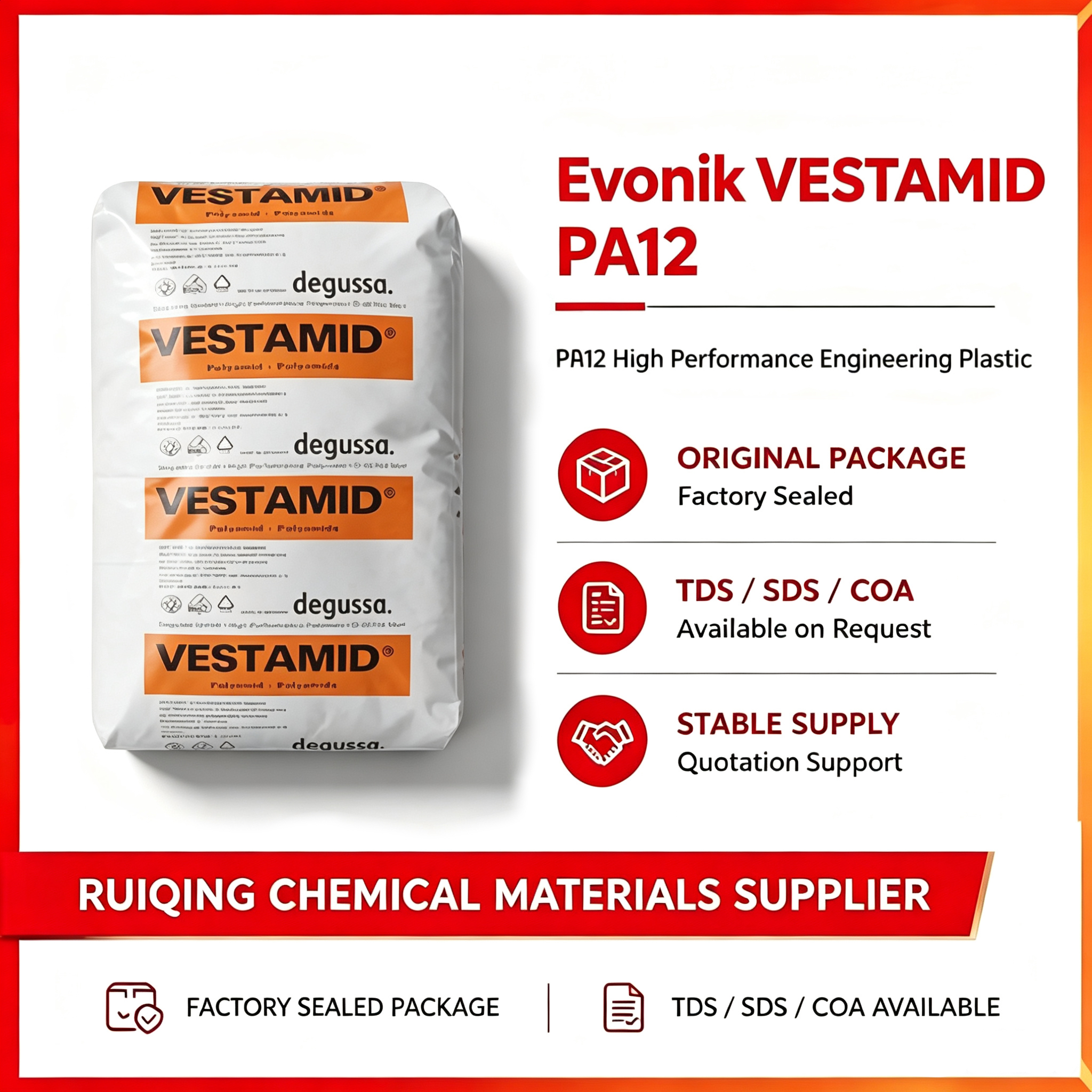
VESTAMID L1930 NC is a heat-stabilized polyamide 12 compound reinforced with approximately 30% milled glass fiber. Manufactured by Evonik Operations GmbH, this PA12-GD30 grade is designed for injection molding of stiff, dimensionally stable and relatively low-warpage engineering components.
The reinforcement system is the key technical feature of VESTAMID L1930 NC. Evonik uses specialty short / milled glass fibers to reduce the difference between longitudinal and transverse shrinkage relative to the melt-flow direction. Compared with many conventional glass-fiber-reinforced materials, this more balanced shrinkage behavior helps reduce distortion in precision molded parts.
Published Evonik data lists molding shrinkage of approximately 0.7% parallel to flow and 0.6% normal to flow. The relatively small difference between the two directions supports the low-warpage positioning of this grade.
The PA12 matrix also contributes very low moisture uptake. Published water absorption is approximately 1.1%, while humidity absorption is approximately 0.5%. This helps molded parts retain dimensions and mechanical performance when ambient humidity changes.
Mechanical performance is well suited to rigid precision parts. VESTAMID L1930 NC has a typical tensile modulus of approximately 3,740 MPa and tensile / yield strength of about 63 MPa in the dry state. It also retains useful impact strength at both room temperature and -30°C.
As a semi-crystalline PA12 material, the grade provides strong chemical resistance, including resistance to fuels, oils and fats. These characteristics make it suitable for automotive, industrial and precision engineering applications where dimensional accuracy and chemical resistance are required together.
The grade is supplied in natural color, giving processors greater flexibility where a black pre-colored compound is not required.
Explore additional grades in our PA12 Polyamide 12 Product Category →.
For manufacturer information about VESTAMID PA12 materials, visit the Official Evonik VESTAMID Page →.
Key Features of VESTAMID L1930 NC
| Feature | Benefit |
|---|---|
| 30% Milled Glass Fiber Reinforcement | Increases rigidity and supports more balanced dimensional behavior |
| Low Warpage | Specialty short glass fibers reduce directional shrinkage differences |
| Heat Stabilized | Designed for demanding engineering injection-molding applications |
| High Rigidity | Typical dry tensile modulus of approximately 3,740 MPa |
| Low Water Absorption | Helps limit dimensional changes caused by humidity |
| Balanced Mold Shrinkage | Approx. 0.7% parallel and 0.6% normal in published ISO data |
| Good Dimensional Stability | Suitable for precision components and close tolerances |
| Chemical Resistance | Good resistance to fuels, oils, fats and many industrial media |
| Electrical Insulation | High volume resistivity and CTI 600 support insulating applications |
| Useful Impact Strength | Retains impact performance at room and sub-zero temperatures |
| Natural Color | Suitable where a non-black resin is preferred |
| Injection Molding Grade | Developed for reinforced precision PA12 molded parts |
The defining advantage of VESTAMID L1930 NC is not simply its 30% glass content, but the use of milled glass fibers to achieve a more balanced shrinkage profile and lower warpage.
Typical Applications for VESTAMID L1930 NC
VESTAMID L1930 NC is suited to injection-molded parts where rigidity, dimensional accuracy and low warpage are important.
| Application Area | Typical Use |
|---|---|
| Precision Engineering | Close-tolerance molded components |
| Automotive Components | Rigid parts exposed to fuels, oils and changing humidity |
| Mechanical Components | Precision gears, housings and functional structural parts |
| Electrical Components | Insulating housings and dimensionally stable parts |
| Industrial Equipment | Rigid molded components requiring chemical resistance |
| Pump & Valve Components | Selected housings and mechanical parts using PA12 chemical resistance |
| Sensor Components | Precision parts where stable dimensions are important |
| General Injection Molding | Low-warpage reinforced PA12 technical components |
Evonik classifies this grade for automotive and mobility as well as industry and engineering applications. Its combination of low warpage, chemical resistance and electrical insulation makes it especially useful where a general reinforced PA12 grade may not provide sufficient dimensional control.
Typical Properties of VESTAMID L1930 NC
Physical & Rheological Properties
| Property | Typical Value | Test Method |
|---|---|---|
| Density | 1.24 g/cm³ | ISO 1183 |
| Water Absorption | 1.1% | Similar to ISO 62 |
| Humidity Absorption | 0.5% | Similar to ISO 62 |
| Melt Volume-Flow Rate (MVR) | 24 cm³/10 min | ISO 1133 |
| MVR Test Condition | 240°C / 5 kg | — |
| Molding Shrinkage – Parallel | 0.7% | ISO 294-4 / 2577 |
| Molding Shrinkage – Normal | 0.6% | ISO 294-4 / 2577 |
The close parallel and transverse shrinkage values are one of the most important performance characteristics of VESTAMID L1930 NC.
Mechanical Properties
| Property | Typical Value | Test Method |
|---|---|---|
| Tensile Modulus | 3,740 MPa | ISO 527 |
| Tensile Strength | 63 MPa | ISO 527 |
| Yield Stress | 63 MPa | ISO 527 |
| Yield Strain | 4.5% | ISO 527 |
| Stress at Break | 55 MPa | ISO 527 |
| Nominal Strain at Break | 12% | ISO 527 |
| Charpy Unnotched Impact, 23°C | 89 kJ/m² | ISO 179/1eU |
| Charpy Unnotched Impact, -30°C | 65 kJ/m² | ISO 179/1eU |
| Charpy Notched Impact, 23°C | 8 kJ/m² | ISO 179/1eA |
| Charpy Notched Impact, -30°C | 11 kJ/m² | ISO 179/1eA |
These values show that VESTAMID L1930 NC combines reinforced rigidity with useful toughness, including performance at low temperatures.
Thermal & Flammability Properties
| Property | Typical Value | Test Method |
|---|---|---|
| Melting Temperature | 178°C | ISO 11357-1/-3 |
| HDT @ 1.80 MPa | 130°C | ISO 75-1/-2 |
| HDT @ 0.45 MPa | 170°C | ISO 75-1/-2 |
| Vicat Softening Temperature A | 175°C | ISO 306 |
| Vicat Softening Temperature B | 170°C | ISO 306 |
| CTE – Parallel | 50 × 10⁻⁶/K | ISO 11359-1/-2 |
| CTE – Normal | 50 × 10⁻⁶/K | ISO 11359-1/-2 |
| Flammability @ 1.5 mm | HB | IEC 60695-11-10 |
| UL Yellow Card | Available | — |
The identical published thermal-expansion coefficients in the parallel and normal directions further support the dimensional-stability profile of VESTAMID L1930 NC.
Electrical Properties
| Property | Typical Value | Test Method |
|---|---|---|
| Volume Resistivity | >1 × 10¹³ Ω·m | IEC 62631-3-1 |
| Relative Permittivity, 100 Hz | 4.1 | IEC 62631-2-1 |
| Relative Permittivity, 1 MHz | 3.4 | IEC 62631-2-1 |
| Dissipation Factor, 100 Hz | 310 × 10⁻⁴ | IEC 62631-2-1 |
| Dissipation Factor, 1 MHz | 240 × 10⁻⁴ | IEC 62631-2-1 |
| Dielectric Strength | 40 kV/mm | Similar to IEC 60243-1 |
| Comparative Tracking Index (CTI) | 600 | IEC 60112 |
| Insulation Group | I | DIN EN 60664-1 |
These values confirm that VESTAMID L1930 NC is an electrically insulating PA12-GD30 rather than a conductive or antistatic compound.
Why Choose VESTAMID L1930 NC?
The main reason to choose VESTAMID L1930 NC is its low-warpage reinforcement concept.
Conventional chopped-glass-fiber materials often develop strong fiber orientation in the flow direction during molding. That orientation can cause a large difference between longitudinal and transverse shrinkage, leading to twisting or warpage.
The specialty milled glass fibers used in this grade reduce that difference. Published shrinkage values are approximately 0.7% parallel and 0.6% normal, giving a much more balanced dimensional response than many conventional reinforced polymers.
PA12’s low moisture uptake adds another advantage. Parts are less sensitive to humidity-induced dimensional change than many PA6 or PA66 components.
Chemical resistance is also important. As a semi-crystalline PA12, the material is well suited to environments involving oils, greases, fuels and other industrial media.
For components where dimensional precision matters more than achieving the maximum possible tensile modulus, VESTAMID L1930 NC offers a useful balance of rigidity, low warpage, moisture stability and chemical resistance.
Processing Guidelines for VESTAMID L1930 NC
VESTAMID L1930 NC is intended for injection molding. The current product datasheet lists the following specific processing window and ISO test conditions:
| Processing Item | Typical / Recommended Guidance |
|---|---|
| Primary Processing Method | Injection Molding |
| Recommended Melt Temperature Range | Approx. 230–270°C |
| ISO Test Melt Temperature | 250°C |
| ISO Test Mold Temperature | 80°C |
| ISO Test Injection Velocity | 200 mm/s |
| ISO Test Holding Pressure | 70 MPa |
| Recommended Mold Temperature Range | Approx. 30–100°C |
| Supply Condition | Dry pellets in moisture-proof packaging |
VESTAMID compounds are supplied in moisture-proof packaging. Material from intact original packaging is generally ready for processing. If the pellets have been exposed to ambient air and absorbed moisture, drying should be carried out before molding.
Because VESTAMID L1930 NC contains 30% glass reinforcement, molding equipment should be suitable for reinforced engineering plastics. Gate location, injection speed, holding pressure and mold temperature should be optimized for the actual geometry.
For precision low-warpage parts, balanced cavity filling is particularly important. Although the milled-glass system reduces shrinkage anisotropy, flow path and gate design can still influence final dimensions.
VESTAMID L1930 NC vs. VESTAMID L1930 BK
| Feature | VESTAMID L1930 NC | VESTAMID L1930 BK |
|---|---|---|
| Base Polymer | PA12-GD30 | PA12-GD30 |
| Reinforcement | 30% milled glass fiber | 30% milled glass fiber |
| Color | Natural | Black |
| Low-Warpage Concept | Yes | Yes |
| Primary Processing | Injection Molding | Injection Molding |
| Main Selection Point | Natural-color base | Ready-colored black formulation |
Choose VESTAMID L1930 NC when the project requires the L1930 low-warpage performance package in a natural-color formulation.
Choose a black L1930 grade when a ready-colored black material is preferred. For direct substitution between specific color grades, confirm the approved grade designation and current technical documentation.
Related Products
VESTAMID L1930 BK 9.7503 – Black PA12-GD30 low-warpage reinforced grade.
VESTAMID L1930 BK 9.7506 – Alternative black L1930 PA12-GD30 designation.
VESTAMID L1833 NC – Natural-color PA12-GF23 with higher tensile modulus and easy mold release.
View More PA12 Polyamide 12 Materials →
Technical Documents for VESTAMID L1930 NC
| Document Type | Description |
|---|---|
| TDS | Technical Data Sheet with physical, mechanical, thermal and electrical properties |
| SDS | Safety Data Sheet |
| COA | Batch-specific Certificate of Analysis where available |
| Compliance Documents | Relevant regulatory and material-compliance documentation subject to availability |
Need technical documentation for VESTAMID L1930 NC?
📧 Email: ruiqingchem@gmail.com
📝 Online form: Contact Us →
Please state VESTAMID L1930 NC and the required document type when submitting your inquiry.
FAQ About VESTAMID L1930 NC
Q1: What is VESTAMID L1930 NC?
VESTAMID L1930 NC is a heat-stabilized PA12 compound reinforced with approximately 30% milled glass fiber. It is designed for injection molding of rigid, relatively low-warpage precision parts.
Q2: What does PA12-GD30 mean?
PA12 identifies polyamide 12. GD30 indicates approximately 30% milled or ground glass reinforcement, which helps produce a more balanced shrinkage profile than many conventional chopped-glass-fiber compounds.
Q3: Why is VESTAMID L1930 NC considered low warpage?
Evonik uses specialty short glass fibers that reduce the difference between longitudinal and transverse shrinkage. Published shrinkage is approximately 0.7% parallel and 0.6% normal.
Q4: What is the density of VESTAMID L1930 NC?
The typical density is approximately 1.24 g/cm³ according to ISO 1183.
Q5: What is the tensile modulus of VESTAMID L1930 NC?
The typical dry tensile modulus is approximately 3,740 MPa according to ISO 527.
Q6: What is the MVR of VESTAMID L1930 NC?
The typical melt volume-flow rate is approximately 24 cm³/10 min at 240°C / 5 kg according to ISO 1133.
Q7: What is the HDT of VESTAMID L1930 NC?
The typical heat deflection temperature is approximately 130°C at 1.80 MPa and 170°C at 0.45 MPa.
Q8: What processing temperature is recommended for VESTAMID L1930 NC?
The current product datasheet gives a melt-processing range of approximately 230–270°C. The ISO test-specimen melt temperature is 250°C, with an 80°C mold temperature.
Q9: Is VESTAMID L1930 NC electrically insulating?
Yes. The typical dry volume resistivity is greater than 1 × 10¹³ Ω·m, and the material has a typical CTI of 600.
Q10: Can you provide VESTAMID L1930 NC TDS, SDS and COA?
Yes. Please request the required documents through our Contact Page → or email ruiqingchem@gmail.com.
Request VESTAMID L1930 NC Price & Technical Support
For pricing, availability, technical documents or grade-selection support for VESTAMID L1930 NC, please provide:
- Required quantity
- Destination country or port
- Target application
- Part dimensions and tolerance requirements
- Warpage / shrinkage requirements
- Injection-molding conditions
- Color requirements
- Required mechanical or thermal performance
- TDS, SDS or COA requirements
- Sample requirement, if applicable
📧 Email: ruiqingchem@gmail.com
📝 Send Inquiry →