描述
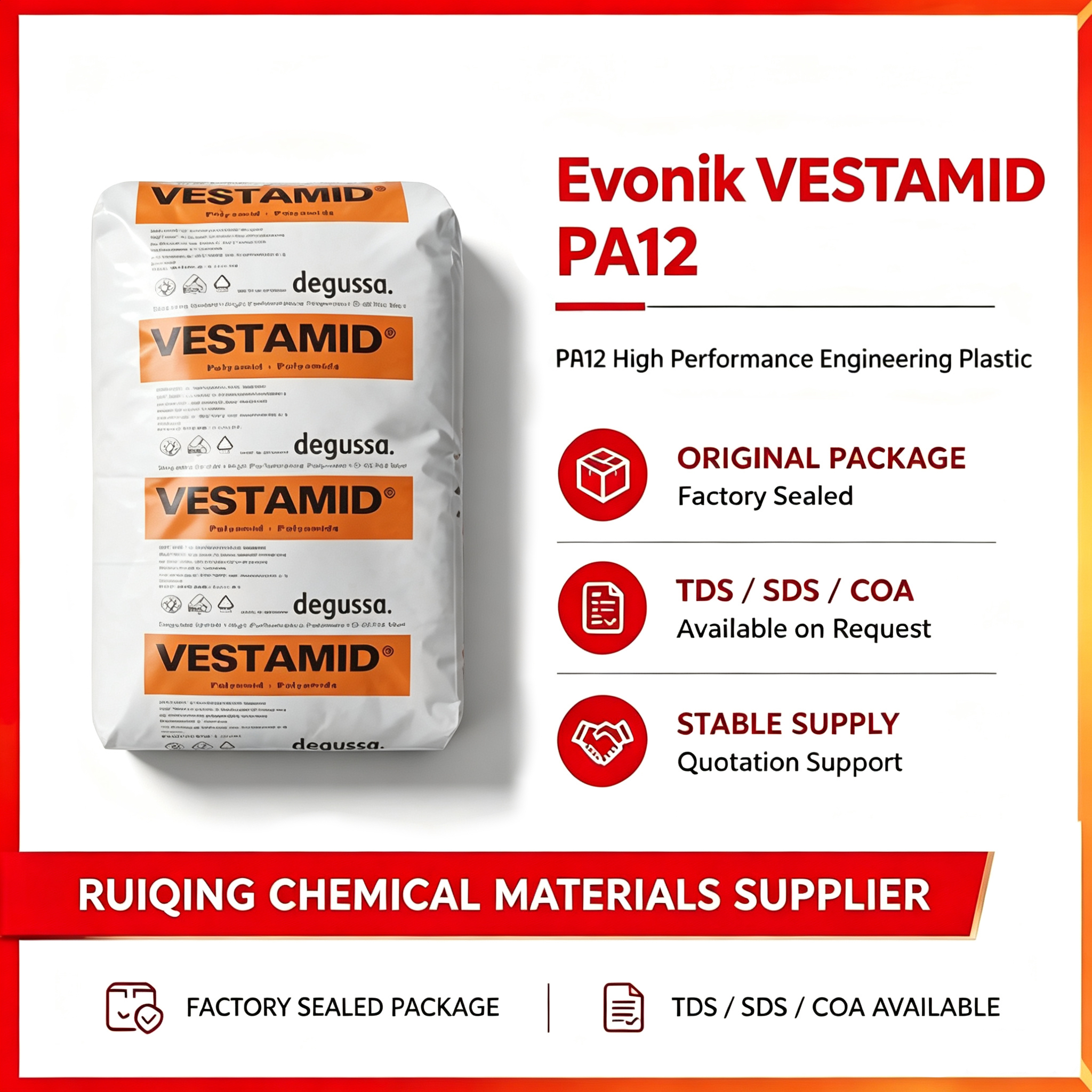
VESTAMID L-R3-MHI BK is a medium-viscosity, impact-modified polyamide 12 compound from Evonik Operations GmbH. The grade is heat and light stabilized, antistatic, black in color, and contains a processing aid designed to support fast and uniform mold filling.
A key strength of VESTAMID L-R3-MHI BK is its good impact resistance at low temperatures. The PA12 base already provides low moisture absorption and strong dimensional stability, while the impact-modified formulation gives the material additional toughness for parts that may experience shock, vibration or cold-service conditions.
The grade also offers increased electrical conductivity compared with standard insulating PA12. Its typical volume resistivity is approximately 6 Ω·m, making VESTAMID L-R3-MHI BK suitable for applications where antistatic behavior or controlled dissipation of electrical charge is required.
Unlike heavily reinforced PA12 compounds, this grade is not primarily designed around high stiffness. Its value is the combination of toughness, antistatic performance, medium viscosity, low-temperature impact behavior and the chemical-resistance characteristics associated with PA12.
Evonik’s VESTAMID L family is based on polyamide 12 and is known for very low water absorption, dimensional stability, impact strength and resistance to oils, greases, fuels and many solvents.
Explore additional materials in our PA12 Polyamide 12 Product Category →.
For manufacturer information about the broader VESTAMID PA12 portfolio, visit the Official Evonik VESTAMID Page →.
Key Features of VESTAMID L-R3-MHI BK
| Feature | Benefit |
|---|---|
| Impact Modified PA12 | Provides higher toughness than standard rigid PA12 grades |
| Good Low-Temperature Impact Resistance | Maintains useful toughness at sub-zero temperatures |
| Antistatic | Helps reduce static charge accumulation in functional components |
| Increased Electrical Conductivity | Typical volume resistivity is much lower than conventional insulating PA12 |
| Medium Viscosity | Balanced processing behavior for injection molding |
| Heat Stabilized | Supports stable performance in elevated-temperature service |
| Light Stabilized | Improved resistance to light exposure |
| Plasticized Formulation | Supports flexibility and toughness |
| Processing Aid | Promotes fast and even mold filling |
| Low Moisture Uptake | Helps maintain dimensional stability under changing humidity |
| Black Color | Supplied as a ready-to-process black functional compound |
| PA12 Chemical Resistance | Useful resistance to oils, fuels, greases and many solvents |
The combination of antistatic behavior and low-temperature impact performance distinguishes VESTAMID L-R3-MHI BK from conventional general-purpose PA12 grades.
Typical Applications for VESTAMID L-R3-MHI BK
VESTAMID L-R3-MHI BK is suitable for molded engineering components that need a balance of toughness, antistatic behavior and dimensional stability.
| Application Area | Typical Use |
|---|---|
| Antistatic Components | Molded parts where static charge accumulation should be reduced |
| Industrial Housings | Tough black housings exposed to vibration, handling or changing temperatures |
| Electrical & Electronic Components | Functional parts requiring lower electrical resistance than standard PA12 |
| Cold-Environment Components | Parts requiring useful impact performance at low temperatures |
| Industrial Machinery | Components exposed to oils, greases or mechanical shock |
| Precision Moldings | PA12 components requiring stable dimensions under varying humidity |
| Functional Technical Parts | Components where toughness, antistatic behavior and chemical resistance are required together |
For applications with a specific electrical resistance target, final molded components should be tested under actual production conditions because resistance can be influenced by processing, part geometry and material flow.
Typical Properties of VESTAMID L-R3-MHI BK
Physical Properties
| Property | Typical Value | Test Method |
|---|---|---|
| Density | 1.10 g/cm³ | ISO 1183 |
| Water Absorption | 1.5% | Similar to ISO 62 |
| Humidity Absorption | 0.8% | Similar to ISO 62 |
| Molding Shrinkage – Parallel | 1.4% | ISO 294-4 / 2577 |
| Molding Shrinkage – Normal | 1.6% | ISO 294-4 / 2577 |
| Melt Volume-Flow Rate (MVR) | 10 cm³/10 min | ISO 1133 |
| MVR Test Condition | 275°C / 5 kg | — |
These values reflect the medium-viscosity and impact-modified character of this grade.
Mechanical Properties
| Property | Typical Value | Test Method |
|---|---|---|
| Tensile Modulus | 1,640 MPa | ISO 527 |
| Yield Stress | 38 MPa | ISO 527 |
| Yield Strain | 5% | ISO 527 |
| Nominal Strain at Break | 30% | ISO 527 |
| Charpy Impact Strength, 23°C | No Break (N) | ISO 179/1eU |
| Charpy Impact Strength, -30°C | No Break (N) | ISO 179/1eU |
| Charpy Notched Impact, 23°C | 44 kJ/m² | ISO 179/1eA |
| Charpy Notched Impact, -30°C | 15 kJ/m² | ISO 179/1eA |
The 23°C notched impact value of 44 kJ/m² and the -30°C value of 15 kJ/m² highlight the strong impact-modified positioning of VESTAMID L-R3-MHI BK, particularly compared with many rigid or highly reinforced PA12 grades.
Thermal Properties
| Property | Typical Value | Test Method |
|---|---|---|
| Melting Temperature | 178°C | ISO 11357-1/-3 |
| HDT @ 0.45 MPa | 130°C | ISO 75-1/-2 |
| HDT @ 1.80 MPa | 50°C | ISO 75-1/-2 |
| Vicat Softening Temperature B | 140°C | ISO 306 |
| CTE – Parallel | 180 × 10⁻⁶/K | ISO 11359-1/-2 |
| Flammability @ 1.6 mm | HB | IEC 60695-11-10 |
Electrical Properties
| Property | Typical Value | Test Method |
|---|---|---|
| Volume Resistivity | 6 Ω·m | IEC 62631-3-1 |
The electrical behavior is one of the important functional differences between this grade and a standard electrically insulating PA12 resin.
Why Choose VESTAMID L-R3-MHI BK?
The main reason to choose this grade is its combination of impact resistance and antistatic functionality.
Many conventional PA12 materials provide good chemical resistance and low moisture absorption but remain electrically insulating. This grade lowers electrical resistance while retaining a tough, flexible PA12 performance profile.
Its notched impact strength is especially notable for a functional antistatic PA12. At 23°C, the typical Charpy notched impact value is 44 kJ/m², while at -30°C it remains 15 kJ/m². This makes the material attractive for parts exposed to shocks or cold conditions.
The medium viscosity also helps distinguish VESTAMID L-R3-MHI BK from higher-viscosity extrusion-oriented grades. It is positioned primarily as an injection-molding compound with a processing aid that supports reliable mold filling.
Processing Guidelines for VESTAMID L-R3-MHI BK
VESTAMID L-R3-MHI BK is intended primarily for injection molding. Published material data lists the following typical test conditions:
| Processing Item | Typical Condition |
|---|---|
| Processing Temperature Range | 230–270°C |
| Injection-Molding Melt Temperature | Approx. 250°C |
| Mold Temperature | Approx. 80°C |
| Injection Velocity | Approx. 200 mm/s |
| Holding Pressure | Approx. 70 MPa |
For PA12 compounds, moisture control is important. Evonik’s general VESTAMID processing guidance states that drying is normally required only when packaging has been damaged or material has been exposed to air long enough to absorb moisture.
For plasticized PA12, the general recommended drying temperature is approximately 80°C. Drying time depends on the dryer type and actual moisture level. The target water content before processing should be below approximately 0.1%.
Because this is a plasticized grade, excessive drying temperatures or unnecessarily long drying cycles should be avoided.
VESTAMID L-R3-MHI BK vs. VESTAMID L-R3-EI BK
| Feature | VESTAMID L-R3-MHI BK | VESTAMID L-R3-EI BK |
|---|---|---|
| Base Polymer | PA12-I | PA12-I |
| Viscosity | Medium | High |
| Primary Character | Impact modified / antistatic | High-viscosity conductive PA12 |
| Volume Resistivity | Approx. 6 Ω·m | Lower-resistance conductive grade |
| Notched Impact, 23°C | Approx. 44 kJ/m² | Lower than L-R3-MHI BK |
| Main Advantage | Strong impact performance + antistatic behavior | Higher conductivity + high viscosity |
| Best Fit | Tough antistatic injection-molded components | Conductive parts and higher-viscosity applications |
Choose VESTAMID L-R3-MHI BK when toughness, low-temperature impact performance and antistatic functionality are the main priorities.
Choose VESTAMID L-R3-EI BK when the application requires stronger electrical conductivity and a higher-viscosity conductive PA12 formulation.
Related Products
VESTAMID L-R3-EI BK – High-viscosity electrically conductive PA12-I.
VESTAMID L-R2-GF25 BK – Glass-fiber reinforced conductive PA12 for higher stiffness.
VESTAMID L-GF30 – 30% glass-fiber reinforced PA12 for structural applications.
View More PA12 Polyamide 12 Materials →
Technical Documents for VESTAMID L-R3-MHI BK
| Document Type | Description |
|---|---|
| TDS | Technical Data Sheet with physical, mechanical, thermal and electrical properties |
| SDS | Safety Data Sheet |
| COA | Batch-specific Certificate of Analysis where available |
| Compliance Documents | Relevant regulatory and material compliance documentation subject to availability |
Need technical documents for VESTAMID L-R3-MHI BK?
📧 Email: ruiqingchem@gmail.com
📝 Online form: Contact Us →
Please state VESTAMID L-R3-MHI BK and the required document type in your inquiry.
FAQ About VESTAMID L-R3-MHI BK
Q1: What is VESTAMID L-R3-MHI BK?
VESTAMID L-R3-MHI BK is a medium-viscosity, plasticized and impact-modified PA12 compound from Evonik. It is antistatic, heat and light stabilized, and designed primarily for injection molding.
Q2: Is VESTAMID L-R3-MHI BK antistatic?
Yes. VESTAMID L-R3-MHI BK is classified as an antistatic PA12-I grade with increased electrical conductivity compared with standard insulating PA12.
Q3: What is the volume resistivity of VESTAMID L-R3-MHI BK?
The typical volume resistivity is approximately 6 Ω·m according to IEC 62631-3-1.
Q4: What is the density of VESTAMID L-R3-MHI BK?
The typical density is approximately 1.10 g/cm³ according to ISO 1183.
Q5: What is the tensile modulus of VESTAMID L-R3-MHI BK?
The typical tensile modulus is approximately 1,640 MPa according to ISO 527.
Q6: How good is the low-temperature impact resistance?
VESTAMID L-R3-MHI BK has a typical Charpy notched impact strength of 15 kJ/m² at -30°C, showing strong low-temperature toughness for an antistatic PA12 compound.
Q7: What is the melting temperature of VESTAMID L-R3-MHI BK?
The typical melting temperature is approximately 178°C.
Q8: What processing temperature is recommended for VESTAMID L-R3-MHI BK?
Published material information gives a processing range of approximately 230–270°C. A typical injection-molding test melt temperature is around 250°C.
Q9: Does VESTAMID L-R3-MHI BK need drying before molding?
Material from intact moisture-proof packaging normally does not require drying. If moisture has been absorbed, Evonik’s general guidance for plasticized PA12 recommends drying at about 80°C until the moisture content is below approximately 0.1%.
Q10: Can you provide VESTAMID L-R3-MHI BK TDS, SDS and COA?
Yes. Please request the required documents through our Contact Page → or email ruiqingchem@gmail.com.
Request VESTAMID L-R3-MHI BK Price & Technical Support
For pricing, availability, technical documents or grade-selection support for VESTAMID L-R3-MHI BK, please provide:
- Required quantity
- Destination country or port
- Target application
- Processing method
- Required electrical / antistatic performance
- TDS, SDS or COA requirements
- Sample requirement, if applicable
📧 Email: ruiqingchem@gmail.com
📝 Send Inquiry →